Practice Questions Only Count as Studying When You Review the Reveal
Last updated August 24, 2026
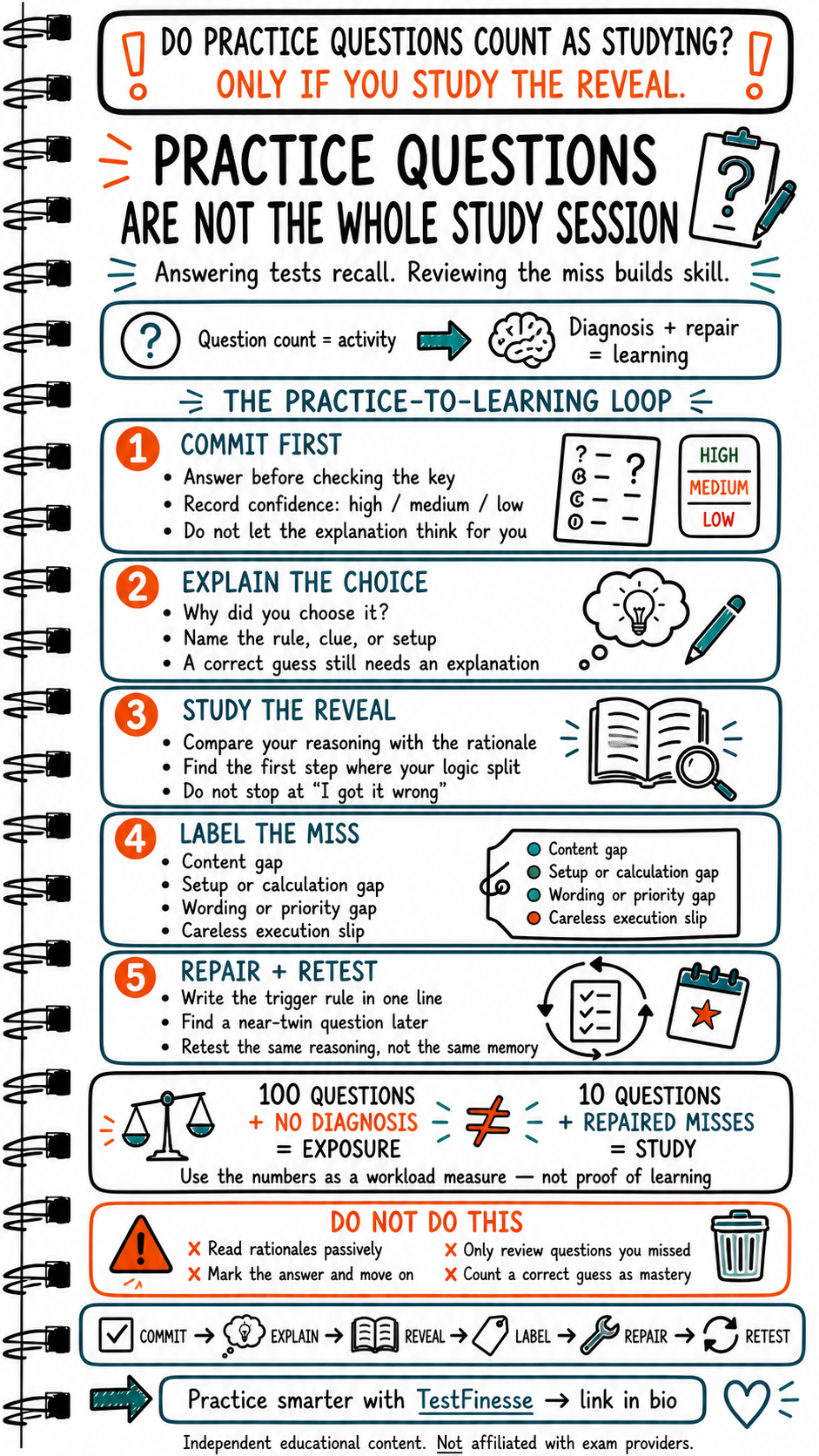
Completing practice questions feels productive because the number is easy to measure.
You can say:
“I completed 25 questions.”
“I finished a full practice set.”
“I answered 100 questions this week.”
But question count is only a workload measure. It is not proof that learning occurred.
Answering the question gives you a retrieval attempt. The real learning often happens afterward, when you examine your reasoning, identify the first point where it broke down, and practice the repaired skill on a new problem.
That is why:
100 questions with no diagnosis can equal exposure, while 10 questions with repaired misses can become real study.
The Practice-to-Learning Loop gives every question a purpose:
Commit → Explain → Reveal → Label → Repair → Retest
Why Answering Alone Is Not Enough
A correct answer can come from:
Strong understanding
Partial understanding
A lucky guess
Pattern recognition
Familiar wording
An elimination strategy that happened to work
A wrong answer can come from:
A missing content rule
A setup or calculation error
Misreading the question
Choosing the wrong priority
A careless execution slip
Low confidence under pressure
If you only mark the answer and move on, you do not know which situation occurred.
That is the central problem with passive practice. You collect outcomes, but you do not collect explanations.
1. Commit Before Checking the Key
Answer the question before looking at the correct answer or rationale.
This matters because an explanation can make the solution feel obvious after the fact. If you read the answer first, the explanation is doing the thinking for you.
Before checking the key, record:
Your answer
Your confidence: high, medium, or low
The reason you chose it
Any formula, rule, clue, or assumption you used
Do not worry about making the explanation perfect. The goal is to capture your actual thinking before the reveal changes it.
A useful format
Answer: C
Confidence: Medium
Reason: I chose C because the question asks for the next safe action, and the new finding suggests a priority change.
This creates a baseline for review.
A correct answer with low confidence may deserve attention. A wrong answer with high confidence may reveal a dangerous misconception. Both are valuable.
2. Explain the Choice
Before reading the rationale, explain why you selected your answer.
Ask:
What rule did I use?
What clue mattered most?
What was the question asking?
What setup did I choose?
What did I eliminate, and why?
What assumption did I make?
A correct guess still needs an explanation. Otherwise, you may not be able to reproduce the result when the question is worded differently.
For calculation questions
Write:
The requested quantity
The target unit
The formula or relationship
The conversion path
The estimate
For reading or reasoning questions
Write:
The question type
The claim or task
The evidence supporting your choice
The reason the other options fail
For nursing or clinical-style questions
Write:
The client risk
The priority
The evidence in the scenario
The action that best matches the task
The goal is to make your reasoning visible before the explanation arrives.
3. Study the Reveal
The rationale is not a permission slip to say, “I got it wrong.”
It is a chance to compare two reasoning paths:
Your path
The test’s intended path
Find the first step where those paths separated.
Maybe you:
Missed a conversion before applying the formula
Read “best” as “first”
Focused on a detail instead of the main idea
Chose an answer that was true but irrelevant
Treated a stable finding as more urgent than a new change
Used outside knowledge that did not fit the stem
Stopped after recognizing the topic instead of solving the task
Do not only copy the correct answer. Copy the decision process that produced it.
The key question
Where did my logic split from the correct reasoning?
That question is more useful than simply asking, “Why was I wrong?”
4. Label the Miss
Every missed question should receive one primary label.
Use a short error taxonomy:
Content gap
You did not know the relevant fact, definition, rule, or concept.
Setup or calculation gap
You knew the content but selected the wrong formula, relationship, conversion, or first step.
Wording or priority gap
You misunderstood the command word, question type, priority, or relationship between the choices and the stem.
Careless execution slip
You knew what to do but made an avoidable error, such as misreading a number, skipping a unit, clicking the wrong option, or rushing.
One label is better than a vague note such as “I need to study this more.”
The label tells you what kind of repair to make.
5. Repair and Retest
Once you know the miss type, write a one-line trigger rule.
Examples:
If the unit changes, convert before calculating.
If the question asks for the first action, identify the immediate risk first.
If two answers seem close, compare them to the exact task.
If the passage does not prove the claim, eliminate the outside assumption.
If I cannot explain the answer, I do not yet own the skill.
Then find a near-twin question later.
A near-twin should test the same reasoning but use:
Different numbers
A different scenario
New wording
A new passage
A different answer order
The goal is to retest the reasoning, not your memory of the original question.
What Not to Do
Avoid these low-value review habits:
Reading rationales passively
Marking an answer and immediately moving on
Reviewing only questions you missed
Treating every correct answer as proof of mastery
Counting questions without tagging errors
Copying explanations without restating them
Retaking the same question until the answer is memorized
Reviewing an entire chapter when one rule caused the miss
Correct guesses and low-confidence correct answers deserve review too. A lucky answer may conceal a weak skill that fails on the next variation.
Use the TestFinesse Practice Loop
The TestFinesse method follows the same sequence:
Answer: Commit before checking the key.
Explain: State the rule, clue, setup, or reason.
Reveal: Compare your path with the rationale.
Fix the gap: Write the trigger rule and practice a near-twin.
Keep a simple review table:
QuestionConfidenceMiss TypeTrigger RuleRetest Date12LowWordingRead the command word firstThursday18HighSetupWrite the target unit before solvingFriday23MediumContentReview the rule, then solve without notesSaturday
This changes practice from a collection of isolated questions into a feedback system.
Final Takeaway
Practice questions are not the entire study session.
Answering tests recall. Reviewing the miss builds skill.
Use question counts to measure workload, but use explanations, error labels, repair rules, and retests to measure learning.
The strongest practice loop is:
Commit → Explain → Reveal → Label → Repair → Retest
That is how a missed question becomes more than a wrong answer. It becomes a rule you can use when the next question looks unfamiliar.
Independent educational content. Not affiliated with any exam provider. Practice strategies should be adapted to your exam format, course requirements, and preparation goals.
Keep studying
Practice Exam Skills
Turn this into a better score
Reading about a skill only gets you so far. TestFinesse's AI coach walks you through exam questions, explains exactly where your reasoning breaks down, and adapts to what you actually need to practice next.
Explore All Exams