Mind Went Blank? Use This Exam Reset Sequence
Last updated August 9, 2026
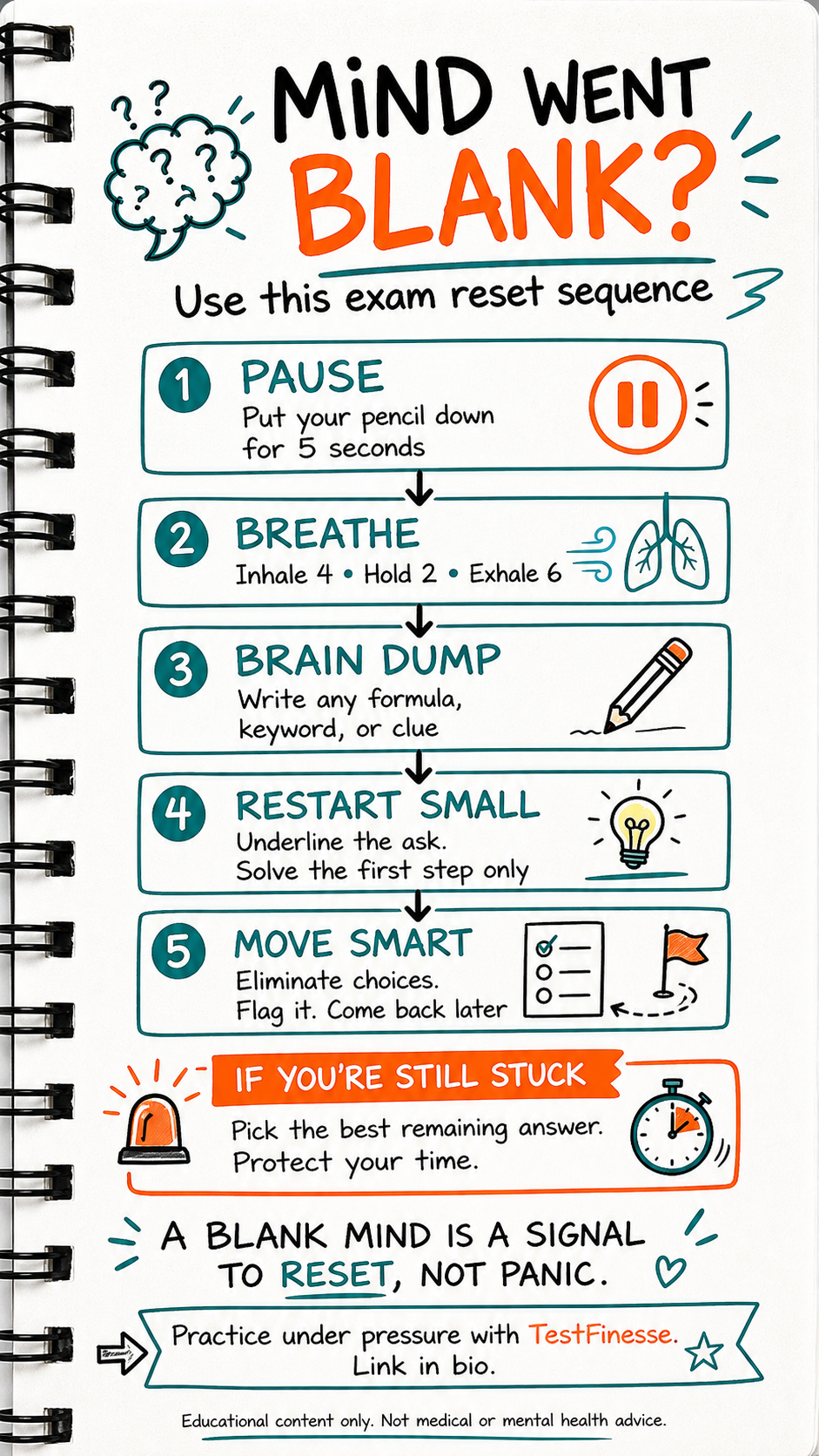
A blank mind during a test can feel terrifying.
One second, you know the material. The next second, the question looks unfamiliar, your thoughts scatter, and your brain feels like it has gone offline.
That moment does not mean you are unprepared.
It means your brain needs a reset.
Test pressure can make it harder to retrieve information, especially when you start thinking about time, score, consequences, or what might happen if you miss the question. The goal is not to panic your way back into focus. The goal is to give your brain a simple sequence to follow.
A blank mind is a signal to reset, not panic.
Why Your Mind Goes Blank During A Test
When stress rises, your body may shift into a threat response. Your heart rate can increase, your breathing can get shallow, and your attention may narrow.
That can make it harder to access what you studied.
You may start thinking:
“I should know this.”
“I’m running out of time.”
“What if I fail?”
“Why can’t I remember anything?”
Those thoughts use mental energy that you need for the question.
A reset sequence helps because it gives you a next step. Instead of trying to force the answer to appear, you calm the body, capture any clues, and restart with the smallest possible action.
1. Pause
First, pause for five seconds.
Put your pencil down, take your hands off the keyboard, or stop moving through the answer choices.
This is not wasted time.
It is a controlled interruption.
When your brain is spinning, continuing to reread the same sentence usually does not help. A short pause breaks the panic loop and gives you a chance to restart deliberately.
Try this:
Stop
Look away from the question for a moment
Relax your shoulders
Let your hands rest
Count five seconds
The point is not to become perfectly calm.
The point is to stop feeding the spiral.
2. Breathe
Next, use one slow breathing cycle.
The infographic suggests:
Inhale 4. Hold 2. Exhale 6.
That means:
Breathe in for 4 seconds
Hold for 2 seconds
Breathe out for 6 seconds
A longer exhale can help signal to the body that it is safe to settle. Relaxation techniques, including deep breathing, are commonly used to reduce stress symptoms and help with focus.
Do not make this complicated.
One cycle is enough to restart.
If holding your breath feels uncomfortable, skip the hold and simply breathe in gently, then exhale slowly.
The goal is steady breathing, not a perfect technique.
3. Brain Dump
Now write down any formula, keyword, clue, step, or fact you can remember.
Use only the scratch paper, whiteboard, or workspace allowed by your exam rules. Some exams have strict policies about when and where you can write notes, so follow the rules for your specific test.
A brain dump might include:
A formula
A vocabulary word
A grammar rule
A passage clue
A diagram
A unit conversion
A process step
A keyword from the question
Do not try to write everything.
Write anything useful.
For example:
DTI = monthly debts ÷ gross monthly income
Inference = must be supported
Except = find the one that does not fit
Area = pi r²
Main idea = author’s point
Airway before breathing before circulation
This gives your brain something concrete to work with.
A blank page often makes panic worse. A small clue can restart the process.
4. Restart Small
When your mind goes blank, do not try to solve the whole question at once.
Restart small.
Ask:
“What is the first step only?”
Then do that.
Examples:
Underline the ask
Circle the command word
Identify the topic
Write the formula
Find the paragraph
Label the units
Eliminate one answer
Translate the first sentence
Set up the equation without solving it
Small steps matter because they reduce the pressure.
Instead of telling your brain, “Solve this entire problem right now,” you are saying:
“Just find the task.”
That is much easier to do under stress.
5. Move Smart
If the answer still does not come, move strategically.
Do not let one question steal the rest of the section.
Use smart movement:
Eliminate choices you know are wrong
Make the best supported guess if appropriate
Flag the question if your exam allows it
Move on
Return later if time remains
This is not giving up.
This is protecting your score.
A hard question can cost more than one point if it causes you to lose time, panic, or rush through easier questions later.
Your goal is to keep the section moving.
If You Are Still Stuck
If you are still stuck after the reset, pick the best remaining answer and protect your time.
Before test day, learn your exam’s scoring rules. Many exams do not penalize wrong answers, which means a blank is usually worse than a best guess. Some exams have different rules, so always know the policy for your test.
If guessing is allowed and time is running out:
Eliminate what you can
Choose the strongest remaining answer
Do not keep rereading endlessly
Move forward
The test is bigger than one question.
Practice The Reset Before Test Day
Do not wait until the real exam to try this.
Practice the reset during timed study sets.
When you get stuck, run the sequence:
Pause
Breathe
Brain dump
Restart small
Move smart
This trains your brain to recognize the blank moment as a routine, not an emergency.
The more you practice it, the faster it becomes.
Final Takeaway
A blank mind does not have to become a panic spiral.
Use the reset sequence:
Pause for five seconds
Breathe slowly
Write any clue you can
Restart with the first small step
Eliminate, flag, guess, or move on strategically
You do not need to force the whole answer back at once.
You need one calm next move.
A blank mind is a signal to reset, not panic.
Accuracy sources checked: Mayo Clinic Relaxation Techniques, NHS Breathing Exercises for Stress, and APA Education Test Anxiety Strategies.