MCAT Chem/Phys Decoder: Use Units and Relationships Before You Calculate
Last updated August 11, 2026
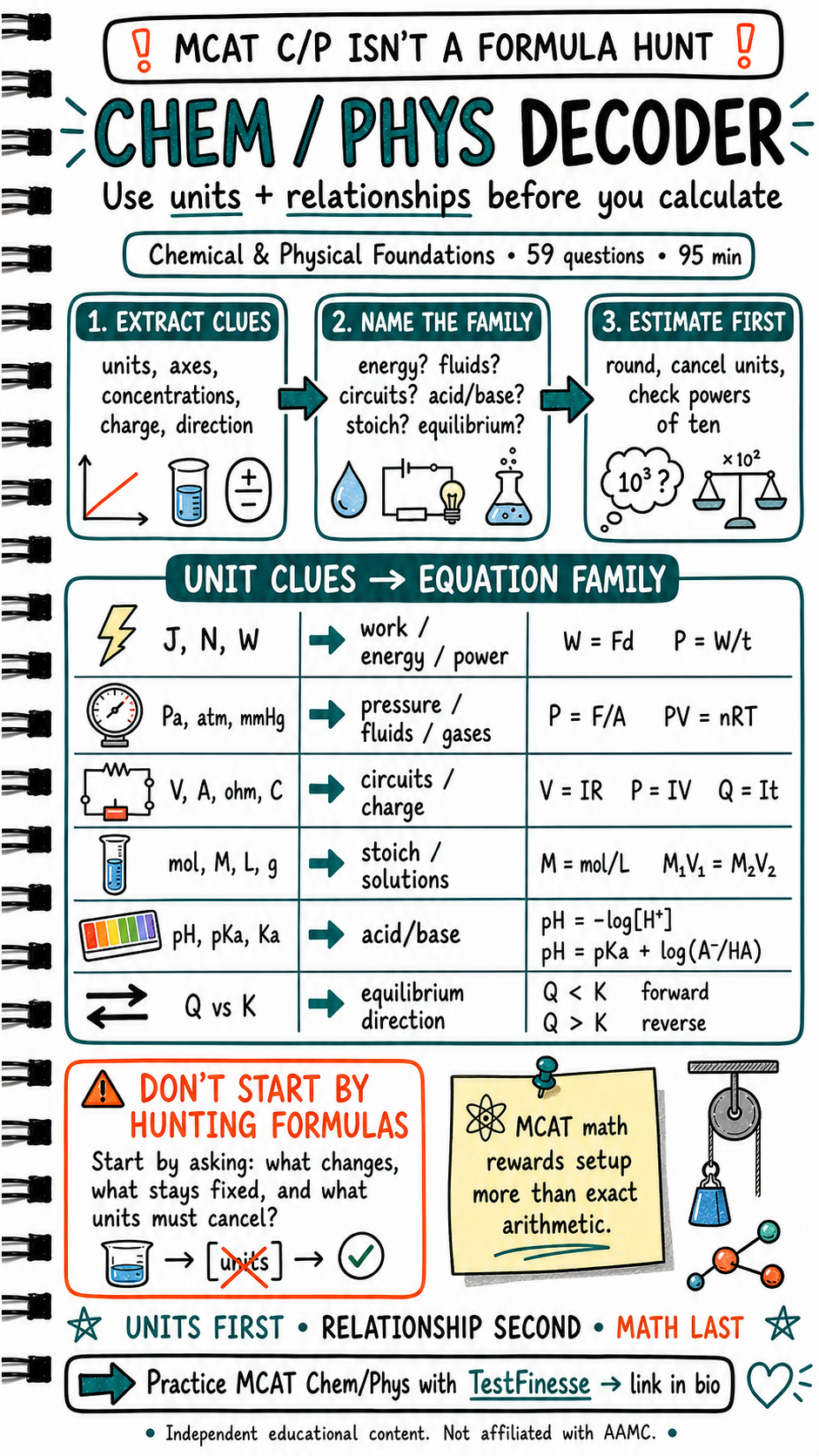
MCAT Chem/Phys is not a formula hunt.
That is one of the biggest shifts students need to make in the Chemical and Physical Foundations of Biological Systems section.
Yes, formulas matter. You need to know relationships from general chemistry, organic chemistry, physics, biochemistry, and biology. But the MCAT rarely rewards students for blindly searching memory for an equation and plugging in numbers.
The section is designed to test whether you can combine chemical and physical concepts with scientific reasoning.
That means the better question is not:
“What formula do I remember?”
The better question is:
“What relationship is this problem testing?”
The AAMC lists Chem/Phys as 59 questions in 95 minutes, with a mix of passage-based and discrete questions. During the real exam, you have access to the periodic table and a noteboard, but this is still a section where quick setup matters.
The strongest rule is:
Units first. Relationship second. Math last.
Why Chem/Phys Feels Hard
Chem/Phys feels difficult because it blends content with reasoning.
A question might look like physics, but the passage is biological. A chemistry question might hide inside a graph. A fluids question might require you to notice pressure units before you remember the equation. An acid-base question might be more about direction and relative values than exact arithmetic.
Students often lose points because they:
Start calculating too soon
Miss the units
Choose the wrong equation family
Ignore graph axes
Forget what stays fixed
Skip estimation
Chase exact arithmetic when a relationship is enough
MCAT math often rewards setup more than calculation.
Your job is to decode the problem before you solve it.
Before You Calculate
Use the three-step decoder from the infographic:
Extract clues
Name the family
Estimate first
This gives your brain a process before the answer choices start pulling your attention in different directions.
1. Extract Clues
Before choosing a formula, look for clues.
Useful clues include:
Units
Axes
Concentrations
Charge
Direction
Slope
Ratios
What increases or decreases
What stays constant
Whether the question asks for magnitude or comparison
Units are especially important.
If the answer choices are in joules, you may be dealing with work or energy. If the choices are in watts, the question is asking for power. If the passage gives Pa, atm, or mmHg, think pressure, fluids, or gases.
Do not treat numbers as the first clue.
Treat units as the first clue.
Ask:
“What kind of answer does this unit belong to?”
That question often tells you where to go.
2. Name The Family
After extracting clues, name the equation family.
Do not jump straight to one formula.
First ask:
Is this energy?
Is this fluids?
Is this circuits?
Is this acid/base?
Is this stoichiometry?
Is this solutions?
Is this equilibrium?
Is this gases?
Naming the family narrows the search.
For example:
Units like J, N, W point toward work, energy, or power
Units like Pa, atm, mmHg point toward pressure, fluids, or gases
Units like V, A, ohm, C point toward circuits and charge
Units like mol, M, L, g point toward stoichiometry and solutions
Terms like pH, pKa, Ka point toward acid/base
Comparisons like Q vs. K point toward equilibrium direction
This is how you stop formula hunting.
You are not asking your memory for every equation you have ever learned.
You are choosing the right family first.
3. Estimate First
Before doing arithmetic, estimate.
Estimation is not a shortcut for students who are bad at math. It is a control system for students who want fewer careless mistakes.
Estimate by asking:
Should the answer be bigger or smaller?
Should the exponent be positive or negative?
Can I round the numbers?
Can I cancel units first?
Are the answer choices far apart?
Does the magnitude make sense?
Powers of ten are especially important on MCAT Chem/Phys.
If your answer is off by a factor of 100 or 1,000, the issue is often not the concept. It is usually a unit conversion, exponent, or decimal-place mistake.
A good habit:
Round, cancel units, and check powers of ten before exact math.
Unit Clues To Equation Families
The infographic gives a useful way to think about Chem/Phys: let the units point you toward the relationship.
Work, Energy, And Power
Unit clues:
J
N
W
Common relationships:
W = Fd
P = W/t
If the question asks for work, energy, or power, label the units carefully.
Remember:
Joule = energy or work
Newton = force
Watt = power
Power = energy or work per time
If the answer choices are in watts but you calculated joules, you are not finished. You may need to divide by time.
Pressure, Fluids, And Gases
Unit clues:
Pa
atm
mmHg
Common relationships:
P = F/A
PV = nRT
Pressure questions often hide in biological contexts, especially fluids and gases.
Before calculating, ask:
Is pressure changing?
Is volume changing?
Is temperature constant?
Is this force over area?
Is this an ideal gas setup?
For gas equations, watch the units and use absolute temperature when required.
Circuits And Charge
Unit clues:
V
A
ohm
C
Common relationships:
V = IR
P = IV
Q = It
Circuits questions often become easier when you name what is being compared.
Ask:
Is current changing?
Is resistance changing?
Is voltage fixed?
Is power being asked for?
Is charge moving over time?
Do not memorize circuits as isolated formulas. Study the relationships.
Stoichiometry And Solutions
Unit clues:
mol
M
L
g
Common relationships:
M = mol/L
M1V1 = M2V2
For solution questions, units usually tell you what to do.
If you see molarity, liters, and moles, write the molarity relationship before calculating.
If dilution is involved, identify:
Initial concentration
Initial volume
Final concentration
Final volume
Then use the relationship only after the variables are labeled.
Acid/Base
Unit clues:
pH
pKa
Ka
Common relationships:
pH = -log[H+]
pH = pKa + log(A-/HA)
Acid-base questions often test relative thinking.
Ask:
Is the solution acidic or basic?
Is pH above or below pKa?
Which species dominates?
Is this a buffer question?
Is the question asking for direction, not exact value?
You may not always need exact logarithm arithmetic. Sometimes the relationship is enough.
Equilibrium Direction
Unit clues:
Q vs. K
Reaction direction language
Forward or reverse shift
Core relationship:
Q < K: reaction moves forward
Q > K: reaction moves reverse
Equilibrium questions often reward comparison.
Do not overcomplicate it.
Ask:
“Is the current mixture short on products or heavy on products compared with equilibrium?”
That tells you the direction.
Do Not Start By Hunting Formulas
Formula hunting feels productive, but it can waste time.
Instead, start by asking:
What changes?
What stays fixed?
What units must cancel?
What relationship connects the variables?
Can I estimate the answer size?
This is especially useful because MCAT Chem/Phys often embeds calculations inside passages. The passage may give extra details, experimental context, or biological language that distracts from the core relationship.
Your first job is to simplify.
Find the relationship.
Then calculate.
Common Chem/Phys Mistake Patterns
When reviewing missed questions, label the miss.
Common patterns include:
Wrong equation family
Unit conversion error
Ignored graph axis
Used exact math too early
Missed what stayed constant
Confused pressure, force, and area
Mixed up charge, current, and time
Used molarity without converting volume
Missed Q vs. K direction
Picked an answer with the wrong units
Each mistake should become a rule.
Example:
Next time, identify the answer unit before choosing a formula.
Or:
Next time, compare Q and K before thinking about equilibrium math.
That is how practice becomes useful.
Use The TestFinesse Practice Loop
The TestFinesse method is:
Answer
Explain
Reveal
Fix the gap
For MCAT Chem/Phys, explain before you reveal.
Ask:
What clues did I extract?
What equation family did I name?
What units did I need to cancel?
What relationship was being tested?
Did I estimate before calculating?
Was the miss setup, units, or content?
After revealing the answer, do not just copy the explanation.
Write one fix rule.
Examples:
Next time, use units to identify whether the answer is work or power.
Next time, label molarity as mol/L before solving.
Next time, check pH vs. pKa before choosing the dominant species.
Next time, compare Q and K before deciding direction.
Next time, round and check powers of ten before exact arithmetic.
Final Takeaway
MCAT Chem/Phys is not a formula hunt.
It is a decoding task.
Use the pattern:
Extract clues
Name the family
Estimate first
Cancel units
Then calculate
The best Chem/Phys prep does not only ask:
“Do I know the formula?”
It asks:
“Can I recognize the relationship fast?”
Units first.
Relationship second.
Math last.
Independent educational content. Not affiliated with AAMC.
Accuracy sources checked: AAMC Chemical and Physical Foundations Overview, AAMC What’s on the MCAT Exam, AAMC Items Allowed in the Testing Room.
Keep studying
Practice Exam Skills
Turn this into a better score
Reading about a skill only gets you so far. TestFinesse's AI coach walks you through exam questions, explains exactly where your reasoning breaks down, and adapts to what you actually need to practice next.
Explore All Exams