How to Study When English Is Your Second Language: Build a Test-Language Bridge
Last updated August 9, 2026
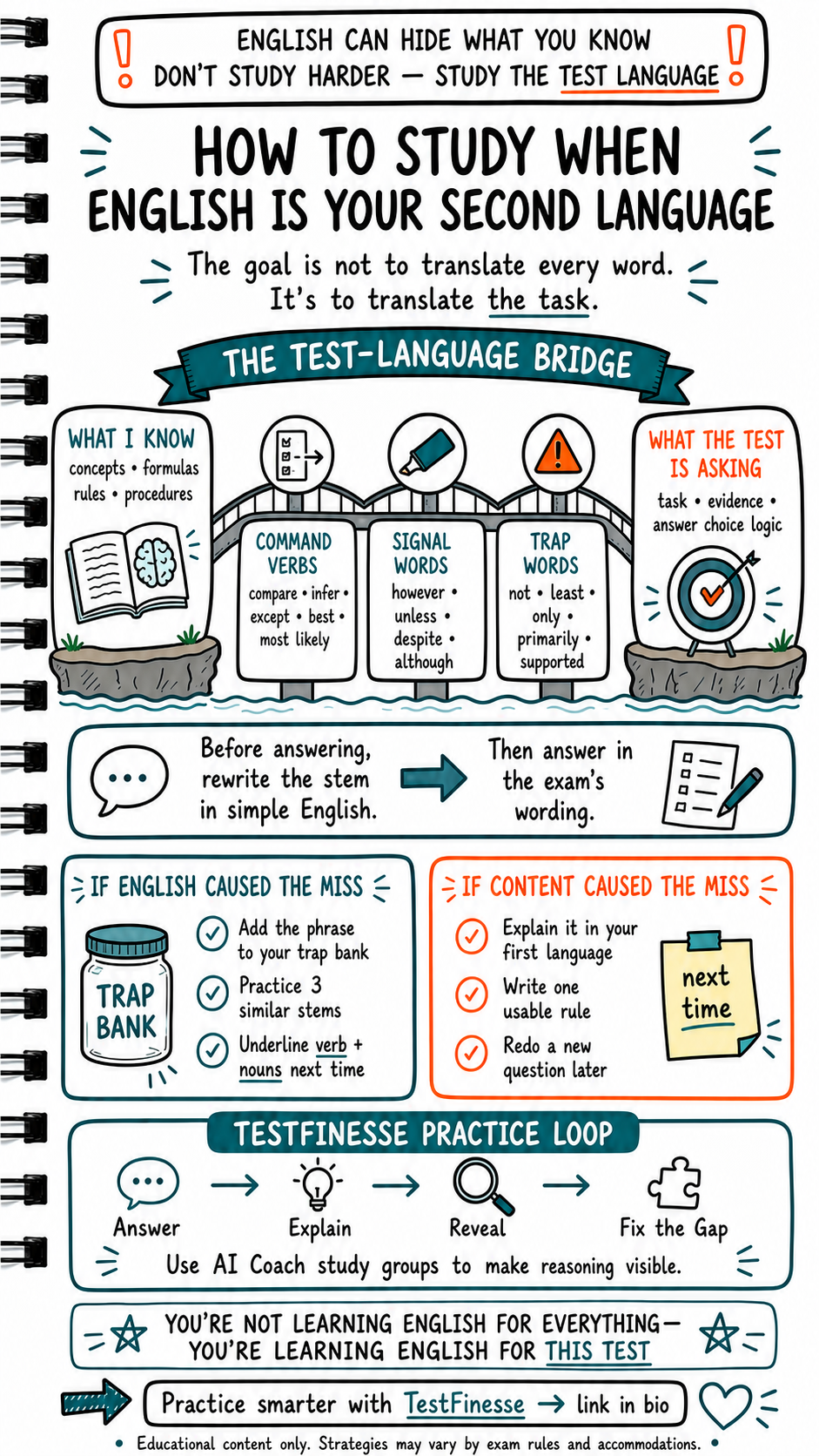
When English is your second language, studying harder is not always the answer.
Many multilingual students already understand the concept, formula, rule, or procedure being tested. The problem is that the test does not simply ask:
“Do you know this?”
It asks through a very specific kind of language.
That language can hide what you know.
This is why effective ESL test prep is not only about memorizing more vocabulary or translating every sentence word by word. The real goal is to understand what the test is asking you to do.
Once you can translate the task, not just the words, you can show what you actually know.
That is the idea behind the Test-Language Bridge.
Why English Can Make Tests Harder Than The Content
A test question has two layers:
The content layer: the math skill, science concept, grammar rule, reading idea, procedure, or professional knowledge.
The test-language layer: the command verbs, signal words, answer choice patterns, and trap words that tell you how to use what you know.
For students learning in a second language, the second layer can become the bigger obstacle.
You may know the subject but miss the question because of one small word, such as:
except
least
primarily
most likely
not
only
You may understand the passage but choose the wrong answer because you missed a contrast word like:
however
although
despite
unless
You may solve the problem correctly in your head but misunderstand what the exam wants as evidence.
That is not always a content failure.
Sometimes, it is a test-language failure.
And that difference matters because the fix is different.
Do Not Translate Every Word. Translate The Task.
One of the biggest mistakes students make is trying to translate every word before answering.
This can be:
Slow
Exhausting
Confusing
Easy to overthink
Tests often use formal, indirect, or complicated wording. If you try to process every word equally, you may lose sight of the question’s purpose.
Instead, before answering, pause and rewrite the question stem in simple English.
For example:
“What can reasonably be inferred from the passage?”
becomes: “What idea is suggested but not directly said?”“Which choice is least supported by the evidence?”
becomes: “Which answer has the weakest proof?”“Which statement best explains the author’s purpose?”
becomes: “Why did the author write this?”
This small habit changes the way you read the question.
You are no longer trapped inside the exam’s wording. You are converting the question into a task you can actually perform.
Then, after you understand the task, answer in the exam’s wording.
That part matters because tests grade based on the answer choices in front of you. Simple English helps you understand the task, but you still need to connect your reasoning back to the exact language the test uses.
The Three Parts Of The Test-Language Bridge
The infographic shows three major supports in the bridge:
Command verbs
Signal words
Trap words
These are the words that often decide what the test is really asking.
1. Command Verbs Tell You What To Do
Command verbs are action words. They tell you the thinking move the test wants.
Common examples include:
Compare
Infer
Explain
Identify
Support
Evaluate
Analyze
These words are not interchangeable.
For example:
Compare means look for similarities or differences.
Infer means reach a conclusion based on evidence.
Explain means give the reason why.
Support means find proof.
Evaluate means judge the strength, quality, or usefulness of something.
If you treat every command as simply “find the answer,” you may miss the required thinking step.
A strong test-taking habit is to underline the command verb before you look at the answer choices.
Ask yourself:
“What is this question asking me to do?”
That one question can prevent a lot of mistakes.
2. Signal Words Show The Logic
Signal words show relationships between ideas.
They help you understand whether the sentence is adding information, contrasting information, giving a condition, or showing cause and effect.
Important signal words include:
however
although
despite
unless
therefore
because
while
in contrast
A single signal word can change the entire meaning of a question.
For example, the word however usually means the direction is about to shift. The word unless creates a condition. The word despite tells you that something happened even though another thing might suggest otherwise.
When you see signal words, slow down.
They often point directly to the logic of the question.
3. Trap Words Create Common Mistakes
Trap words are small words that can completely flip the task.
Common trap words include:
not
least
except
only
always
never
primarily
most likely
Many wrong answers happen because the student knew the content but missed the trap word.
For example, if a question asks, “Which answer is least supported?”, the test is not asking for the best answer. It is asking for the weakest one.
If a question asks, “Which of the following is not true?”, the correct answer is the false statement, not the true one.
That sounds obvious after the fact, but under time pressure, these words are easy to miss.
A simple fix:
Underline trap words before answering.
This forces your brain to notice the part of the question most likely to cause the mistake.
How To Review Mistakes The Smart Way
Every missed question should be sorted into one of two categories:
English caused the miss
Content caused the miss
This is one of the most important habits for students who speak English as a second language.
If you do not separate these two causes, you may study the wrong thing.
If English Caused The Miss
If the problem was the wording, do not just redo the question and move on.
Instead:
Add the phrase to your trap bank
Practice three similar question stems
Underline the verb and key nouns next time
Rewrite the stem in simple English
Look for the same pattern in future questions
Your trap bank might include phrases like:
Which is not true?
Which is least likely?
Which choice best supports?
What can be inferred?
Which evidence weakens the claim?
Which statement is most consistent with the passage?
The goal is pattern recognition.
You are building familiarity with the exam’s language so it stops surprising you.
If Content Caused The Miss
If the problem was the concept itself, the fix is different.
Try this:
Explain the idea in your first language if that helps you think clearly.
Write one usable rule in simple English.
Do a new question later to prove you can apply it.
Avoid only rereading the explanation.
Track whether the same concept appears again.
This matters because rereading an explanation can feel like learning, but a new question proves whether you can actually use the idea independently.
Use The Answer, Explain, Reveal, Fix Loop
The TestFinesse practice loop is simple:
Answer
Explain
Reveal
Fix the gap
Here is how it works.
First, answer the question without looking at the explanation.
Second, explain your reasoning. Say why you chose that answer and why the other choices seemed wrong.
Third, reveal the correct answer and read the explanation.
Fourth, fix the gap.
Ask yourself:
Did I miss because of vocabulary?
Did I miss a trap word?
Did I misunderstand the command verb?
Did I ignore a signal word?
Did I know the content but choose too quickly?
Did I actually need to review the concept?
This loop is especially helpful for multilingual learners because it separates English confusion from subject confusion.
Without that separation, students often assume:
“I am bad at this topic.”
But sometimes the real issue was one phrase in the question.
You Are Learning English For This Test
You do not need to master all of English to improve your test score.
You need to master the English patterns that appear on your exam.
That is a much smaller, more practical goal.
Focus on:
The command verbs your test uses most often
The signal words that change meaning
The trap words that cause careless misses
The question stems you keep seeing
The answer choice patterns that confuse you
This approach helps you protect the knowledge you already have.
It also makes studying more efficient because you are no longer treating every missed question the same way.
For students who speak English as a second language, better test prep is not just about more hours. It is about better diagnosis.
Before you move on from a missed question, ask:
“Did I miss this because I did not know the content, or because English hid the task?”
Once you can answer that question, your practice becomes much more powerful.
You are not learning English for everything.
You are learning English for this test.