How to Pass the SAFE MLO Exam: Pass the File, Pass the Timing, Pass the Rule
Last updated August 16, 2026
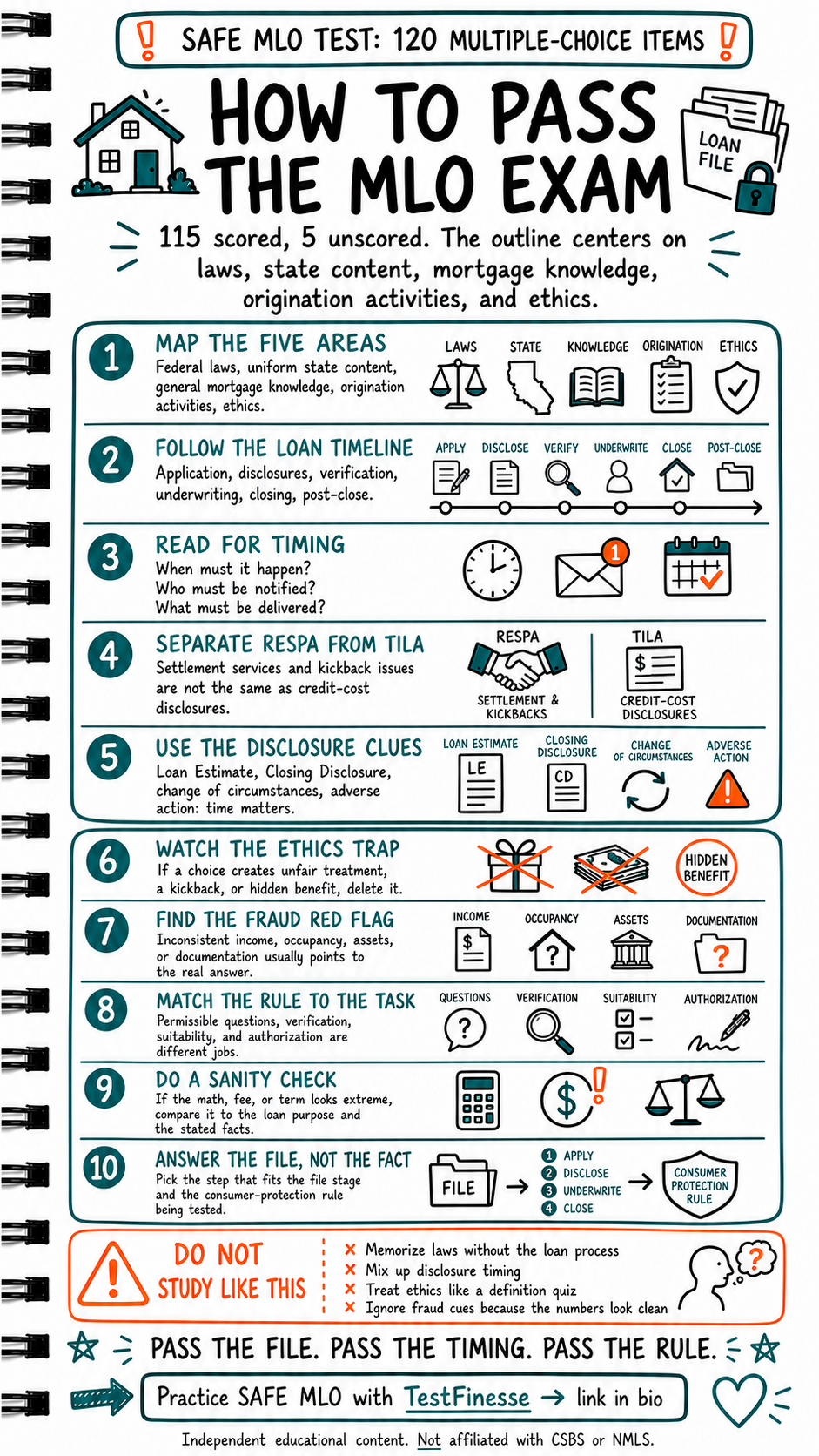
The SAFE MLO exam is not a trivia contest.
It is a rules-and-process exam built around mortgage laws, state content, loan knowledge, origination activities, and ethics. The image gets the core idea right: you do better when you read the file like a process, not a pile of isolated facts.
One important correction first: the current NMLS testing handbook states that the SAFE MLO Test is 120 multiple-choice items, with 115 scored questions and 5 unscored pretest questions, and the test length is 190 minutes. The appointment length is longer because it includes the tutorial and optional survey. So the image’s “110 questions in 6 hours” is not the current test specification.
The real strategy stays the same, though:
Pass the file. Pass the timing. Pass the rule.
Why SAFE MLO Feels So Dense
SAFE MLO prep is hard because it mixes:
federal law
uniform state content
general mortgage knowledge
origination activities
ethics
The NMLS content outline makes that structure explicit. It also shows that the test is weighted across five major areas, so one weak bucket can drag down the whole result.
That means you should not study random mortgage facts in isolation.
You should study by file stage, rule type, and disclosure clue.
1. Map The Five Areas
Start by knowing the five major content areas:
Federal mortgage-related laws
Uniform state content
General mortgage knowledge
Mortgage loan origination activities
Ethics
That map matters because each area uses a slightly different mental move.
A law question often asks, “What does the rule require?”
A state question often asks, “What is allowed in this jurisdictional framework?”
A knowledge question often asks, “What product or term are we looking at?”
An origination question often asks, “What happens next in the file?”
An ethics question often asks, “What action is fair, lawful, and safe?”
TestFinesse rule: If you do not know which area you are in, you are already behind.
2. Follow The Loan Timeline
Think in stages:
application
disclosures
verification
underwriting
closing
post-close
SAFE MLO questions often become easier when you know where the file is in the timeline.
For example:
What should happen at application?
What needs to be delivered or disclosed?
What must be verified before underwriting?
What belongs in closing?
What changes after closing?
The timeline matters because many rules are tied to when something must happen, not just what it is.
Timeline rule: The file stage often determines the correct answer.
3. Read For Timing
When a question sounds procedural, ask timing questions first:
When must it happen?
Who must be notified?
What must be delivered?
How soon?
Before what event?
SAFE MLO is full of disclosure and process timing. If the question includes a deadline, order of events, or required delivery, the clock is part of the answer.
This is where students miss easy points by reading for topic only and ignoring sequence.
Timing rule: “What comes first?” is often the real question.
4. Separate RESPA From TILA
This is one of the cleanest score moves on the whole exam.
RESPA and TILA are not the same thing.
A practical way to separate them is:
RESPA: settlement services and kickback-type issues
TILA: credit-cost disclosures and borrower cost clarity
The outline shows both laws as major content categories, and the exam can test them in similar-looking scenarios. If you blur them together, the answer choices start to feel interchangeable. They are not.
Rule: Settlement and kickbacks point you toward RESPA. Credit-cost disclosure logic points you toward TILA.
5. Use The Disclosure Clues
Loan Estimate, Closing Disclosure, change of circumstances, and adverse action are clue words, not decoration.
Ask:
Which disclosure is this?
What triggered it?
Does timing matter?
What must be delivered?
Is this before closing or after closing?
Is the issue a disclosure problem or a file-change problem?
The clue tells you whether the question is about a document, a timing rule, or a change in the loan file.
Disclosure rule: Read the document name like a code word.
6. Watch The Ethics Trap
Ethics questions are not always definition questions.
They often ask whether a choice is:
unfair
deceptive
abusive
a kickback
a hidden benefit
a bad referral
a steering issue
an improper compensation move
If the answer creates unfair treatment, a kickback, or a hidden benefit, delete it early.
A lot of students overcomplicate ethics because they think the “right” answer must sound legalistic. Usually it just has to be the fair, transparent, compliant move.
Ethics rule: If it looks like hidden advantage, it is a trap.
7. Find The Fraud Red Flag
Fraud questions are often hiding in plain sight.
Watch for inconsistency in:
income
occupancy
assets
documentation
employer information
stated purpose
application details
The exam often gives you clean-looking numbers and then hides the real problem in a mismatch between the facts.
Ask:
Does the story match the documents?
Does the occupancy claim fit the file?
Do the assets support the stated plan?
Does the income line up with the rest of the application?
Fraud rule: Inconsistency is the red flag.
8. Match The Rule To The Task
Not every task is the same job.
Some questions ask about:
permission
verification
suitability
authorization
required action
allowed action
prohibited action
That sounds similar, but the task is different each time.
For example:
A question about verification is not the same as one about suitability.
A question about authorization is not the same as one about disclosure.
A question about a permitted act is not the same as one about a required act.
Task rule: Match the rule to the job, not just the topic.
9. Do A Sanity Check
If the math, fee, or term looks extreme, compare it to the loan purpose and the stated facts.
SAFE MLO math and mortgage logic can produce answers that seem technically possible but do not fit the loan scenario.
Ask:
Does the result make sense for the loan type?
Does the fee fit the stage?
Does the number fit the purpose?
Does the answer align with the stated file details?
Sanity rule: Extreme-looking answers deserve a second look.
10. Answer The File, Not The Fact
This is the key move.
Do not answer the question like it is a vocabulary quiz. Answer the file step that fits the situation.
Ask:
What stage is this file in?
What rule applies here?
What timeline matters?
What is the correct next step?
What disclosure or law is being tested?
The best answer is often the one that fits the file stage and the consumer-protection rule at the same time.
Do Not Study Like This
The wrong way to study SAFE MLO is to:
memorize laws without the loan process
mix up disclosure timing
treat ethics like a definition drill
ignore fraud clues because the numbers look clean
pick the most detailed answer instead of the safest one
That approach creates recognition without judgment. The exam wants judgment.
Use The TestFinesse Practice Loop
The TestFinesse method is:
Answer
Explain
Reveal
Fix the gap
For SAFE MLO, use it like this:
Answer: What is the safest file-stage move?
Explain: Which law, rule, or disclosure controls it?
Reveal: What did the official content outline or handbook say?
Fix the gap: Was the miss about timing, rule choice, ethics, or fraud detection?
That turns every missed question into a repeatable rule.
Final Takeaway
To pass SAFE MLO, do not study random mortgage facts.
Study the file.
Pass the file. Pass the timing. Pass the rule.
If you can map the five areas, follow the loan timeline, separate RESPA from TILA, and spot ethics and fraud clues, you will stop missing the same question in different clothing.
Educational content only. Rules and requirements vary; check official sources for your exam or jurisdiction. Independent content. Not affiliated with NMLS or CSBS.
Accuracy sources checked: SAFE MLO National Test Content Outline, NMLS MLO Testing Handbook - Preparing for the Test, MLO Testing Handbook Overview and Test Specifications, SAFE MLO Testing FAQ.
Keep studying
Practice Exam Skills
Turn this into a better score
Reading about a skill only gets you so far. TestFinesse's AI coach walks you through exam questions, explains exactly where your reasoning breaks down, and adapts to what you actually need to practice next.
Explore All Exams