10 NMLS Mortgage Math Formulas: Quick Calculations for SAFE MLO Exam Day
Last updated August 9, 2026
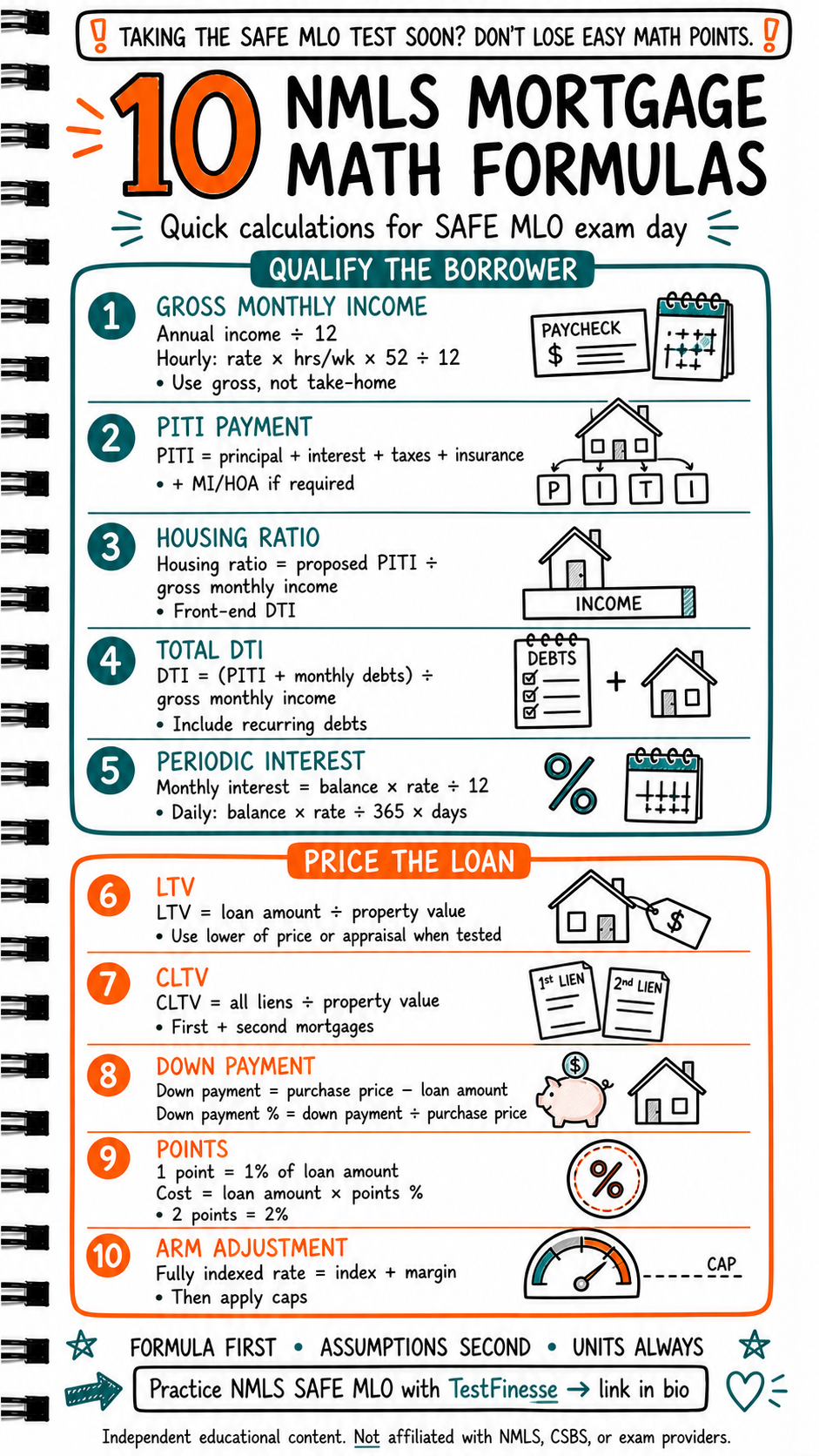
Mortgage math can feel intimidating on the SAFE MLO exam, but most calculation questions come down to a small group of repeatable formulas.
The goal is not to memorize random numbers. The goal is to know which formula fits the question, identify the right inputs, and keep your units clean.
The NMLS SAFE MLO test content outline includes financial calculations such as periodic interest, monthly payments, down payments, closing costs/prepaids, and ARM adjustments. It also includes borrower qualification topics such as income, liabilities, qualifying ratios, LTV, and debt-to-income.
That means mortgage math is not separate from loan origination. It is part of understanding whether a borrower qualifies and how a loan is structured.
Use this guide as a formula-first review for the most common SAFE MLO math concepts.
Formula First. Assumptions Second. Units Always.
Before solving any mortgage math question, slow down and check three things:
Formula first: What is the question asking you to calculate?
Assumptions second: Does the problem tell you whether to include taxes, insurance, HOA dues, mortgage insurance, or other debts?
Units always: Are you working monthly, annual, daily, dollars, decimals, or percentages?
Many missed math questions are not caused by difficult arithmetic. They happen because the student used the right formula with the wrong input.
1. Gross Monthly Income
Gross monthly income is income before taxes and deductions.
Common formulas:
Annual income ÷ 12 = gross monthly income
Hourly rate × hours per week × 52 ÷ 12 = gross monthly income
For example, if a borrower earns $72,000 per year:
$72,000 ÷ 12 = $6,000 gross monthly income
If a borrower earns $25 per hour and works 40 hours per week:
$25 × 40 × 52 ÷ 12 = $4,333.33 gross monthly income
The key exam reminder is simple:
Use gross income, not take-home pay.
Take-home pay is after deductions. Debt-to-income calculations generally use gross monthly income.
2. PITI Payment
PITI stands for:
Principal
Interest
Taxes
Insurance
A basic PITI formula is:
PITI = principal and interest + property taxes + homeowners insurance
If the question includes mortgage insurance, HOA dues, assessments, or other required housing expenses, read carefully. The exam may be asking for a broader monthly housing expense, often closer to PITIA.
A practical version is:
Monthly housing expense = P&I + taxes + insurance + mortgage insurance + HOA/assessments if required
The biggest mistake is using only principal and interest when the question asks for the full housing payment.
3. Housing Ratio
The housing ratio is also called the front-end ratio.
Formula:
Housing ratio = proposed monthly housing expense ÷ gross monthly income
For example:
Proposed housing expense: $1,800
Gross monthly income: $6,000
$1,800 ÷ $6,000 = 0.30 = 30%
This ratio focuses on the borrower’s housing payment compared with gross monthly income.
The key question is:
How much of the borrower’s gross monthly income would go toward the proposed housing expense?
4. Total Debt-To-Income Ratio
The total debt-to-income ratio is often called the back-end DTI.
Formula:
DTI = total monthly debt payments ÷ gross monthly income
For mortgage qualification questions, total monthly debt often includes:
Proposed housing expense
Auto loans
Student loans
Credit card minimum payments
Installment loans
Other recurring debts included by the problem
For example:
Proposed housing expense: $1,800
Other monthly debts: $600
Gross monthly income: $6,000
($1,800 + $600) ÷ $6,000 = 0.40 = 40% DTI
The CFPB defines DTI as monthly debt payments divided by gross monthly income. For exam prep, always watch whether the question asks for only the housing ratio or the total DTI.
5. Periodic Interest
Periodic interest questions ask you to calculate interest for a month, a day, or a specific number of days.
Monthly interest formula:
Monthly interest = loan balance × annual interest rate ÷ 12
Daily interest formula:
Daily interest = loan balance × annual interest rate ÷ 365
For multiple days:
Daily interest × number of days
Example:
Loan balance: $300,000
Interest rate: 6%
Days: 15
Daily interest:
$300,000 × 0.06 ÷ 365 = $49.32
Interest for 15 days:
$49.32 × 15 = $739.80
Use the day-count method provided in the question if one is given. If the question does not provide one, many basic mortgage math practice problems use a 365-day year.
6. Loan-To-Value Ratio
Loan-to-value ratio, or LTV, compares the loan amount to the property value.
Formula:
LTV = loan amount ÷ property value
Example:
Loan amount: $240,000
Property value: $300,000
$240,000 ÷ $300,000 = 0.80 = 80% LTV
For purchase transactions, underwriting commonly uses the lower of the sales price or appraised value as the property value. That detail matters.
If the purchase price is $300,000 but the appraisal is $290,000, the LTV calculation may be based on $290,000, depending on the context of the question.
7. Combined Loan-To-Value Ratio
Combined loan-to-value ratio, or CLTV, includes more than one lien secured by the property.
Formula:
CLTV = total liens ÷ property value
Example:
First mortgage: $240,000
Second mortgage: $30,000
Property value: $300,000
($240,000 + $30,000) ÷ $300,000 = 0.90 = 90% CLTV
CLTV is important because a borrower may have a first mortgage and subordinate financing.
A simple way to remember it:
LTV looks at one loan. CLTV combines liens.
If the problem involves a HELOC, read carefully because some contexts use HCLTV, which may treat the available line differently.
8. Down Payment
Down payment is the borrower’s upfront contribution toward the purchase price.
Formula:
Down payment = purchase price - loan amount
Down payment percentage:
Down payment percentage = down payment ÷ purchase price
Example:
Purchase price: $400,000
Loan amount: $360,000
Down payment:
$400,000 - $360,000 = $40,000
Down payment percentage:
$40,000 ÷ $400,000 = 0.10 = 10%
Do not confuse down payment percentage with LTV.
If the borrower puts 10% down, the loan is usually 90% of the purchase price, assuming no appraisal issue changes the calculation.
9. Points
Mortgage points are calculated as a percentage of the loan amount.
Formula:
1 point = 1% of the loan amount
Cost formula:
Cost of points = loan amount × points percentage
Example:
Loan amount: $250,000
Points: 2 points
Since 2 points equals 2%:
$250,000 × 0.02 = $5,000
A half point would be 0.5%.
Example:
$250,000 × 0.005 = $1,250
The CFPB confirms that one point equals one percent of the loan amount. On the exam, convert the points into a decimal before multiplying.
10. ARM Adjustment
ARM stands for adjustable-rate mortgage.
A common ARM formula is:
Fully indexed rate = index + margin
Then apply any caps.
Example:
Index: 4%
Margin: 2.5%
4% + 2.5% = 6.5% fully indexed rate
But an ARM question may include caps, such as:
Initial adjustment cap
Periodic adjustment cap
Lifetime cap
That means the fully indexed rate may not be the final allowed rate if a cap limits the adjustment.
The correct order is:
Add index + margin
Compare the result to the cap rules
Use the rate allowed by the cap
Calculate the payment if the question asks for it
The CFPB explains that an ARM interest rate is based on the index plus margin, subject to rate caps.
How To Avoid Easy Mortgage Math Mistakes
Most NMLS mortgage math mistakes happen in predictable ways.
Watch for these traps:
Using net income instead of gross income
Using annual income when the formula needs monthly income
Forgetting to convert a percentage into a decimal
Using only principal and interest when the question asks for PITI
Forgetting mortgage insurance or HOA dues when the problem says to include them
Using purchase price when the problem says to use the lower of price or appraisal
Calculating LTV when the question asks for CLTV
Forgetting to apply ARM caps after index + margin
Rounding too early
A strong rule is:
Do not calculate until you label the inputs.
Write down what each number represents before plugging it into the formula.
Use The TestFinesse Practice Loop
The TestFinesse practice loop is:
Answer
Explain
Reveal
Fix the gap
For mortgage math, this loop is especially useful because every wrong answer can be sorted into a specific mistake type.
Ask:
Did I choose the wrong formula?
Did I use the wrong income number?
Did I forget a monthly debt?
Did I forget to convert the rate?
Did I confuse LTV and CLTV?
Did I ignore a cap?
Did I round incorrectly?
That diagnosis matters more than simply seeing the correct answer.
If you missed because of the formula, make a formula card.
If you missed because of the wording, add the phrase to your trap bank.
If you missed because of arithmetic, slow down and write the units.
Final Takeaway
You do not need hundreds of formulas for SAFE MLO mortgage math.
You need a reliable core set:
Gross monthly income
PITI or monthly housing expense
Housing ratio
Total DTI
Periodic interest
LTV
CLTV
Down payment
Points
ARM adjustment
The best exam-day habit is simple:
Formula first. Assumptions second. Units always.
When you know what the question is really asking, mortgage math becomes much more manageable.
Accuracy sources checked: NMLS SAFE MLO Test Content Outline, CFPB DTI, CFPB PITI, CFPB Points, CFPB ARM Index and Margin, and Fannie Mae LTV Guidance.
Keep studying
Practice Exam Skills
Turn this into a better score
Reading about a skill only gets you so far. TestFinesse's AI coach walks you through exam questions, explains exactly where your reasoning breaks down, and adapts to what you actually need to practice next.
Explore All Exams