Don’t Memorize the Whole Handbook: Study MLO by Rule Type
Last updated August 20, 2026
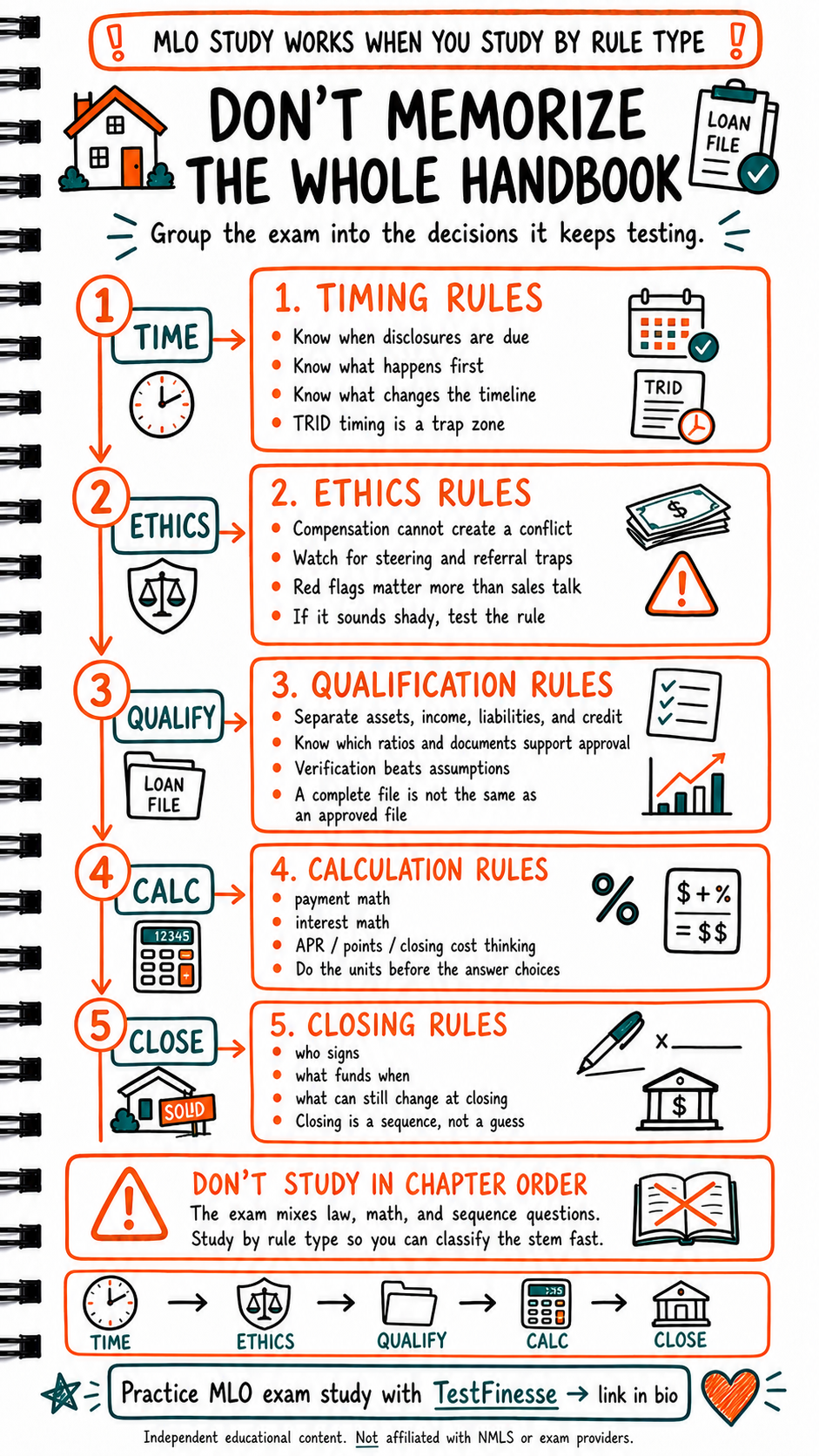
The SAFE MLO test is easier to study when you stop treating it like a textbook quiz.
It is not a chapter-order exam. It is a rule-type exam.
That is the whole point of the infographic. Mortgage licensing questions tend to repeat the same decision patterns over and over: timing, ethics, qualification, calculations, and closing logic. If you study by those families instead of by chapter order, you start seeing the exam the way it is actually written.
That matters because the official SAFE MLO National Test with Uniform State Test content is structured around 120 multiple-choice items, including 115 scored questions and 5 unscored questions, with 190 minutes to finish and a 75% passing standard. The content is distributed across five major areas, so your prep should follow the same logic instead of wandering through the handbook in order.
The best MLO study plan is simple:
Classify the question type first
Name the rule family
Then do the math or compliance check
Use misses to build a rule bank
That is how you stop memorizing the whole handbook and start answering the file the test is really showing you.
1. Timing Rules
The first rule family is time.
That includes:
when disclosures are due
what happens first
what changes the timeline
which step comes before the next one
where TRID timing becomes a trap zone
A lot of MLO questions are not asking, “Do you know mortgage law?” They are asking, “Do you know what happens now versus what happens later?”
That is why timing questions punish vague studying. If you only know that a form exists, you can still miss the question if you do not know its place in the sequence.
Why this works: timing is one of the cleanest ways the exam separates real process knowledge from surface familiarity. If you know the order, you can eliminate the wrong answer even when the wording is slippery.
2. Ethics Rules
The second rule family is ethics.
This is where the test checks whether you can spot:
conflicts of interest
steering traps
referral problems
compensation concerns
red flags that sound shady even if they sound professional
The right instinct here is not to look for the most impressive answer. It is to look for the cleanest rule.
If a choice creates a conflict, gives someone an improper advantage, or sounds like a referral or steering problem, it is probably wrong. The exam likes to dress bad behavior up in smooth language. Your job is to test the rule, not the sales pitch.
Score-leak warning: ethics misses often come from overthinking. Students talk themselves into the “helpful” answer instead of the compliant one.
3. Qualification Rules
The third rule family is qualification.
This is where you sort out:
assets
income
liabilities
credit
verification
documentation
whether a file is complete, approved, or just hopeful
The infographic is right to emphasize this: verification beats assumptions.
That is one of the most important MLO habits you can build. A complete file is not the same thing as an approved file. A lot of candidates confuse “all the forms are present” with “the borrower qualifies.” The test does not let you do that.
When you study qualification questions, train yourself to ask:
What is confirmed?
What is only claimed?
What ratio or document matters here?
Is this a documentation question or an approval question?
Why this works: qualification questions reward evidence-based thinking. The exam wants you to separate what is known from what is inferred.
4. Calculation Rules
The fourth rule family is calculation.
That includes:
payment math
interest math
APR thinking
points
closing costs
unit checking before you trust the answer choices
This is the part of MLO prep where students often go too fast. They see numbers and start pressing buttons before they know what the problem is asking.
The safer sequence is:
identify the target
check the units
match the formula family
calculate
confirm the answer choice makes sense
That last step matters. Mortgage math questions are often designed so the wrong answer looks almost plausible. If you do not check units and context, you can miss a point on a calculation that was otherwise straightforward.
Practical rule: do the units before the answer choices.
5. Closing Rules
The fifth rule family is closing.
This includes:
who signs
what funds when
what still can change at closing
what is a sequence question versus a guess question
what disclosures and documents belong at the close
Closing questions are really sequence questions in disguise. They ask whether you understand the final stage of the file and what can still move at that point.
That is why the infographic says closing is a sequence, not a guess.
If the question is about the closing table, do not answer from memory alone. Ask:
What stage of the file is this?
What is already locked in?
What still has to happen?
Which rule belongs to the final step?
That keeps you from jumping too early to the most attractive answer.
Don’t Study in Chapter Order
This is the trap the infographic is warning against.
If you study in chapter order, you may feel organized, but you are not necessarily becoming test-ready. The SAFE MLO exam mixes law, math, ethics, sequence, and qualification problems in ways that force classification.
A better plan is to study by rule type:
Time
Ethics
Qualify
Calc
Close
That way, when the stem appears, your brain already knows which file drawer to open.
Build the Rule Bank
A useful MLO review routine looks like this:
Write the topic from lecture or reading
Convert it into one rule
Turn that rule into 5 practice questions
Tag misses by rule type
Re-drill the bucket that keeps leaking
Examples:
“TRID disclosure timing”
“Compensation and steering”
“Verification versus assumption”
“Payment math with correct units”
“Closing sequence and final documents”
That is how you build a real trap bank. Not by rereading the handbook, but by sorting misses into repeatable categories.
Use The TestFinesse Practice Loop
The TestFinesse method here is:
Answer
Explain
Reveal
Fix the gap
For MLO prep, that means:
Answer: take a timed set or quiz
Explain: say why the answer belongs to that rule type
Reveal: identify the miss as timing, ethics, qualification, calculation, or closing
Fix the gap: write one sentence rule and test it again
That loop is better than passive review because it turns every miss into a better classifier.
Final Takeaway
The SAFE MLO test rewards candidates who can classify the stem fast.
Do not memorize the whole handbook. Group the exam into the decisions it keeps testing. If you can spot the rule type first, you will move faster, miss less, and study with much more precision.
The short version is:
Time first
Ethics second
Qualification third
Calculation fourth
Closing fifth
That is how you turn the handbook into a rule system.
Educational content only. Rules and requirements vary; check official NMLS sources for your exam and jurisdiction. Not affiliated with NMLS or exam providers.
Accuracy sources checked: NMLS MLO Testing Handbook, SAFE MLO Content Outline, SAFE MLO Testing FAQ, Online Proctored SAFE MLO Test
Keep studying
Practice Exam Skills
Turn this into a better score
Reading about a skill only gets you so far. TestFinesse's AI coach walks you through exam questions, explains exactly where your reasoning breaks down, and adapts to what you actually need to practice next.