CMA Pharmacology Question Decoder: Classify the Drug Before Choosing the Action
Last updated August 31, 2026
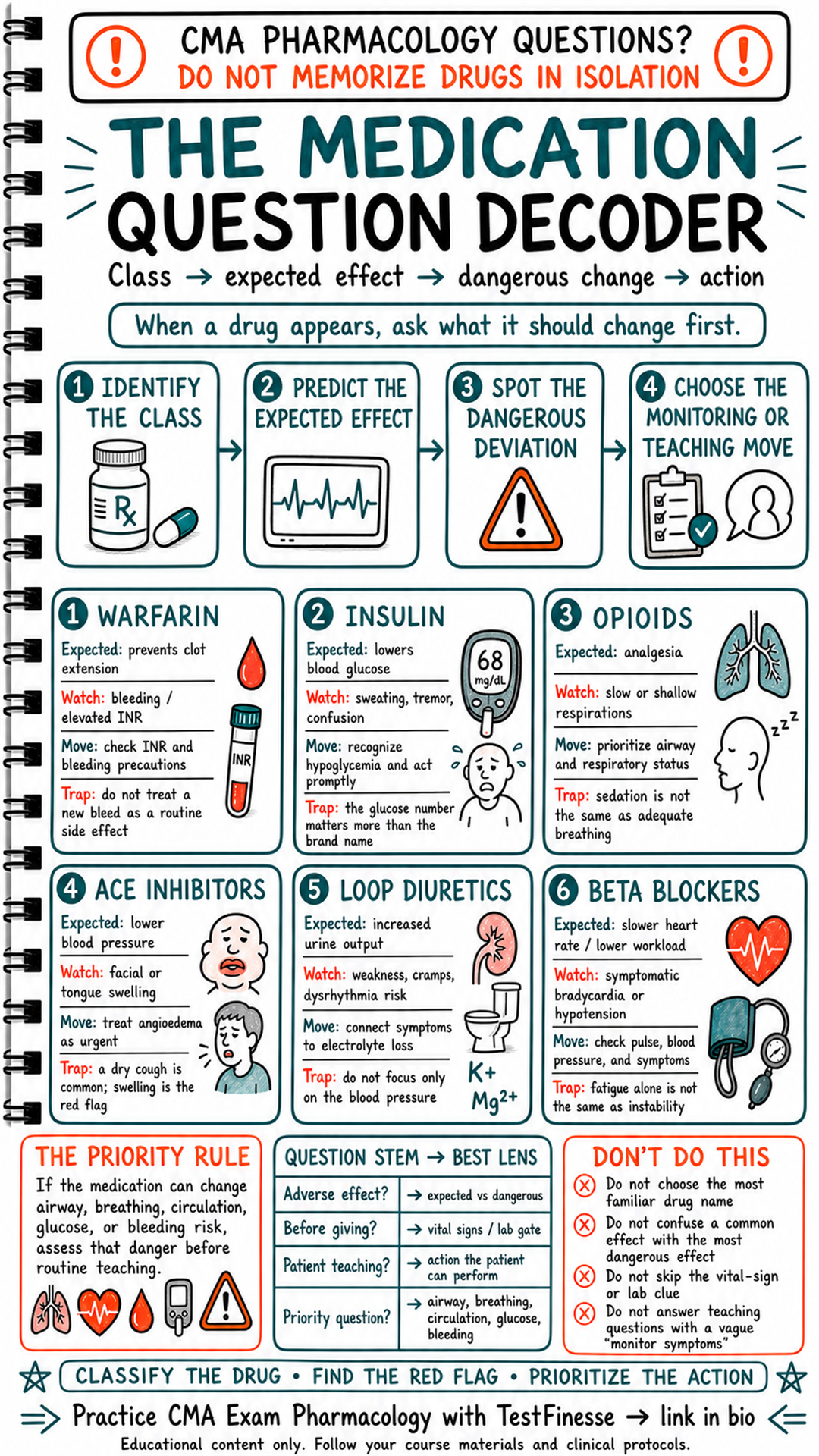
CMA pharmacology questions are rarely just drug-name memory tests.
A medication may appear in a question because the exam wants you to recognize its class, predict its expected effect, identify a dangerous change, or choose the appropriate monitoring and teaching response.
That means memorizing a medication name in isolation is not enough. You need to connect the medication to a clinical pattern:
Drug class → expected effect → dangerous deviation → appropriate action
The current CMA (AAMA) content outline includes drug classes, desired effects, indications, adverse reactions, side effects, allergic reactions, contraindications, medication administration, dosage calculations, metric conversions, routes, documentation, and medication-error reporting. CMA (AAMA) Certification Exam Content Outline
The most useful question to ask is:
What should this medication change first, and what abnormal change would be dangerous?
The Medication Question Decoder
When a drug appears in a stem, move through four steps:
Identify the class.
Predict the expected effect.
Spot the dangerous deviation.
Choose the monitoring or teaching move.
This method helps you avoid two common traps:
Choosing the drug name that looks most familiar
Choosing a common side effect instead of the most urgent finding
The correct answer is usually connected to the patient’s risk, the question’s command word, and the medication’s expected physiologic effect.
1. Warfarin: Think Clot Prevention and Bleeding Risk
Warfarin is an anticoagulant. Its purpose is to reduce clot formation and prevent clot extension.
The high-value connection is:
Anticoagulant → reduced clotting → bleeding surveillance
A question may include:
An elevated INR
New bruising
Nosebleeds
Blood in urine or stool
Unusual or prolonged bleeding
A fall or injury
Do not treat new bleeding as a routine nuisance. The medication’s desired effect is reduced clotting, but excessive anticoagulation raises bleeding risk.
For exam questions, focus on the relationship between the medication, the laboratory monitoring clue, and the patient’s symptoms. The important distinction is not simply “warfarin equals INR.” It is:
What does the INR suggest, and is the patient showing a dangerous bleeding change?
Always follow the clinical protocol, provider instructions, and organizational policy in real practice.
2. Insulin: Think Lower Glucose and Hypoglycemia
Insulin lowers blood glucose. A patient receiving insulin may be tested on expected glucose reduction or on signs that glucose has fallen too far.
Watch for:
Sweating
Tremor
Weakness
Confusion
Dizziness
Irritability
Altered level of consciousness
A glucose value in the stem may be useful, but the patient’s symptoms matter too. The exam may be testing whether you connect the medication’s intended effect to a dangerous deviation.
The trap is focusing on the medication’s brand name while ignoring the physiologic result. The better sequence is:
Identify insulin.
Predict lower blood glucose.
Look for symptoms of hypoglycemia.
Follow the required response for the situation described.
The glucose number is not the whole question. It is one piece of evidence that must be interpreted with the patient’s condition and the question’s wording.
3. Opioids: Airway and Breathing Come First
Opioids are associated with analgesia, or pain relief. They can also cause sedation and respiratory depression.
When an opioid appears in a question, prioritize:
Respiratory rate
Depth of breathing
Oxygenation
Level of consciousness
Airway protection
Responsiveness
A sleepy patient is not automatically experiencing a life-threatening problem. But slow, shallow, or inadequate respirations are a major danger signal.
The key distinction is:
Sedation is not the same as adequate breathing.
If the question asks for the priority action, airway and respiratory status may outrank routine pain reassessment or documentation. Do not choose an answer merely because it sounds comfortable or reassuring.
4. ACE Inhibitors: Separate Common Effects From Red Flags
ACE inhibitors are commonly associated with lowered blood pressure. A dry cough may occur, but facial, lip, tongue, or throat swelling is a more serious warning sign consistent with angioedema.
The exam strategy is to separate:
A known but less urgent side effect
A potentially dangerous airway-related reaction
A dry cough may require follow-up according to the care plan. Swelling involving the face, lips, tongue, or throat raises a much more urgent concern.
When a medication can affect the airway, the airway clue deserves priority.
Read the stem carefully. Determine whether it describes an expected nuisance effect, a contraindication, an allergic reaction, or a potentially emergent change.
5. Loop Diuretics: Think Urine Output and Electrolytes
Loop diuretics increase urine output by promoting fluid excretion. The expected effect may be reduced fluid overload, but increased fluid loss can also affect electrolytes and circulation.
Watch for clues such as:
Weakness
Muscle cramps
Dizziness
Orthostatic symptoms
Dehydration
Abnormal potassium or magnesium findings
Dysrhythmia risk
The trap is focusing only on blood pressure. The broader question is what happens when fluid and electrolytes shift.
Connect the symptoms to the medication’s mechanism:
More diuresis → more fluid loss → possible electrolyte disturbance
For exam purposes, choose the answer that best matches the stated symptoms, vital signs, labs, and requested task. In real practice, medication administration and follow-up must follow the authorized care plan and facility protocol.
6. Beta Blockers: Think Slower Heart Rate and Lower Workload
Beta blockers may lower heart rate and reduce cardiac workload. The important monitoring clues include:
Pulse
Blood pressure
Dizziness
Fainting
Symptomatic bradycardia
Signs of poor perfusion
Fatigue alone may not be the most urgent finding. The question may be testing whether you distinguish a common effect from instability.
Use the stem’s complete picture:
Is the patient symptomatic?
Is the heart rate dangerously low?
Is blood pressure reduced?
Is the patient dizzy or faint?
Is there a new change from baseline?
A medication question is often about the patient’s response, not the medication name.
Match The Stem To The Best Lens
Use the wording of the question to choose your approach.
Question stemBest lens“Adverse effect?”Expected effect versus dangerous deviation“Before administering?”Vital signs, allergies, labs, or required checks“Patient teaching?”What the patient should monitor, avoid, or report“Priority?”Airway, breathing, circulation, glucose, bleeding, or instability“Medication error?”Stop, assess, report, document, and follow policy as directed
Do not answer a teaching question with a priority intervention unless the stem asks for the immediate action. Do not answer an adverse-effect question with a routine indication. Match the action to the task.
Common Pharmacology Traps
Avoid these patterns:
Choosing the most familiar drug name.
Confusing a desired effect with an adverse reaction.
Treating every side effect as equally urgent.
Ignoring vital signs or laboratory clues.
Choosing a teaching answer when the patient is unstable.
Jumping to an intervention before identifying the risk.
Assuming a medication class has only one important effect.
Giving a vague answer such as “monitor the patient” without identifying what to monitor.
The best answer usually names the relevant assessment or teaching target:
Respiratory status
Blood glucose
INR or bleeding
Blood pressure
Pulse
Electrolytes
Allergy or airway symptoms
Use The TestFinesse Practice Loop
Turn every missed pharmacology question into a four-part repair:
Answer: Commit to a choice before viewing the explanation.
Explain: State the drug class, expected effect, dangerous deviation, and reason for your action.
Reveal: Compare your reasoning with the rationale.
Fix the gap: Write one trigger rule in your own words.
Examples:
“If an opioid question includes slow, shallow breathing, prioritize respiratory status.”
“If insulin is followed by sweating and confusion, consider hypoglycemia.”
“If an ACE inhibitor question includes facial or tongue swelling, treat the airway clue as urgent.”
“If a beta blocker patient is dizzy with a very low pulse, do not dismiss it as fatigue.”
“If a loop diuretic question includes weakness and cramps, connect the symptoms to possible electrolyte loss.”
Then practice a near-twin question using a different medication or symptom pattern. The goal is transferable reasoning, not memorization of one drug card.
Final Takeaway
CMA pharmacology questions become more manageable when you stop studying medications as isolated names.
Classify the drug. Predict the expected effect. Find the dangerous deviation. Choose the monitoring or teaching move that matches the question.
The strongest pharmacology answer is not always the most detailed one. It is the one that recognizes the patient’s risk and responds to the task actually being asked.
Educational exam-prep content only. This is not medical advice. In clinical practice, follow your course materials, supervising clinician, facility policy, medication-administration rights, and current official guidance.
Accuracy sources checked: CMA (AAMA) Certification Exam Content Outline, AAMA Certification Overview
Keep studying
Practice Exam Skills
Turn this into a better score
Reading about a skill only gets you so far. TestFinesse's AI coach walks you through exam questions, explains exactly where your reasoning breaks down, and adapts to what you actually need to practice next.