10 Medical Assistant Exam Score Moves That Show Up Again and Again
Last updated August 13, 2026
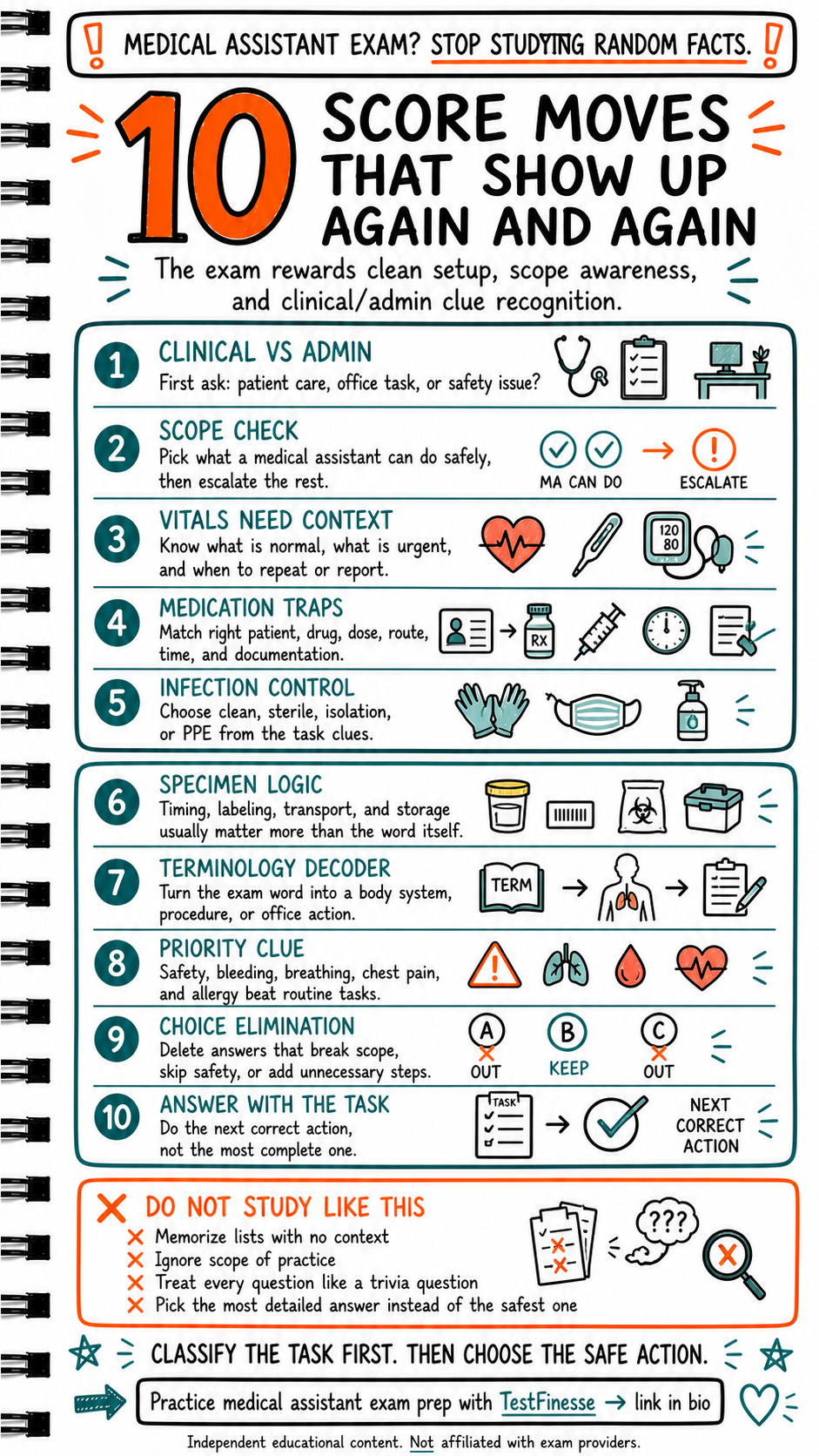
Medical assistant exam prep goes off the rails when students study random facts.
That feels busy, but it does not build the kind of pattern recognition these exams reward. The better move is to train the repeated decisions: clinical vs. admin, scope vs. escalate, normal vs. urgent, and safest action vs. most impressive action.
The infographic is built around a simple truth:
The exam rewards clean setup, scope awareness, and clue recognition.
If you are preparing for a medical assistant certification exam, that is the right place to focus. AAMA notes that CMA (AAMA) preparation centers on the exam content outline and the duties and skills medical assistants perform in general, clinical, and administrative work. The exact exam you are taking may differ by provider, but the logic stays the same: classify the task first, then choose the safest answer.
Why Medical Assistant Questions Repeat
Medical assistant questions often look like different topics on the surface:
vitals
medications
infection control
specimens
terminology
office tasks
patient safety
But many of them are testing the same underlying move:
Can you identify the task, stay inside scope, and choose the next correct action?
That is why memorizing isolated facts is not enough. The exam wants you to recognize what kind of situation you are in before you jump to an answer.
1. Clinical Vs. Admin
The first question is not “What fact do I know?”
It is:
Is this patient care, office work, or a safety issue?
That split matters because medical assistant questions often blend clinical and administrative tasks. If you do not classify the task, you can easily choose a technically correct answer in the wrong category.
Examples:
Scheduling, records, billing, and correspondence are administrative.
Vitals, specimen handling, medication support, and patient prep are clinical.
Bleeding, breathing problems, severe pain, and other urgent findings are safety issues that should be escalated.
The faster you classify the task, the faster you avoid the trap of answering the wrong type of question.
2. Scope Check
A safe answer is one a medical assistant can actually do.
That means you should ask:
Can a medical assistant do this safely, or should it be escalated?
The point is not to guess the most advanced action. The point is to choose the action that fits the role and the situation.
AAMA says the CMA(AAMA) credential reflects a wide scope of general, clinical, and administrative responsibilities. That does not mean every answer is within independent decision-making. On exam questions, you still need to notice when the safer move is to report, clarify, or escalate rather than act beyond the role.
TestFinesse rule: If the answer sounds powerful but stretches scope, it is probably a trap.
3. Vitals Need Context
Vital signs are not just numbers.
They only matter when you know:
what is normal for the client
what is urgent
what is new or changing
whether the finding needs a repeat or a report
A number by itself can be misleading. A heart rate or blood pressure may look okay on paper but still matter when compared with the client’s baseline, symptoms, or recent change.
This is why “normal-ish” vitals can still be a question trap.
Ask:
Is this new?
Is this worse?
Is this expected?
Does this need a repeat?
Does this need reporting?
On the exam, the best answer is usually the one that uses context instead of worshiping the number.
4. Medication Traps
Medication questions are usually not trying to test how impressive your memorization is.
They are testing whether you can match the right:
patient
medication
dose
route
time
documentation
That is the safety chain.
A wrong answer may look close because it matches the right drug but misses the route, or matches the route but misses the timing, or matches the dose but misses the patient.
Medication rule: If one link in the chain is wrong, the answer is wrong.
5. Infection Control
CDC says standard precautions apply to all patient care and include hand hygiene, PPE, and other core infection prevention practices.
That means infection control questions are often clue questions, not memorization questions.
Look for words like:
clean
sterile
isolation
PPE
hand hygiene
contamination
exposure
transmission
Sometimes the correct answer is basic. That is the point. Basic safety often beats a fancier intervention.
If the question gives a task that could spread infection, the first move is usually the one that protects the patient and the environment.
6. Specimen Logic
Specimen questions often care more about process than vocabulary.
The usual clues are:
timing
labeling
transport
storage
source
collection order
handling
You do not need to overthink these items. Read the workflow clues. If the question is about a specimen, the right answer usually respects the chain from collection to labeling to transport.
Specimen rule: The exam often tests the process, not just the name of the specimen.
7. Terminology Decoder
Medical terminology is often easier when you decode the word instead of memorizing the whole sentence.
Break the term into:
body system
procedure
office action
condition
direction or location
That helps you locate the meaning quickly and avoids random guessing.
For example, a term may tell you whether the question is really about a body system, a procedure, or an administrative task. Once you know that, the answer choices become easier to sort.
8. Priority Clue
Safety beats routine.
When the question includes:
bleeding
breathing
chest pain
severe allergic reaction
sudden change
obvious distress
urgent infection concern
the safest action usually moves ahead of routine work.
If one answer protects the client before the next question, that is often the priority choice.
9. Choice Elimination
Delete answers that break:
scope
safety
logic
sequence
patient identity
task order
A lot of test takers try to choose the most detailed answer. That is backwards.
Often the right answer is the one that is safe, simple, and inside role. If a choice adds unnecessary steps or skips an obvious safety check, it probably belongs in the trash.
10. Answer With The Task
Do the next correct action, not the most complete one.
That is one of the most useful exam habits you can build.
If the question asks for the next correct action, do not jump ahead to the final outcome. If the question asks for the safest first step, do not choose a later step that sounds more impressive.
Task rule: Pick the next correct action inside scope.
Do Not Study Like This
The image’s warning is accurate:
do not memorize lists with no context
do not ignore scope of practice
do not treat every question like trivia
do not pick the most detailed answer instead of the safest one
That kind of studying creates recognition without judgment. The exam wants both.
Use The TestFinesse Practice Loop
The TestFinesse method is:
Answer
Explain
Reveal
Fix the gap
For medical assistant prep, use it like this:
Answer: Choose the best action.
Explain: Say why it is clinical, admin, or safety.
Reveal: Check the correct answer and reasoning.
Fix the gap: Tag the miss as scope, vitals, medication, infection control, specimen logic, terminology, or priority.
That turns every missed question into a skill you can train again.
Final Takeaway
Medical assistant exams are not random fact dumps.
They repeat a small set of decisions:
Classify the task first. Then choose the safe action.
If you can spot the clue, stay in scope, and choose the next correct step, you will stop missing the same question in different clothing.
Educational exam prep only. Always follow your program, supervisor, facility policy, and scope of practice. Independent content. Not affiliated with exam providers.
Accuracy sources checked: AAMA Medical Assisting, AAMA Prepare for the CMA (AAMA) Exam, CDC Standard Precautions for All Patient Care, CDC Clinical Safety: Hand Hygiene for Healthcare Workers.
Keep studying
Practice Exam Skills
Turn this into a better score
Reading about a skill only gets you so far. TestFinesse's AI coach walks you through exam questions, explains exactly where your reasoning breaks down, and adapts to what you actually need to practice next.
Explore All Exams