10 CMA (AAMA) Exam Moves: Clinical First, Safety Always, Documentation Matters
Last updated August 10, 2026
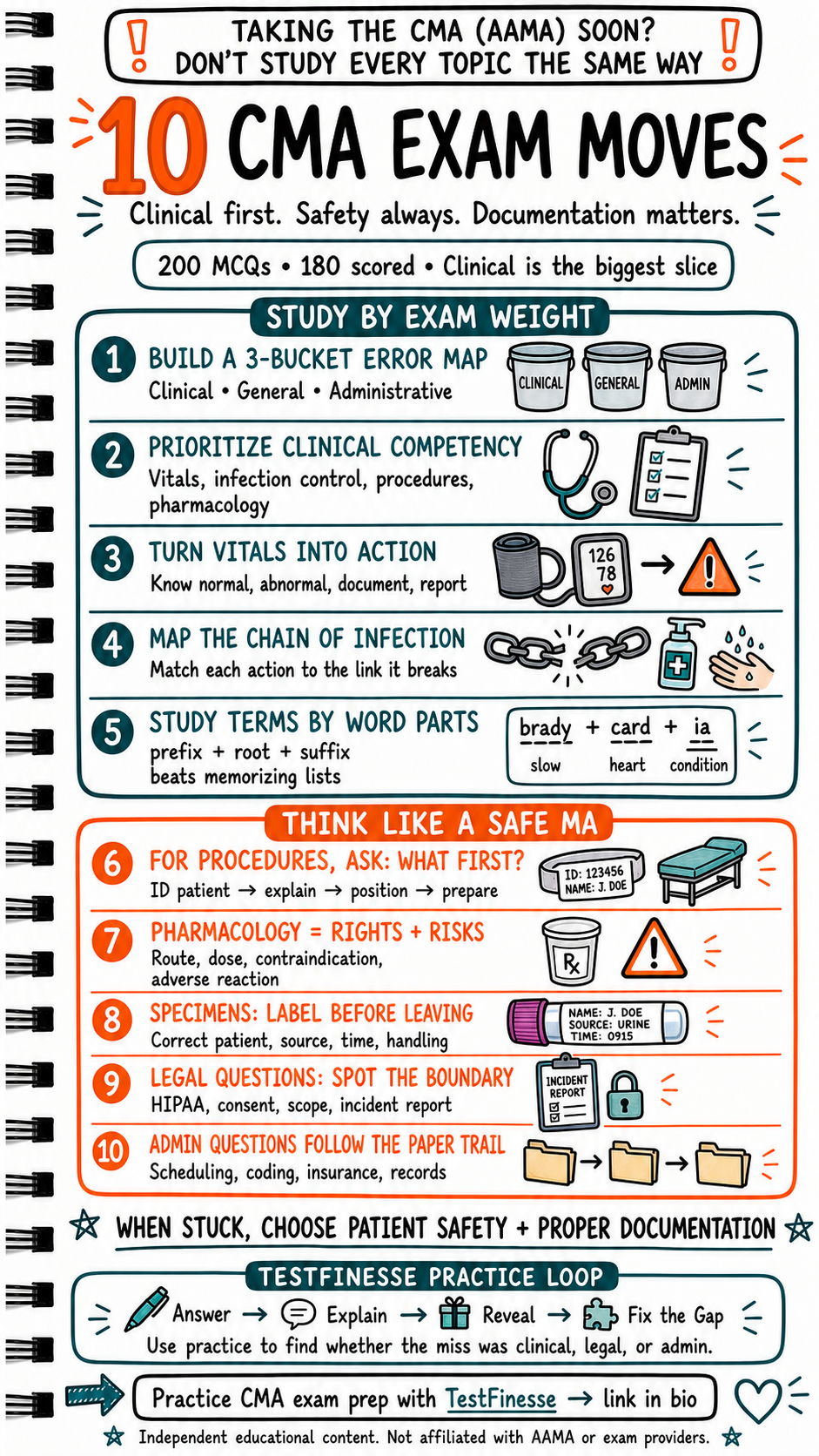
If you are taking the CMA (AAMA) exam soon, do not study every topic the same way.
The CMA (AAMA) Certification Exam has 200 multiple-choice questions. Of those, 180 are scored and 20 are pretest questions that do not count toward the score.
The scored content is not evenly divided.
According to the AAMA content outline, the exam is weighted across three major categories:
Clinical Competency: 59%
General: 21%
Administrative: 20%
That means clinical content is the biggest slice.
You still need legal, ethical, communication, billing, coding, scheduling, insurance, and records knowledge. But if you treat every topic like it deserves the same study time, your plan may not match the exam.
A smarter CMA exam strategy is:
Clinical first. Safety always. Documentation matters.
Study By Exam Weight
The CMA (AAMA) exam is built around real medical assistant responsibilities. The AAMA content outline includes clinical workflow, safety and infection control, procedures, pharmacology, legal and ethical issues, communication, billing, coding, insurance, scheduling, and health information management.
That is a lot of content.
The goal is not to panic-study everything.
The goal is to build a study system that matches the exam.
1. Build A 3-Bucket Error Map
Start by sorting your practice misses into three buckets:
Clinical
General
Administrative
Clinical misses might include:
Vital signs
Infection control
Procedures
Specimen handling
Pharmacology
Anatomy and physiology
Emergency response
General misses might include:
HIPAA
Legal and ethical issues
Communication
Patient rights
Scope of practice
Administrative misses might include:
Scheduling
Coding
Billing
Insurance
Medical records
Office workflow
This turns your practice into a map.
Instead of saying, “I missed 20 questions,” you can say:
“Most of my misses are clinical pharmacology and administrative coding.”
That gives you a plan.
2. Prioritize Clinical Competency
Clinical Competency is the largest exam category, so it deserves serious study time.
High-value clinical areas include:
Vitals
Infection control
Patient intake
Procedures and examinations
Specimen collection
Pharmacology
Anatomy and physiology
Emergency response
This does not mean memorizing isolated facts only.
You need to know what the fact means in a patient-care situation.
For example, do not only memorize pulse ranges. Know when a vital sign needs to be documented, repeated, reported, or connected to another patient clue.
A good clinical study question is:
“What would a safe medical assistant notice, document, or report?”
3. Turn Vitals Into Action
Vital signs are not just numbers.
They are patient data.
A strong CMA exam habit is to sort vitals into four actions:
Know normal
Recognize abnormal
Document accurately
Report when appropriate
Vital signs commonly include:
Blood pressure
Pulse
Respiratory rate
Temperature
Pulse oximetry
Pain scale
Height, weight, and BMI when relevant
The exam may test whether you understand technique, normal and abnormal findings, age-specific differences, and documentation.
Do not study vitals as flashcard numbers only.
Ask:
Is this value expected or concerning?
Should it be repeated?
Should it be documented?
Should the provider be notified?
Does the patient’s symptom make the vital sign more urgent?
Vitals matter because they connect measurement to patient safety.
4. Map The Chain Of Infection
Infection control is a major clinical safety topic.
Instead of memorizing infection control as a list, map the chain of infection.
The basic idea is that infection spreads through linked steps. Prevention works by breaking one or more of those links.
Actions that can break the chain include:
Hand hygiene
Appropriate PPE
Cleaning and disinfection
Safe injection practices
Sharps safety
Proper specimen handling
Standard precautions
Transmission-based precautions when indicated
CDC guidance emphasizes standard precautions for all patient care, including hand hygiene, PPE based on risk, respiratory hygiene, safe injection practices, and proper cleaning and disinfection.
For the exam, ask:
“Which action breaks the link in the chain?”
That question helps you choose between tempting safety answers.
5. Study Terms By Word Parts
Medical terminology is easier when you study word parts instead of memorizing endless lists.
Break terms into:
Prefix
Root
Suffix
Example:
Bradycardia
brady = slow
card = heart
-ia = condition
So bradycardia means a condition of slow heart rate.
This approach helps you decode unfamiliar terms on test day.
Instead of freezing when you see a long word, ask:
What is the root?
What does the prefix change?
What does the suffix tell me?
Is this a body system, condition, procedure, or symptom?
Word parts beat memorizing lists because they transfer to new terms.
Think Like A Safe Medical Assistant
The second half of the exam strategy is about safe decision-making.
When the question gives you a patient scenario, your job is often to choose the safest, most appropriate next step within the medical assistant role.
6. For Procedures, Ask: What First?
Procedure questions often test sequence.
Before jumping to the task, ask:
“What must happen first?”
A safe procedure sequence often includes:
Verify the patient
Confirm the order or task
Explain the procedure
Use hand hygiene and PPE when appropriate
Position the patient
Prepare supplies
Perform the task within scope
Document correctly
The exact order depends on the procedure and the wording of the question.
But patient identification, safety, explanation, and preparation are common first-step clues.
If the answer choice skips straight to the procedure while ignoring patient verification or safety, be careful.
7. Pharmacology = Rights + Risks
Pharmacology questions are not only about drug names.
They are about safe medication handling and patient risk.
Study:
Medication classes
Routes
Dose concepts
Contraindications
Adverse reactions
Side effects
Allergic reactions
Storage
Documentation
Medication error reporting
The AAMA content outline specifically includes medication rights, dosage, metric conversion, routes of administration, safety precautions, injections, documentation, and reporting medication errors.
A strong exam shortcut is:
Rights plus risks.
Ask:
Is this the right patient?
Is the route correct?
Is the dose reasonable?
Is there an allergy or contraindication?
Does this require documentation or reporting?
Is this within the medical assistant’s role and state/facility rules?
Medication questions often reward the safest answer, not the fastest one.
8. Specimens: Label Before Leaving
Specimen questions are safety and documentation questions.
The AAMA content outline includes specimen collection techniques, proper labeling, preparation, preservation, and sources of contamination.
A safe specimen mindset includes:
Correct patient
Correct specimen source
Correct time
Correct handling
Correct labeling
Correct transport or storage
Avoiding contamination
The Joint Commission notes that specimen containers should be labeled using two identifiers in the presence of the patient.
For test prep, the shortcut is:
Label before leaving.
Do not separate the specimen from the patient-identification process.
9. Legal Questions: Spot The Boundary
Legal and ethical questions often test boundaries.
Watch for:
HIPAA
Confidentiality
Consent
Scope of practice
Incident reports
Patient rights
Documentation corrections
Professional communication
HIPAA protects patient health information and sets rules for how covered entities use and disclose it. On the exam, privacy and confidentiality questions often come down to who needs the information, why they need it, and whether disclosure is appropriate.
Scope questions are also important.
Medical assistants must follow state law, provider delegation, facility policy, and training limits. If an answer has the medical assistant diagnosing, independently prescribing, giving unauthorized advice, or acting outside scope, be cautious.
Ask:
“What is the boundary?”
That question helps with legal and ethical scenarios.
10. Administrative Questions Follow The Paper Trail
Administrative questions are not just office trivia.
They test whether you understand how information moves through a medical office.
Study the paper trail for:
Scheduling
Patient registration
Insurance
Coding
Billing
Medical records
Referrals
Prior authorization
Documentation
Health information management
When you get an administrative question, ask:
What document or record is involved?
What happens first?
Who needs the information?
What must be verified?
What must be documented?
What is the privacy concern?
Administrative accuracy matters because mistakes can affect patient care, reimbursement, compliance, and communication.
When Stuck, Choose Patient Safety + Proper Documentation
This is not a magic rule for every question, but it is a strong test-taking filter.
When two answers seem close, ask:
Which answer protects the patient?
Which answer stays within scope?
Which answer documents accurately?
Which answer communicates the right concern to the provider?
Which answer follows policy and procedure?
The CMA exam is built around safe, competent medical assisting.
So when you are stuck, think like a safe MA:
Protect the patient. Respect the boundary. Document the action.
Use The TestFinesse Practice Loop
The TestFinesse practice loop is:
Answer
Explain
Reveal
Fix the gap
For CMA exam prep, use the loop to classify every miss.
Ask:
Was this clinical?
Was this legal or ethical?
Was this administrative?
Did I miss a safety cue?
Did I miss a documentation cue?
Did I confuse the medical assistant role with another provider role?
Did I know the term but miss the scenario?
Then write one fix.
Examples:
Next time, identify whether the question is clinical, general, or administrative first.
Next time, check patient safety before choosing the action.
Next time, label the specimen before leaving the patient.
Next time, identify the legal boundary before answering.
Next time, turn abnormal vitals into document/report decisions.
That is how practice becomes a study plan.
Final Takeaway
The CMA (AAMA) exam is broad, but your prep should not be random.
Focus on these 10 moves:
Build a 3-bucket error map
Prioritize Clinical Competency
Turn vitals into action
Map the chain of infection
Study medical terms by word parts
Ask “what first?” for procedures
Study pharmacology as rights plus risks
Label specimens before leaving
Spot the legal boundary
Follow the administrative paper trail
Clinical first.
Safety always.
Documentation matters.
Educational note: This is independent CMA exam prep content, not clinical guidance. Always follow your medical assisting program, provider direction, state scope-of-practice rules, and facility policies.
Accuracy sources checked: AAMA CMA Exam Content Outline PDF, AAMA Prepare for the CMA Exam, CDC Standard Precautions, CDC Core Infection Prevention Practices, Joint Commission Two Patient Identifiers, HHS HIPAA Privacy Rule Summary, and MedlinePlus Vital Signs.
Keep studying
Practice Exam Skills
Turn this into a better score
Reading about a skill only gets you so far. TestFinesse's AI coach walks you through exam questions, explains exactly where your reasoning breaks down, and adapts to what you actually need to practice next.
Explore All Exams