Close the Loop Before Bed: Make Nightly Review Turn Misses Into Tomorrow’s Rules
Last updated August 17, 2026
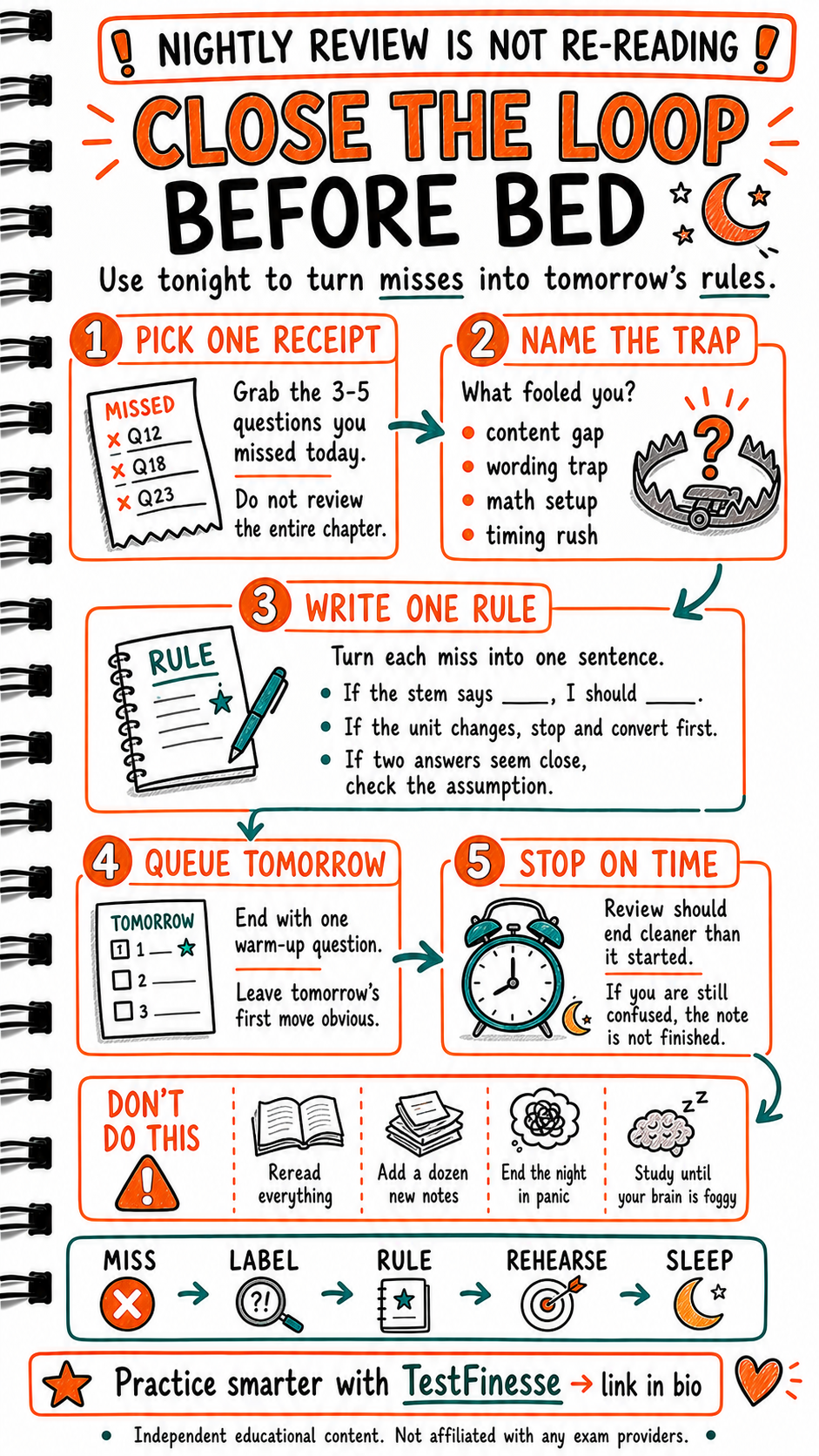
Nightly review is not re-reading.
That is the whole point.
If you finish a study session by rereading everything you saw, you may feel productive, but you are not closing the loop. You are just staying in the material. A better nightly routine is shorter and sharper: take the misses from today, label what happened, turn each one into a rule, then queue tomorrow’s first move.
That is how you make review useful instead of endless.
The TestFinesse version is simple:
Miss → Label → Rule → Rehearse → Sleep
Why Nightly Review Matters
A lot of students study hard all day and then end the night in a fog.
They reread notes, add more notes, and keep pushing until they are too tired to think clearly. That usually backfires because the brain needs a cleaner finish, not a longer struggle.
Nightly review should do three things:
reduce confusion
reduce tomorrow’s decision load
turn mistakes into a usable rule
If it does not do those three things, it is not review. It is noise.
1. Pick One Receipt
Grab the 3 to 5 questions you missed today.
Do not review the entire chapter. Do not restart the whole topic. Do not try to repair the whole week in one night.
Pick a small receipt of actual misses.
That matters because the strongest review starts with evidence, not guilt. You are not reviewing because you failed. You are reviewing because you want to know exactly what the miss was.
Good nightly review is specific:
these few questions
this one set
this one topic
this one passage type
this one formula family
TestFinesse rule: Review the miss set, not the whole mountain.
2. Name The Trap
Ask: What fooled me?
Use a short label:
content gap
wording trap
math setup
timing rush
This is important because the fix depends on the trap.
If the issue was wording, more content reading will not help much. If the issue was math setup, re-reading explanations will not change the first step. If the issue was timing, the fix may be a pacing rule, not another chapter.
A labeled trap becomes actionable. A vague mistake stays vague.
Trap rule: If you cannot name the trap, you cannot fix it cleanly.
3. Write One Rule
Turn each miss into one sentence.
The rule should be short enough to remember and specific enough to use.
Examples:
“If the stem says except, I underline it before reading choices.”
“If the unit changes, I stop and convert first.”
“If two answers are close, I check the assumption.”
“If I cannot name the ask, I do not calculate yet.”
“If I stall for too long, I flag it and move.”
This step is the real win. You are not collecting notes. You are building future behavior.
A nightly rule should feel like a cue, not an essay.
Rule: One miss should become one sentence you can actually use tomorrow.
4. Queue Tomorrow
End with one warm-up question or one first move for tomorrow.
That prevents the next day from starting cold.
Queue something like:
one warm-up question
one formula family
one passage type
one section-specific routine
one first-step rule
The purpose is to make tomorrow’s start obvious.
If the first move is obvious, you waste less time getting started. That is a quiet but important advantage.
TestFinesse rule: Leave tomorrow’s first move visible.
5. Stop On Time
Review should end cleaner than it started.
That is the standard.
If you are still confused, adding more time may just deepen the confusion. If you are tired, the quality of the review is already dropping. If you are panicking, more pages often make the night worse instead of better.
A good stop point sounds like this:
“I have my rule.”
“I know the trap.”
“I know what to do tomorrow.”
“I am done.”
That is enough.
Stop rule: If the note is not clearer, the review is not done.
What Not To Do Tonight
The infographic’s warning is accurate. Do not:
reread everything
add a dozen new notes
end the night in panic
study until your brain is foggy
Those habits feel urgent, but they usually make tomorrow worse.
Why? Because they keep you in passive mode. They do not turn the mistake into a rule. They do not reduce tomorrow’s friction. They do not sharpen the first move.
Nightly review should not expand the pile. It should compress the lesson.
Use The TestFinesse Practice Loop
The TestFinesse method is:
Answer
Explain
Reveal
Fix the gap
For nightly review, use a tighter version:
Miss → Label → Rule → Rehearse → Sleep
That loop keeps the work concrete.
Miss: What went wrong?
Label: What kind of trap was it?
Rule: What should I do next time?
Rehearse: What is tomorrow’s warm-up?
Sleep: End on time so the rule sticks
That is how review becomes behavior change.
Final Takeaway
Nightly review is not re-reading.
It is closing the loop.
Pick a few misses. Name the trap. Write one rule. Queue tomorrow. Stop on time.
Miss → Label → Rule → Rehearse → Sleep
If you do that consistently, your review will get cleaner, your starts will get faster, and your mistakes will turn into rules instead of repeat problems.
Educational content only. Not affiliated with any exam providers.
Keep studying
Practice Exam Skills
Turn this into a better score
Reading about a skill only gets you so far. TestFinesse's AI coach walks you through exam questions, explains exactly where your reasoning breaks down, and adapts to what you actually need to practice next.
Explore All Exams