Can You Be Proud of a Score and Still Feel Disappointed? Yes. Both Things Can Be True.
Last updated August 17, 2026
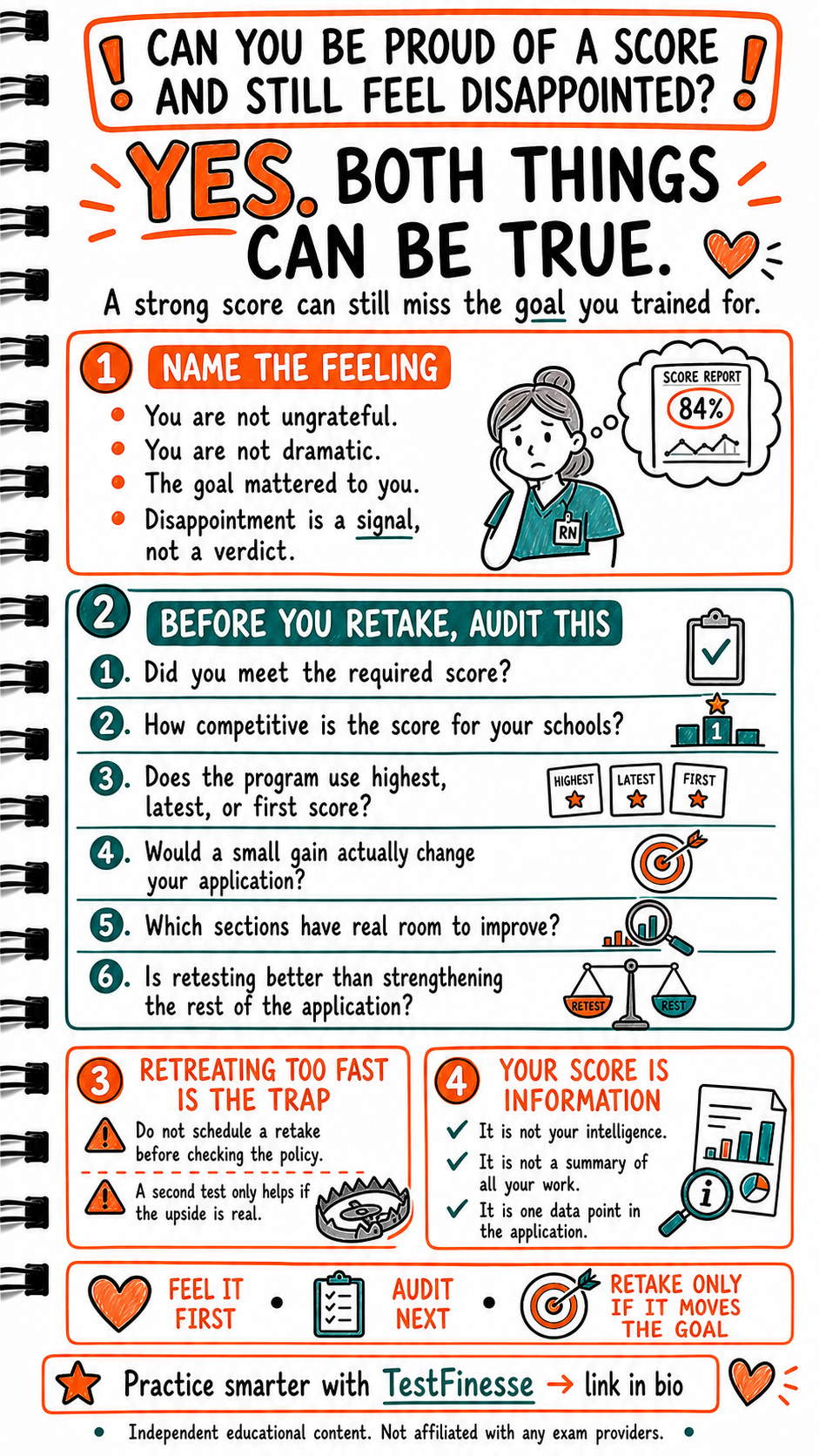
Yes.
Both things can be true.
You can be proud of the work you put in and still feel disappointed by the score. You can recognize improvement and still want more. You can know the score represents real progress and still feel the sting of missing the goal you trained for.
That is not contradiction. That is normal.
A strong score can still miss the goal you trained for. When that happens, the worst move is to immediately collapse the score into your identity. The better move is to name the feeling, audit the result, and decide whether a retake would actually change the application.
That is the TestFinesse approach here:
Feel it first. Audit next. Retake only if it moves the goal.
Why This Feels So Complicated
Exam scores carry two different meanings at once:
a performance result
an emotional result
The performance result is objective. The emotional result is personal.
That is why a score can produce mixed feelings. You might be genuinely proud that you improved, that you met a benchmark, or that you performed better than before. At the same time, you might feel disappointed because the score did not reach the target you hoped for, the schools you wanted are competitive, or a small gain would not actually change the outcome.
That tension is real. It does not mean you are ungrateful. It does not mean you are being dramatic. It means the goal mattered to you.
1. Name The Feeling
Start by naming what happened emotionally.
Do not rush past disappointment just because you think you should be tougher. Do not pretend everything is fine if it is not.
A healthy response sounds like:
“I am proud of the work.”
“I am disappointed by the result.”
“Both of those are true.”
“The goal mattered to me.”
“This feeling is a signal, not a verdict.”
That last line matters.
Disappointment is information. It tells you that the goal had weight. It does not tell you that you failed as a person.
TestFinesse rule: Name the feeling before you name the plan.
2. Before You Retake, Audit This
Do not schedule a retake on emotion alone.
Before you decide to try again, audit the situation with a few practical questions:
Did you meet the required score?
How competitive is the score for your schools or program?
Does the program use your highest, latest, or first score?
Would a small gain actually change your application?
Which sections have real room to improve?
Is retesting better than strengthening the rest of the application?
That audit protects you from two bad decisions:
retaking too fast because you feel bad
giving up too fast because you feel discouraged
Not every disappointing score needs another test. Sometimes the score is good enough for the goal. Sometimes the better move is to improve other parts of the application instead.
3. Retaking Too Fast Is The Trap
A second test only helps if the upside is real.
That means you need to check policy and strategy, not just emotion.
Before retaking, ask:
Is the score actually below the required threshold?
Would a retake meaningfully change competitiveness?
Is there enough time to improve the weak areas?
Are you likely to score better for a reason, not just because you want to?
Would the retake help more than improving essays, experience, letters, or other application pieces?
If the answer is no, the retake may be an emotional reaction instead of a strategic move.
Retake rule: Retake only if it moves the goal.
4. Your Score Is Information
A score is not your intelligence.
It is not a summary of all your work.
It is one data point.
That is the right frame because it keeps the score in its proper place. The number matters, but it does not fully define you. It also does not capture every hour you studied, every concept you corrected, every time you pushed through uncertainty, or every piece of growth that happened along the way.
Your score tells you something useful, but it does not tell the whole story.
Information rule: Treat the score as data, not identity.
What To Do With The Data
Once the emotion is named, move into the audit.
Ask:
What did I actually need for this goal?
Did I get there?
If not, what would change the result?
Is the gap in one section or several?
Is the best next step another test or a stronger application?
This is the part where the score stops being a feeling and becomes a decision tool.
If the gap is small and the policy allows a meaningful retake, another attempt may be worth it. If the gap is large, or if another score will not change the outcome, your energy may be better spent elsewhere.
That is not settling. That is strategy.
Do Not Turn The Review Into A Story About You
The wrong response to a disappointing score is to build a whole identity around it.
Examples of unhelpful stories:
“I’m bad at this.”
“I should have done better.”
“I wasted my time.”
“This score says I’m not cut out for it.”
Those thoughts may show up, but they are not the same as truth.
A score is a result inside a process. It is not a final label on your ability, your effort, or your future.
The useful question is not, “What does this score say about me?”
The useful question is, “What does this score say about the next move?”
Use The TestFinesse Practice Loop
The TestFinesse method is:
Answer
Explain
Reveal
Fix the gap
For score disappointment, the loop becomes:
Answer: What happened, exactly?
Explain: What part is emotional, and what part is strategic?
Reveal: Does the score change the application path?
Fix the gap: Do I retake, strengthen the application, or both?
That keeps the response grounded. You do not have to fake happiness. You also do not have to let disappointment make the decision for you.
Final Takeaway
Yes, you can be proud of a score and still feel disappointed.
Both things can be true.
The score is information. The feeling is information. The next move comes from the audit, not the panic.
Feel it first. Audit next. Retake only if it moves the goal.
Educational content only. Not medical, mental health, or admissions advice.
Keep studying
Practice Exam Skills
Turn this into a better score
Reading about a skill only gets you so far. TestFinesse's AI coach walks you through exam questions, explains exactly where your reasoning breaks down, and adapts to what you actually need to practice next.
Explore All Exams