ACT Score Lever Map: Use Section-Specific Moves to Raise Your Score
Last updated August 12, 2026
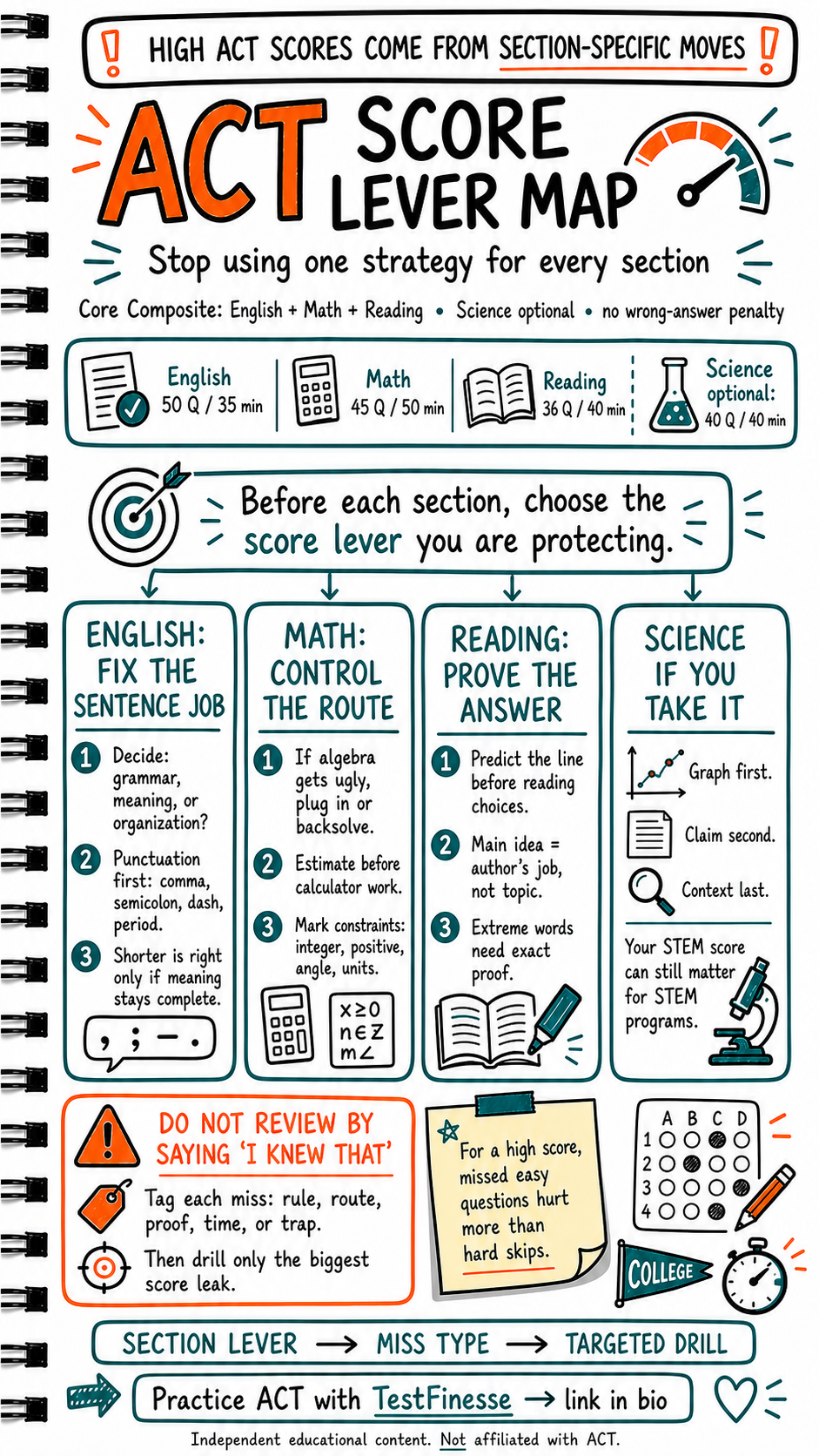
High ACT scores do not come from using one strategy everywhere.
They come from knowing which score lever matters in each section.
That distinction matters even more on the enhanced ACT. The current ACT structure uses English, Math, and Reading for the Composite score, while Science is optional for many test takers and reported separately if taken. ACT also states there is no penalty for guessing, so every section needs a plan for protecting easy points before time runs out.
The TestFinesse rule is simple:
Before each section, choose the score lever you are protecting.
Do not walk into English, Math, Reading, and Science with the same mental script. Each section rewards a different kind of decision.
Know The Current ACT Structure
The enhanced ACT sections are:
English: 50 questions, 35 minutes
Math: 45 questions, 50 minutes
Reading: 36 questions, 40 minutes
Science: optional, 40 questions, 40 minutes
Writing: optional, separate essay section
The Composite score is based on English, Math, and Reading. If you take Science, you still receive a Science score, and ACT reports a STEM score using Math and Science.
One important nuance: for national ACT testing, Science is optional. For some school-day, state, or district administrations, availability can depend on the program or contract. Always confirm your registration details.
Why “Study More” Is Too Vague
A student might say, “I need to improve my ACT score.”
That is too broad to act on.
A better question is:
Which section is leaking points, and what kind of decision is causing the leak?
For example:
English misses may come from grammar rules or sentence purpose.
Math misses may come from choosing the slowest route.
Reading misses may come from picking answers without proof.
Science misses may come from reading background information before the figures.
Each problem needs a different drill.
English: Fix The Sentence Job
ACT English is not just grammar correction. It is also editing for meaning, organization, and clarity.
Before answering, ask:
What job is this sentence supposed to do?
Common jobs include:
Fixing punctuation
Clarifying meaning
Removing clutter
Improving transitions
Keeping the paragraph organized
Choosing the most precise wording
A strong English process starts with the task.
1. Decide: Grammar, Meaning, Or Organization?
Do not treat every ACT English question as a comma question.
First, classify the item:
Grammar: subject-verb agreement, verb tense, pronouns, modifiers
Punctuation: comma, semicolon, colon, dash, period
Meaning: precision, concision, redundancy
Organization: sentence placement, transitions, paragraph logic
When you name the task, you reduce guessing.
2. Punctuation First
If punctuation changes across the answer choices, inspect it early.
Ask:
Are two complete sentences being joined?
Is the punctuation separating a dependent phrase?
Is the dash or colon introducing an explanation?
Does the comma create a fragment or splice?
Punctuation is a high-value lever because the rule is often mechanical. If you can identify the sentence structure, you can eliminate choices quickly.
3. Shorter Is Right Only If Meaning Stays Complete
ACT English often rewards concise writing, but “shorter” is not a rule by itself.
A shorter answer is better only when it keeps:
The same meaning
Necessary detail
Correct grammar
Clear sentence logic
Do not delete meaning just to make the sentence smaller.
Math: Control The Route
ACT Math is not about doing the longest solution correctly. It is about choosing a route that gets to the answer under time pressure.
The current ACT Math section gives more time per question than the old version, but careless route choice can still burn minutes.
Before solving, ask:
Is this an algebra problem, or is there a faster route?
1. If Algebra Gets Ugly, Plug In Or Backsolve
Long algebra is not always the best ACT move.
Try:
Backsolving from answer choices
Plugging in simple numbers
Estimating answer size
Testing constraints
Drawing a quick diagram
If the numbers are answer choices, they are data. Use them.
2. Estimate Before Calculator Work
A permitted calculator can help, but it cannot tell you whether your answer makes sense.
Before calculating, estimate:
Should the answer be bigger or smaller?
Is it positive or negative?
Is it near 10, 100, or 1,000?
Is the angle acute or obtuse?
Is the percent reasonable?
Estimation catches wrong-route answers before they become bubbled answers.
3. Mark Constraints
ACT Math loves constraints.
Watch for:
Integer
Positive
Negative
Angle
Units
Whole number
Least or greatest
Cannot be zero
A correct equation can still produce a wrong answer if you ignore the constraint.
Reading: Prove The Answer
ACT Reading is not a vibes section.
The score lever is proof.
Before you choose an answer, ask:
Where does the passage prove this?
1. Predict The Line Before Reading Choices
For detail and inference questions, pause before the choices and predict where the proof should be.
You do not need a perfect answer yet. You need a proof zone.
Ask:
Which paragraph discussed this?
Which sentence gives the evidence?
Is the answer asking for detail, function, tone, or inference?
This keeps the answer choices from pulling you away from the passage.
2. Main Idea = Author’s Job, Not Topic
A weak main idea answer often names the topic.
A stronger main idea answer names what the author is doing with the topic.
Compare:
Topic: “The passage is about urban gardens.”
Author’s job: “The author explains why urban gardens solve multiple community problems.”
ACT Reading rewards the author’s job, not just the subject.
3. Extreme Words Need Exact Proof
Words like always, never, only, completely, proves, must, all, none need strong support.
If the passage is softer than the answer choice, eliminate it.
Reading rule: Interesting is not enough. Supported wins.
Science: If You Take It, Read The Figures First
ACT Science is optional for many test takers, but it can still matter, especially if a college, scholarship, STEM pathway, or program wants to see Science or STEM information.
If you take it, do not read the background paragraph first by default.
Use this order:
Graph first
Claim second
Context last
The Science section often rewards data reading more than outside science knowledge.
Graph First
Start with:
Axes
Units
Trends
Labels
Table headings
Increasing or decreasing patterns
Most answers are hiding in the visuals.
Claim Second
If the question asks about a hypothesis, experiment, or scientist’s claim, identify the claim before choosing an answer.
Ask:
Who believes what?
Which data supports it?
Which data weakens it?
Are two viewpoints disagreeing?
Context Last
Background information matters, but reading all of it first can waste time.
Use context when the question requires it. Otherwise, let the figures do the first round of work.
Do Not Review By Saying “I Knew That”
This is the biggest plateau trap.
If you review a missed question and only say, “I knew that,” you have not fixed anything.
Instead, tag each miss:
Rule: I did not know the tested rule.
Route: I chose the slowest or wrong method.
Proof: I picked without evidence.
Time: I stalled too long.
Trap: I fell for tempting wording.
Then drill the biggest score leak first.
For a high score, missed easy questions hurt more than hard skips. Protect the points you were supposed to get.
Use The TestFinesse Practice Loop
The TestFinesse method is:
Answer
Explain
Reveal
Fix the gap
For the ACT, add the section lever:
Section Lever → Miss Type → Targeted Drill
Examples:
English punctuation miss → drill comma vs semicolon
Math route miss → drill backsolving and plugging in
Reading proof miss → drill line evidence
Science graph miss → drill axes, units, and trends
Final Takeaway
Do not use one strategy for every ACT section.
Use the lever that matches the section:
English: Fix the sentence job.
Math: Control the route.
Reading: Prove the answer.
Science: Read the figures first, if you take it.
High ACT scores come from section-specific moves, not generic effort.
Independent educational content. Not affiliated with ACT.
Accuracy sources checked: ACT Exam Sections and Structure, ACT Enhanced ACT FAQs, ACT Understanding Your Scores, ACT Test Day.
Keep studying
Practice Exam Skills
Turn this into a better score
Reading about a skill only gets you so far. TestFinesse's AI coach walks you through exam questions, explains exactly where your reasoning breaks down, and adapts to what you actually need to practice next.
Explore All Exams