ACT Math Formula Family Map: Match the Right Setup Before You Calculate
Last updated August 18, 2026
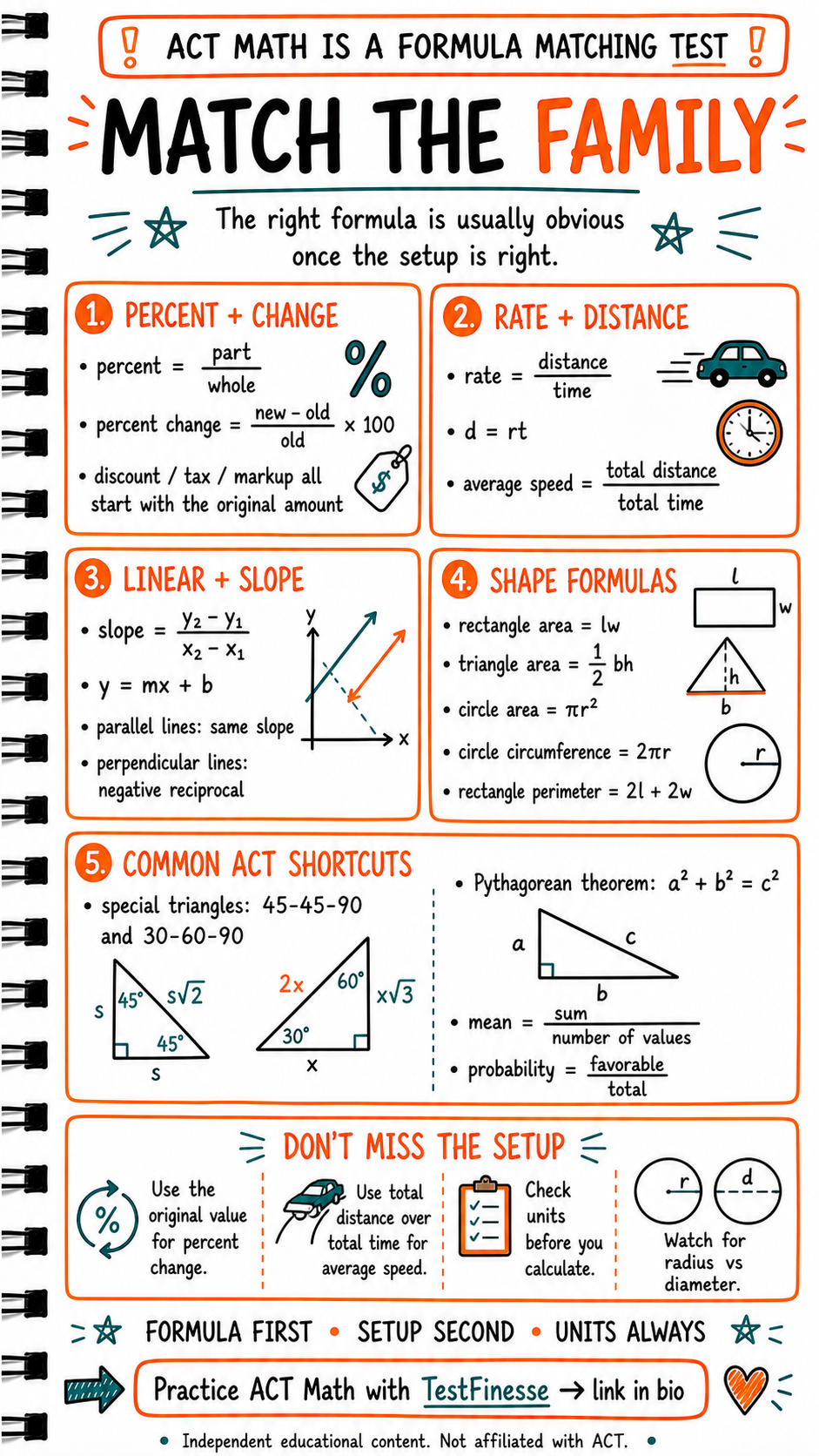
ACT Math is not a chapter-by-chapter memory test.
It is a formula matching test in the practical sense: once you recognize the setup, the right formula family usually becomes obvious. The hard part is not always the calculation. It is deciding which relationship the question is actually asking for.
That matters on the current ACT because the Math section has 45 questions in 50 minutes, calculators are allowed only on Math, and ACT says the section emphasizes mathematical reasoning from pre-algebra through trigonometry. ACT also states that all questions are equally weighted and there is no penalty for guessing. So the test rewards fast setup recognition, not perfect recollection of every detail.
The TestFinesse rule here is simple:
Formula first. Setup second. Units always.
Why ACT Math Feels Faster Than It Is
A lot of students think ACT Math is a race to remember formulas.
That is only half true.
Yes, you need the formulas. But many misses happen because the student picks the wrong family before starting. If you treat a percent problem like a geometry problem, or a rate problem like a raw algebra problem, you can work hard and still miss.
That is why the image organizes the content by formula family. It is a better way to think than “What chapter was this from?”
When you see the right family, the answer is usually much easier to build.
1. Percent + Change
Percent questions should start with the original amount.
Common setups include:
percent = part / whole
percent change = (new - old) / old × 100
discount, tax, markup all start with the original amount
That last point is where many students leak points. They start with the changed amount because it feels more current. But the starting point is usually the original.
Ask:
What is the whole?
What is the part?
What is the original?
What changed?
TestFinesse rule: For percent change, the denominator is usually the original, not the new value.
2. Rate + Distance
Rate questions are about relationships over time.
The key formulas are:
rate = distance / time
d = rt
average speed = total distance / total time
This family often shows up with travel, movement, or work-like language. The clue is not just the word “rate.” The clue is the relationship between amount and time.
Before calculating, ask:
What is being moved or covered?
Is the question asking for a rate, a distance, or a time?
Is this average speed or a single segment?
Do I need total distance over total time?
Rate rule: Use total distance over total time for average speed, not one segment by itself.
3. Linear + Slope
Linear questions are about change and direction.
Common formulas:
slope = (y2 - y1) / (x2 - x1)
y = mx + b
parallel lines have the same slope
perpendicular lines have negative reciprocal slopes
This family matters because ACT loves to ask whether a graph, line, or equation is changing correctly.
Watch for:
a graph with two points
a line equation
comparing line directions
identifying parallel or perpendicular relationships
Slope rule: The slope is a change ratio, not just a number to memorize.
4. Shape Formulas
Shape questions are formula questions, but only if you know what measurement you are solving for.
Common formulas:
rectangle area = lw
triangle area = 1/2 bh
circle area = πr²
circle circumference = 2πr
rectangle perimeter = 2l + 2w
The trap here is usually not the formula itself. It is the measurement type.
Ask:
Is this area, perimeter, or circumference?
Is the radius given, or is the diameter given?
Do I need squared units or linear units?
Is the height the perpendicular height, not the slanted side?
Shape rule: Watch for radius versus diameter and area versus perimeter.
5. Common ACT Shortcuts
Some ACT Math questions reward recognition more than long calculation.
Useful shortcuts include:
45-45-90 triangles
30-60-90 triangles
Pythagorean theorem: a² + b² = c²
mean = sum / number of values
probability = favorable / total
These are high-value because they appear often enough to earn practice, and they save time when you recognize the pattern quickly.
Special Triangles
For the special triangles:
In a 45-45-90 triangle, the legs match and the hypotenuse is the leg times √2.
In a 30-60-90 triangle, the short leg, long leg, and hypotenuse follow the 1 : √3 : 2 pattern.
If you know the triangle family, you do not need to re-derive the ratios every time.
Shortcut rule: Recognize the triangle before you calculate the side lengths.
Don’t Miss The Setup
The formula is not usually the problem.
The setup is.
That is why the image’s warning matters. A lot of ACT Math errors come from skipping the reading step and diving into arithmetic too fast.
Before you calculate, check:
Is this a percent-change problem or a raw percent problem?
Is this average speed or just speed on one segment?
Is this radius or diameter?
Is this area, perimeter, or circumference?
Are the units supposed to change first?
Does the question want a formula family, not just a number?
If the setup is wrong, the answer can look reasonable and still be wrong.
What ACT Math Is Really Testing
ACT says the Math section focuses on:
preparing for higher math
integrating essential skills
modeling
That means the exam is not just checking whether you can do arithmetic. It is checking whether you can translate a situation into a workable math relationship.
That is why formula-family recognition is such a strong strategy. It helps you move from language to structure quickly.
A Clean ACT Math Process
A strong ACT Math routine looks like this:
Read the ask.
Identify the formula family.
Check the setup.
Watch the units.
Calculate.
Sanity-check the answer.
If the answer feels off, do not just trust the calculator. Re-check the family.
Use The TestFinesse Practice Loop
The TestFinesse method is:
Answer
Explain
Reveal
Fix the gap
For ACT Math, use it like this:
Answer: What formula family does this belong to?
Explain: Why is that the right family?
Reveal: What setup clue did I use?
Fix the gap: Did I miss the original amount, the rate relationship, the shape type, or the unit?
That is how you stop memorizing formulas in isolation and start using them under pressure.
Final Takeaway
ACT Math is not about hunting formulas one at a time.
It is about matching the right family to the right setup.
Formula first. Setup second. Units always.
If you can recognize percent change, rate and distance, slope, shape formulas, and shortcut patterns quickly, the math gets a lot cleaner.
Independent educational content. Not affiliated with ACT.
Accuracy sources checked: ACT Exam Sections and Structure, ACT Mathematics Test Description, ACT Calculator Policy, Enhanced ACT FAQs, ACT Test Day Info.
Keep studying
Practice Exam Skills
Turn this into a better score
Reading about a skill only gets you so far. TestFinesse's AI coach walks you through exam questions, explains exactly where your reasoning breaks down, and adapts to what you actually need to practice next.
Explore All Exams