ACT Reading Score Lever Map: How to Map Passages, Prove Answers, and Avoid Traps
Last updated August 21, 2026
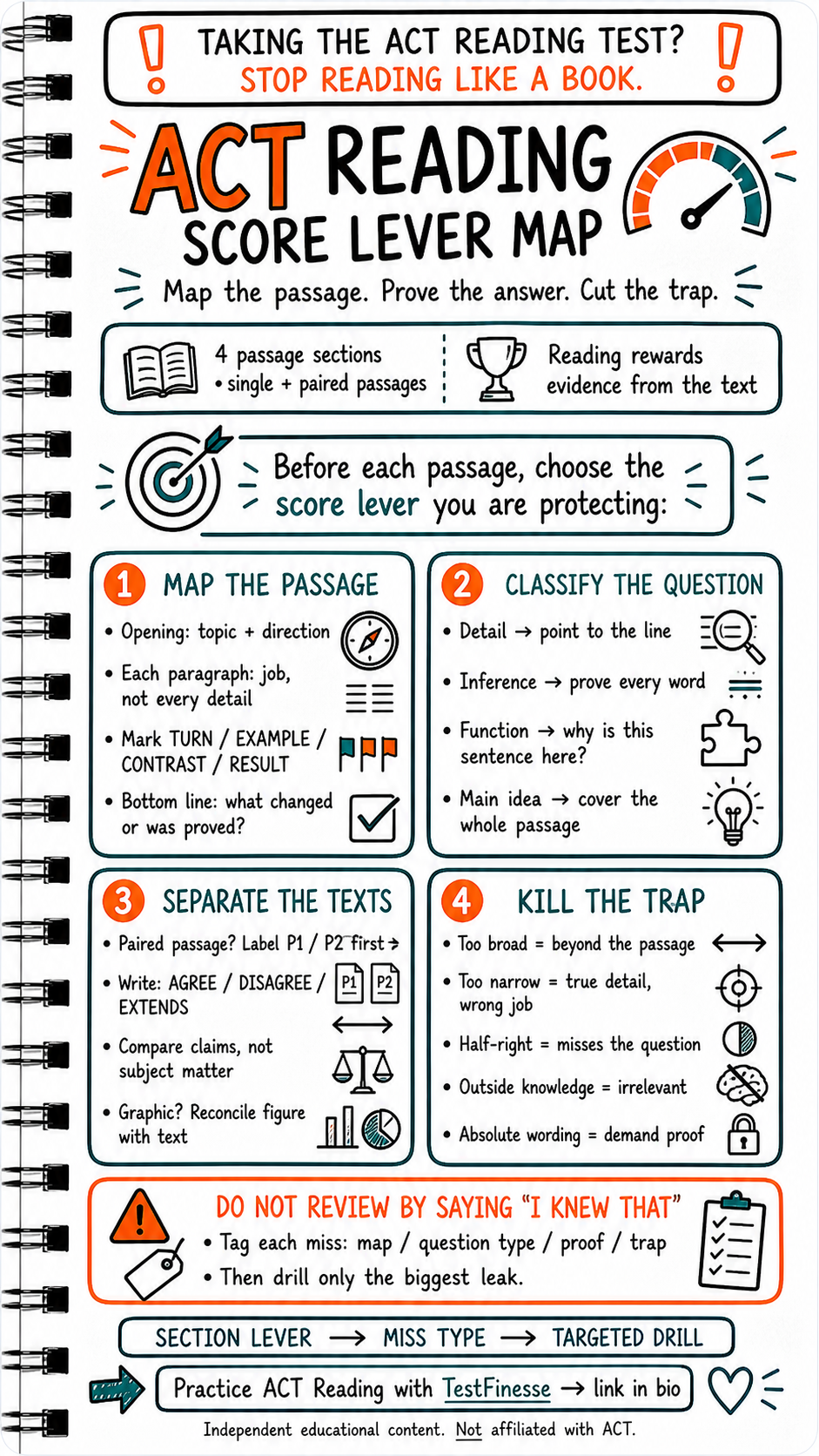
The ACT Reading section is not asking you to read every passage like a book.
You are not being tested on whether you can remember every detail, appreciate every sentence, or form an opinion about the topic. You are being tested on whether you can locate evidence, understand the author’s purpose, follow relationships between ideas, and choose an answer that the passage actually supports.
That requires a different approach.
The goal is not to read more slowly or memorize more details. The goal is to make better decisions with the text in front of you.
Map the passage. Classify the question. Prove the answer. Cut the trap.
Know the Current ACT Reading Structure
The current ACT Reading section has 36 questions and 40 minutes. ACT describes the section as measuring close reading, logical reasoning, and the ability to integrate information from multiple sources. The enhanced ACT also includes embedded field-test questions, so not every item necessarily contributes to the reported score.
The exact passage mix and administration details can vary by test form and administration. Use current official ACT materials when practicing rather than assuming that every practice test will have identical passage patterns.
That means your strategy should be flexible enough to work across literary, social science, humanities, natural science, single-passage, and paired-passage questions.
Before Each Passage, Choose the Score Lever
Before you begin, decide what you are protecting on that passage.
Are you trying to protect:
Accuracy on detail questions?
Evidence discipline on inference questions?
Time by avoiding over-reading?
Comparison accuracy on paired passages?
Main-idea accuracy after a dense or unfamiliar topic?
This creates a specific objective. Instead of vaguely trying to “do well,” you enter the passage with a decision system.
1. Map the Passage
You do not need to write a summary of every paragraph. You need to understand what each part is doing.
Start with the opening:
What is the broad topic?
What direction does the passage take?
Is the author introducing a problem, defending a view, describing a discovery, or comparing ideas?
Then label each paragraph by function. A paragraph may provide:
Background
Evidence
An example
A contrast
A shift in the author’s position
A result or consequence
A criticism or response
Watch for transition signals such as however, although, instead, for example, therefore, in contrast, and as a result. These words often reveal the passage’s structure.
Your notes should be short enough to help you return to the text quickly. For example:
P1: background
P2: old theory
P3: evidence against it
P4: new explanation
P5: result
Map the author’s movement, not every sentence.
2. Classify the Question
Different question types require different proof.
Detail Questions
A detail question usually points you toward a specific line or paragraph. Return to the text and confirm the answer directly.
Do not choose based on memory alone. The answer may depend on a small qualifier, comparison, or exception.
Inference Questions
An inference must be supported by the passage even if the exact answer is not written word-for-word.
For every answer choice, ask:
Can I point to the evidence?
Does the choice follow from the text?
Am I adding outside knowledge?
Is the wording stronger than what the passage supports?
The correct inference is usually defensible and restrained. It does not require you to invent a new claim.
Function Questions
Function questions ask why a sentence, example, paragraph, or detail appears where it does.
Do not answer with a description of what the sentence says. Explain its job.
A sentence may:
Introduce a problem
Provide evidence
Give an example
Challenge an earlier claim
Clarify a technical idea
Shift the discussion
Support the author’s conclusion
Main Idea Questions
The main idea must cover the passage as a whole. A choice that describes only one paragraph may be accurate but still too narrow.
Ask: Does this answer explain the author’s overall job?
3. Separate Paired Passages
When the ACT gives you two related texts, label them immediately:
P1
P2
Then identify the relationship:
Agree
Disagree
Extend
Qualify
Apply the same idea differently
Paired-passage questions are not simply asking whether the texts discuss the same subject. They are asking how their claims relate.
Create a quick comparison:
Passage 1Passage 2Main claimMain claimEvidence usedEvidence usedAttitude or toneAttitude or toneAgreement or conflictAgreement or conflict
If a graphic or data display appears, reconcile it with the written passage. Do not treat the visual as separate from the text. Ask what the figure confirms, complicates, or contradicts.
Compare claims, not just topics.
4. Cut the Answer Traps
ACT Reading wrong answers often look attractive because they are partly true.
Watch for these traps:
Too broad: Goes beyond what the passage establishes.
Too narrow: Describes a true detail but misses the question’s actual job.
Half-right: Contains one supported idea and one unsupported idea.
Outside knowledge: Sounds reasonable in real life but is not proven by the passage.
Absolute language: Uses words such as always, never, completely, or only without direct support.
Wrong function: Describes what a sentence says rather than why it is included.
Before selecting an answer, match the choice to the question type. A detail question needs line evidence. A function question needs a role. A main-idea question needs passage-wide coverage. An inference question needs proof for every important part of the choice.
Review Misses by Type
Do not review a missed question by writing, “I knew that.”
That statement does not explain what went wrong.
Instead, label each miss:
Map: I misunderstood the passage structure.
Question type: I used the wrong approach.
Proof: I did not verify the answer in the text.
Trap: I chose a broad, narrow, extreme, or half-right answer.
Timing: I rushed or spent too long on one item.
Then drill the largest category first.
If most misses are function questions, practice identifying paragraph jobs. If most are inference questions, require yourself to underline proof for every answer. If most are timing misses, practice shorter passage maps and set checkpoints.
Use The TestFinesse Practice Loop
Apply the TestFinesse method to ACT Reading:
Answer the question under realistic timing.
Explain the passage evidence and the answer choice’s job.
Reveal the official reasoning.
Fix the gap by labeling the miss and writing one rule for next time.
A useful rule might be:
“For inference questions, prove every word.”
“For main idea, cover the entire passage.”
“For paired passages, compare claims, not topics.”
“For function questions, explain why the sentence is there.”
“For extreme wording, demand direct proof.”
Then complete a short targeted drill using fresh questions.
Final Takeaway
ACT Reading rewards disciplined evidence use. You do not need to memorize every passage or read like you are studying a novel.
You need a repeatable system:
Map the passage. Classify the question. Prove the answer. Cut the trap.
Independent educational content. Not affiliated with ACT.
Accuracy sources checked: ACT Exam Sections, Structure & Timing, ACT Information for Examinees, ACT Test Enhancements for Higher Education
Keep studying
Practice Exam Skills
Turn this into a better score
Reading about a skill only gets you so far. TestFinesse's AI coach walks you through exam questions, explains exactly where your reasoning breaks down, and adapts to what you actually need to practice next.
Explore All Exams