ACT Question Triage Map: Commit, Mark, and Move Without Losing Points
Last updated September 1, 2026
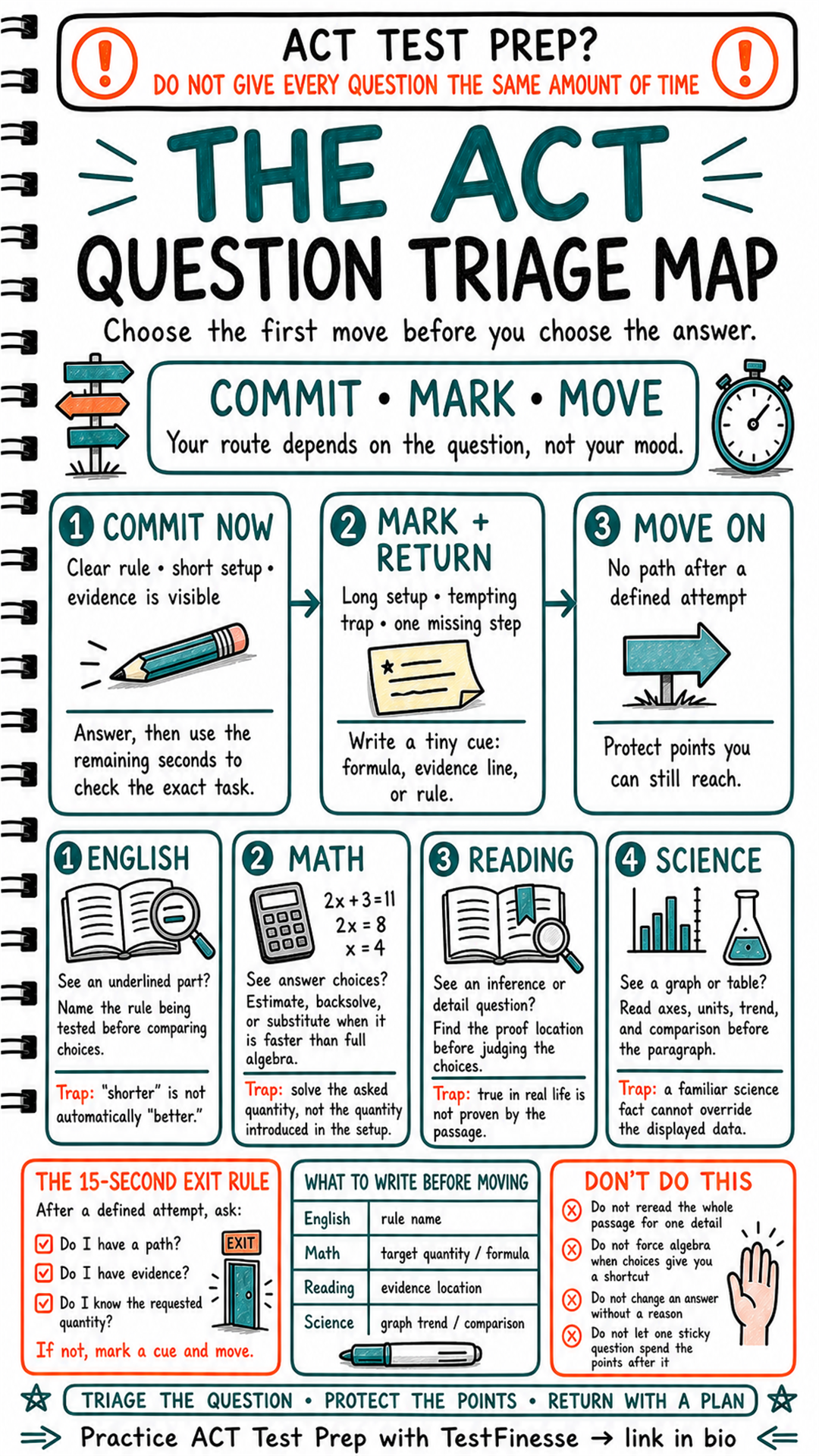
The ACT does not reward giving every question the same amount of time.
Some questions have a clear rule, a short setup, or visible evidence. Others contain a long calculation, a tempting trap, or one missing step that may consume too much time.
The goal is not to rush through everything. The goal is to make a deliberate decision about where your time is most likely to produce a point.
The core framework is:
Commit → Mark → Move
Your route depends on the question, not your mood.
Why Question Triage Matters
A difficult question can become expensive when you keep trying the same approach after the path has stopped being productive. You may spend several minutes protecting one uncertain answer while leaving easier points unanswered.
Triage gives you a stopping rule.
You are asking:
Is the task clear?
Is the evidence visible?
Do I have a workable path?
Do I know what quantity or rule the question is asking for?
Would another 20 seconds likely help?
If I leave now, what cue will help me return?
This is not an excuse to abandon hard questions. It is a way to protect points you can still reach.
1. Commit Now
Commit when the question has:
A clear rule
A short setup
Visible evidence
A manageable calculation
A confident elimination path
Answer the question, then use the remaining seconds to check the exact task. That last check matters because many avoidable errors happen when students solve a nearby problem instead of the one on the page.
Before moving on, verify:
Did I answer what was asked?
Did I use the correct unit?
Did I read the underlined portion correctly?
Did I use the passage or graph evidence?
Did I copy the numbers accurately?
Did I select the intended quantity?
Commit does not mean careless. It means the path is clear enough to finish.
2. Mark And Return
Mark the question when the setup is long, the answer choices create a shortcut, or one specific step is missing.
Examples include:
A multi-step math problem
An English question with several plausible punctuation choices
A reading question requiring proof from multiple lines
A science question with a dense graph or table
A question where you know the topic but cannot yet identify the exact task
Before leaving, write a tiny cue if the testing interface or your practice method allows it:
Formula
Evidence line
Rule name
Target quantity
Graph trend
One unresolved step
The cue should help you restart quickly. “Hard” is not a useful cue. “Find the denominator” or “compare paragraph 2 with paragraph 4” is much better.
Marking is a decision, not a failure. You are preserving the question while protecting the rest of the section.
3. Move On
Move on when there is no productive path after a defined attempt.
A defined attempt might mean:
You identified the task but cannot establish a method.
You tested the obvious formula and it does not fit.
You searched the passage but cannot locate supporting evidence.
You cannot determine what the graph’s axes represent.
You are repeating the same calculation without learning anything new.
You are stuck between choices without a defensible reason.
Moving on protects points you can still earn.
Do not turn one sticky question into a section-wide time problem. Leave a cue, continue, and return if time remains.
The move is not “give up.” The move is:
Protect the points that are still available.
English: Name The Rule Before Comparing Choices
English questions often place several answers that sound acceptable beside an underlined section.
Do not choose based only on which version sounds smoother. First identify the rule:
Subject-verb agreement
Pronoun reference
Modifier placement
Parallel structure
Verb tense
Sentence boundaries
Commas and punctuation
Concision and relevance
Organization or transition
If you see an underlined phrase, ask:
What rule is this question testing?
Then compare only the choices that follow that rule.
A common trap is treating “shorter” as automatically better. Concision matters only when the shorter choice preserves meaning, grammar, and the sentence’s purpose.
Rule first, answer choice second.
Math: Identify The Target Quantity
Math questions often become slower because students begin solving before defining what the problem wants.
Before calculating, circle or mentally identify:
The unknown
The unit
The relationship
The quantity introduced by the setup
The answer choice format
The answer choices may allow a shortcut such as:
Estimating
Backsolving
Substituting values
Testing a simple case
Eliminating impossible results
Do not force full algebra when the choices provide a faster valid route. At the same time, do not use a shortcut that answers the wrong quantity.
For example, a setup may introduce a variable for one part while the question asks for the total. A correct equation can still produce the wrong answer if the target is not defined.
Know what you are solving for before you solve.
Reading: Find Proof Before Judging Choices
Reading questions reward evidence from the passage.
For detail questions, return to the relevant line. For inference questions, prove every part of the answer from the text. For main-idea questions, make sure the choice covers the passage rather than one interesting paragraph.
Common traps include:
Choosing what is true in real life but not proven by the passage
Selecting a detail that answers a different question
Picking an answer that is too broad
Choosing a statement that is only half-supported
Relying on memory instead of returning to the text
If the question asks for an inference, your answer should be a reasonable conclusion supported by the passage, not an outside fact.
Find the proof location before judging the choices.
Science: Read The Display Before The Paragraph
Science questions often provide graphs, tables, diagrams, or experimental results. Read the display before interpreting the surrounding description.
Check:
Axis labels
Units
Scale
Legend
Independent variable
Dependent variable
Direction of the trend
Comparisons between groups
Exceptions or outliers
A familiar science fact cannot override the data shown in the question. If the graph displays a result that differs from what you expected, answer from the displayed evidence.
For experimental passages, identify:
What changed
What was measured
What stayed constant
Which group was compared
What conclusion the data support
Display first, interpretation second.
The 15-Second Exit Rule
After a defined attempt, ask:
Do I have a path?
Do I have evidence?
Do I know the requested quantity or rule?
If the answer is no, mark a cue and move.
Your cue can be section-specific:
SectionCue to writeEnglishRule nameMathTarget quantity or formulaReadingEvidence locationScienceGraph trend or comparison
This turns a vague return into a planned return.
Avoid These ACT Timing Traps
Do not:
Reread an entire passage for one detail.
Force algebra when the answer choices offer a valid shortcut.
Change an answer without new evidence.
Choose a science answer because the fact sounds familiar.
Spend the rest of the section on one sticky question.
Keep repeating the same failed approach.
Read answer choices before identifying the task.
Give every question the same time simply because it appears in the same section.
The correct amount of time depends on the question’s path, not its position.
Use The TestFinesse Practice Loop
Practice triage as deliberately as you practice content.
Answer: Commit, mark, or move based on the question’s structure.
Explain: State why you chose that route.
Reveal: Compare your decision with the solution and timing.
Fix the gap: Write one rule for the next similar question.
Examples:
“If the English question has an underlined phrase, identify the grammar rule first.”
“If the math choices make estimation possible, test the target before doing full algebra.”
“If the reading question asks for detail, locate the proof line.”
“If the science question includes a graph, read axes and units before the paragraph.”
“After a defined attempt without a path, leave a cue and move.”
Then practice with a timed mixed set. Track not only whether you were correct, but whether you made the right triage decision.
Final Takeaway
The ACT question is not asking you to prove that you can suffer through every problem.
It is asking you to make good decisions with limited time.
Commit when the path is clear. Mark when one step is missing. Move when the attempt stops producing progress. Return with a cue, not with panic.
Triage the question. Protect the points. Return with a plan.
Independent educational content. Not affiliated with ACT or any exam provider.
Keep studying
Practice Exam Skills
Turn this into a better score
Reading about a skill only gets you so far. TestFinesse's AI coach walks you through exam questions, explains exactly where your reasoning breaks down, and adapts to what you actually need to practice next.
Explore All Exams