5 Standardized Exam Tricks to Avoid: Replace Test Superstition With Evidence
Last updated August 23, 2026
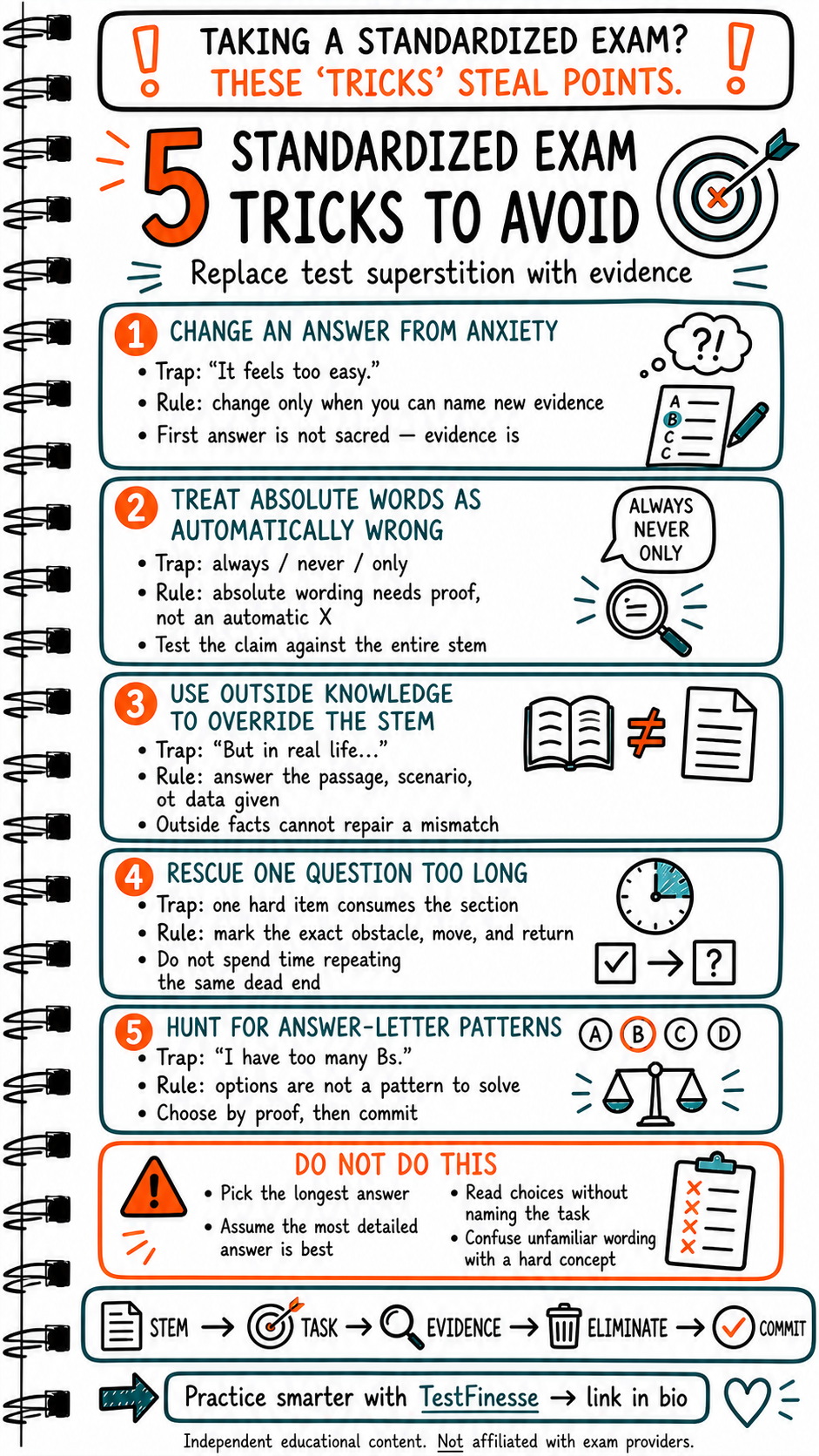
Standardized exams are challenging enough without adding imaginary rules to the decision process.
Many students have heard advice such as:
“Never change your first answer.”
“Answers with always or never are automatically wrong.”
“Choose the longest answer because it has more detail.”
“If there are too many B answers, one must be wrong.”
“You have to finish every question before moving on.”
These rules feel helpful because they create certainty. But standardized exams are not solved by superstition. They are solved by matching the task, evidence, and constraints of the question in front of you.
The better strategy is simple:
Stem → task → evidence → eliminate → commit
This framework keeps you anchored to the information the test actually provides.
1. Do Not Change an Answer From Anxiety
One of the most common traps is changing an answer because it “feels too easy.”
That feeling is not evidence. It may come from test anxiety, unfamiliar wording, fatigue, or the mistaken belief that difficult questions must have complicated answers.
The first answer is not sacred, but it is not automatically suspicious either.
Change an answer only when you can identify:
A fact in the stem you overlooked
A calculation or logic error
A misread command word
A constraint that changes the answer
A stronger piece of evidence supporting another choice
The key question is:
What new evidence changed my mind?
If the answer is only “I became nervous,” keep reviewing the choices instead of changing randomly. If you can clearly identify a mistake in your original reasoning, change the answer confidently.
Practice rule
After every changed answer during practice, write one short explanation:
“I changed because I found ______.”
If you cannot complete that sentence with specific evidence, the change was probably anxiety-driven.
2. Do Not Treat Absolute Words as Automatic Wrong Answers
Words such as always, never, only, completely, and must can make an answer choice look suspicious. Sometimes that suspicion is justified. Absolute claims often require strong, complete support.
But absolute wording is not an automatic reason to eliminate an answer.
The correct approach is to test the entire claim against the stem.
Ask:
Does the passage or scenario support the absolute language?
Is the question asking about a rule that genuinely has no exceptions?
Does the choice accurately describe the full situation?
Is the answer too broad for the evidence provided?
For reading and reasoning exams, an answer with extreme wording often fails because it goes beyond what the text proves. But the word itself is not the proof. The mismatch between the wording and the evidence is what matters.
Practice rule
Do not mark every absolute answer as wrong. Mark it as high scrutiny.
Then look for direct support or a counterexample in the stem.
3. Do Not Use Outside Knowledge to Override the Stem
Outside knowledge can be useful for understanding vocabulary or recognizing a familiar concept. It becomes a problem when it causes you to ignore the information the test gave you.
A standardized question is testing your ability to apply the stated material under stated conditions. The correct answer may depend on:
A definition provided in the passage
A special assumption in the scenario
A data table or graph
A fictional rule
A specific patient, client, or case detail
A narrow question purpose
The thought “But in real life…” is a warning to return to the stem.
Outside facts cannot repair an answer that does not match the task. A choice can be true in general and still be wrong for the question.
Use this distinction
Helpful background knowledge: Helps you understand the given information.
Unhelpful outside knowledge: Replaces the given information with your own assumptions.
Practice rule
Before choosing an answer, point to the line, number, condition, or fact that supports it.
If you cannot identify support in the material, ask whether you are answering from evidence or from memory.
4. Do Not Let One Question Consume the Section
A difficult question can create a false sense of obligation. You may feel that leaving it means you are giving up. In reality, spending too long at one dead end can cost points on questions you could have answered.
The goal is not to rescue every question immediately. The goal is to protect the total section.
When you are stuck:
Identify the exact obstacle.
Eliminate choices you can confidently reject.
Mark the question according to the exam’s rules.
Move forward.
Return only if time remains.
Do not spend several minutes repeating the same failed approach. If the issue is a formula, mark the missing relationship. If the issue is wording, identify the unclear phrase. If the issue is a long passage, write down the specific question task.
This makes your return more efficient.
Better time-management question
Instead of asking, “Can I solve this right now?” ask:
“Is another minute here more valuable than a minute on an unanswered question?”
The answer will depend on the exam’s scoring rules and navigation policy, so always follow the official instructions for your test.
5. Do Not Hunt for Answer-Letter Patterns
A run of B, C, or D answers does not prove that you are making mistakes. Correct answers do not need to alternate or distribute evenly across letters.
Answer choices are not a pattern puzzle.
Looking for letter balance creates several problems:
It encourages you to change answers without evidence.
It distracts you from the question’s actual content.
It can make correct answers feel suspicious.
It consumes time during an already pressured section.
Choose the answer supported by the stem, not the answer that makes your answer sheet look balanced.
Practice rule
When you feel tempted to change an answer because “there are too many Bs,” force yourself to state the evidence for the new choice. If you cannot, keep the evidence-supported answer.
The Bigger Trap: Confusing Unfamiliar With Difficult
Unfamiliar wording can make a simple concept feel advanced. A new scenario can make a familiar rule feel unavailable. A long answer can appear more authoritative than a short one.
Before reacting, separate the surface from the task.
Ask:
What is the question asking me to do?
What information is actually relevant?
What evidence supports each remaining answer?
Which choice answers the task without adding assumptions?
This process prevents you from confusing presentation difficulty with concept difficulty.
Use the TestFinesse Practice Loop
Turn these traps into measurable practice skills:
Answer: Choose the option you currently support.
Explain: State the task and the evidence behind your choice.
Reveal: Review the explanation or correct answer.
Fix the gap: Record the specific trap, then practice a new question with the same decision type.
Your error log can include:
Anxiety change
Absolute-word overreaction
Outside-knowledge mismatch
Timing failure
Answer-pattern superstition
Misread task
Weak evidence comparison
The goal is not to eliminate uncertainty completely. It is to make your decisions depend more on evidence than on nervous predictions.
Final Takeaway
Standardized exams do not reward the answer that feels safest, longest, most familiar, or most evenly distributed across the answer sheet.
They reward the answer that best matches the task and evidence.
Stem → task → evidence → eliminate → commit
Use that sequence consistently, and replace test superstition with a process you can actually defend.
Independent educational content. Not affiliated with any exam provider. Always follow your specific exam’s official rules for timing, navigation, answer changes, and scoring.
Keep studying
Practice Exam Skills
Turn this into a better score
Reading about a skill only gets you so far. TestFinesse's AI coach walks you through exam questions, explains exactly where your reasoning breaks down, and adapts to what you actually need to practice next.
Explore All Exams