10 Test Stress Reducers That Actually Work: How to Stay Calm by Pre-Deciding Your Next Move
Last updated August 9, 2026
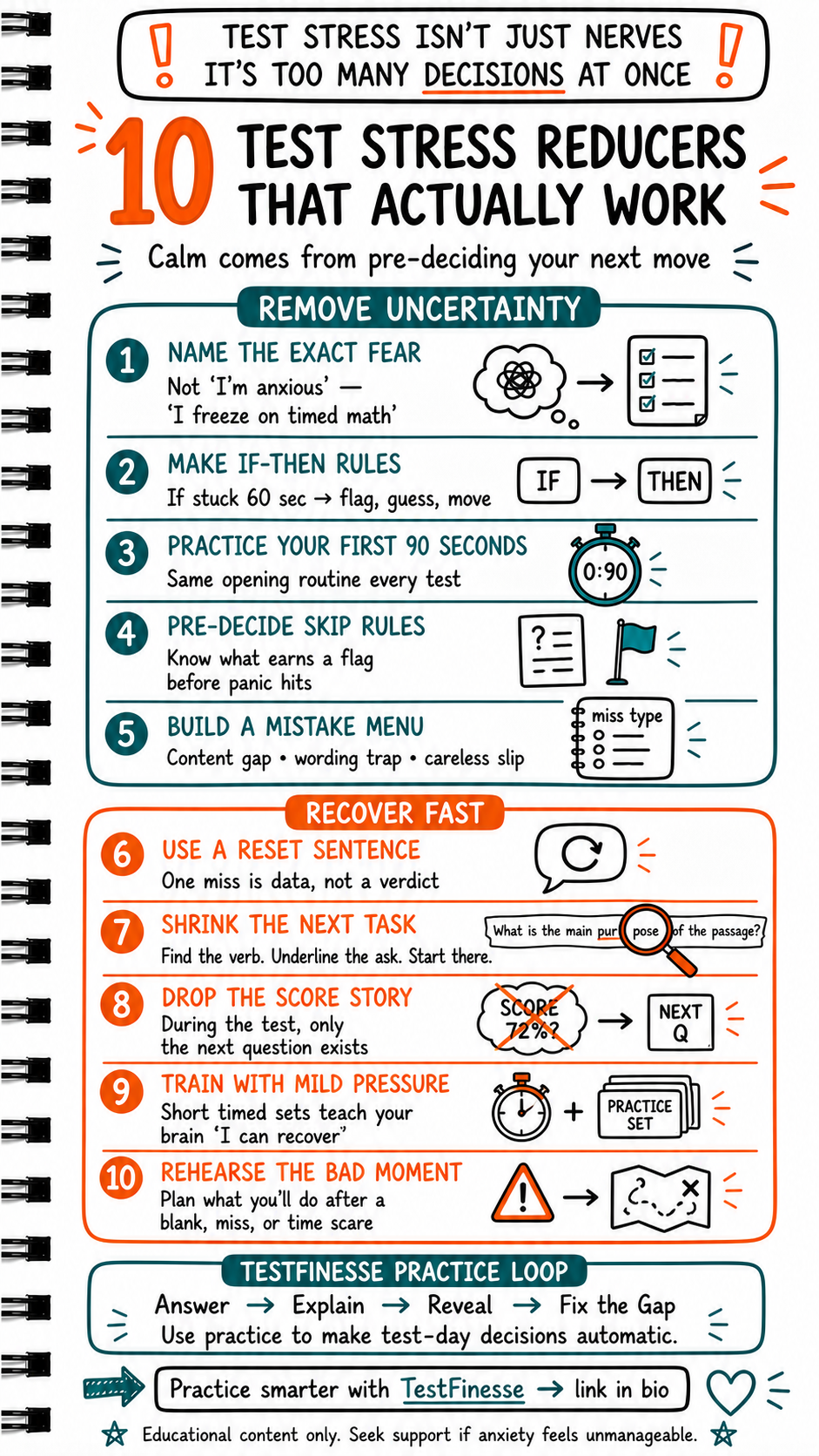
Test stress is not just nerves.
For many students, test stress happens because the brain is trying to manage too many decisions at once.
You are trying to read the question, understand the wording, remember the content, watch the clock, avoid mistakes, choose an answer, and predict your score all at the same time.
That is a lot.
When the pressure rises, your brain does not need a motivational quote. It needs a plan.
The goal is not to eliminate every feeling of stress. The goal is to reduce uncertainty so your next move feels clear.
That is why the best test stress reducers are not vague advice like “just relax” or “try not to worry.” They are specific routines you can practice before test day.
Calm comes from pre-deciding your next move.
Why Test Stress Gets Worse During The Exam
Stress grows when the brain sees too many open loops.
Open loops sound like:
What if I run out of time?
What if I blank?
What if I miss an easy question?
What if I do worse than last time?
Should I skip this one or keep trying?
Should I guess now or come back later?
Each of those questions uses mental energy.
The more decisions you leave for test day, the more pressure your brain has to carry during the test.
That is why strong test-takers do not rely only on knowledge. They also rely on pre-made rules.
They already know what they will do when they get stuck. They already know when to skip. They already know how to reset after a mistake. They already know how to start the first question.
This does not make the test easy, but it makes the test more manageable.
Remove Uncertainty Before Panic Hits
The first five stress reducers are about removing uncertainty. They help you make decisions before the test, so you are not trying to invent a strategy while stressed.
1. Name The Exact Fear
Do not stop at:
“I’m anxious.”
That is too general to fix.
Instead, name the exact fear.
For example:
“I freeze on timed math.”
“I panic when I see a long reading passage.”
“I lose focus after one hard question.”
“I rush when I see the timer.”
“I second-guess myself on answer choices.”
The more specific the fear is, the easier it is to build a response.
A vague fear feels huge. A specific fear becomes a problem you can plan for.
Ask yourself:
“What exactly do I worry will happen during the test?”
Then write the answer in plain language.
That sentence becomes the starting point for your strategy.
2. Make If-Then Rules
An if-then rule turns a stressful moment into a pre-decided action.
Instead of thinking from scratch during the test, you follow the rule.
Examples:
If I am stuck for 60 seconds, then I flag, guess, and move.
If I reread the same sentence twice, then I underline the verb and task.
If I feel panic rising, then I take one slow breath and restart the question.
If two answers look correct, then I find evidence for each one.
If I cannot solve it cleanly, then I eliminate what I can and move on.
This works because stress often comes from not knowing what to do next.
An if-then rule gives your brain a next step before panic gets louder.
3. Practice Your First 90 Seconds
The beginning of a test matters.
If the first minute feels chaotic, your brain may treat the whole test like an emergency.
That is why you should practice the same opening routine every time.
Your first 90 seconds might look like this:
Take one slow breath.
Read the directions carefully.
Check the number of questions and time.
Start with the first manageable task.
Underline the command verb in the first question.
The routine should be simple enough to repeat even when nervous.
You are training your brain to recognize:
“I know how to begin.”
That one feeling can lower the pressure.
4. Pre-Decide Skip Rules
Skipping is not failure. Skipping is time management.
The problem is that many students wait until panic hits before deciding whether to move on. By then, the decision feels emotional instead of strategic.
Create skip rules before the test.
For example:
If I am stuck after 60-90 seconds, I flag and move.
If I do not understand what the question is asking, I rewrite the stem once, then move if it is still unclear.
If a question is taking too long but I know the process, I mark it and return later.
If I eliminate two answers but feel unsure, I choose the best remaining answer and keep going.
A skip rule protects your time.
It also protects your confidence because you are not “giving up.” You are following a plan.
5. Build A Mistake Menu
Not every mistake means the same thing.
If you treat every missed question as proof that you are bad at the subject, your stress will grow. Instead, sort mistakes into categories.
A simple mistake menu might include:
Content gap: I did not know the concept.
Wording trap: I misunderstood the question.
Careless slip: I knew it but rushed or missed a detail.
Time pressure mistake: I panicked because the clock felt too close.
Evidence mistake: I chose an answer without enough support.
This helps you respond correctly.
A content gap needs review. A wording trap needs question-language practice. A careless slip needs a checklist. A time pressure mistake needs timed practice.
Better diagnosis creates better studying.
Recover Fast During The Test
The next five stress reducers are about recovery. Mistakes happen. Hard questions happen. Blank moments happen.
The goal is not to avoid every bad moment.
The goal is to recover quickly.
6. Use A Reset Sentence
After a miss, a blank, or a hard question, your brain may start telling a story:
“I’m failing.”
“I always mess this up.”
“Now the whole test is ruined.”
A reset sentence interrupts that spiral.
Try one of these:
“One miss is data, not a verdict.”
“The next question is separate.”
“I can recover from this.”
“My job is the next step.”
“Flag it and keep moving.”
The sentence should be short, believable, and easy to repeat.
You are not pretending everything is perfect. You are reminding your brain that one moment does not decide the whole test.
7. Shrink The Next Task
When stress gets big, make the task smaller.
Do not tell yourself:
“I have to finish this whole section.”
That is too much pressure.
Instead, shrink the next task:
Find the verb.
Underline the ask.
Circle the numbers.
Eliminate one answer.
Read the first sentence.
Write the formula.
Choose the next best step.
Small actions restart momentum.
When your brain feels frozen, the question is not “How do I solve everything?” The question is:
“What is the next tiny move?”
Start there.
8. Drop The Score Story
During the test, the score does not exist yet.
Only the next question exists.
Score stories sound like:
“I probably already failed.”
“I need every question right now.”
“If I miss this, my score is ruined.”
“Everyone else is doing better than me.”
These thoughts feel urgent, but they do not help you answer the question in front of you.
A better test-day rule is:
During the test, I do not calculate my score. I work the next question.
You can review performance after the test. During the test, score prediction is usually just stress wearing a costume.
Bring your attention back to the next task.
9. Train With Mild Pressure
If you only practice in calm conditions, test day can feel like a shock.
You do not need extreme pressure. You need mild, controlled pressure.
Try:
Short timed sets
Five-question sprints
One passage with a timer
Mixed review instead of only one topic
Practice after a short break, not only when you feel perfectly ready
The point is not to scare yourself.
The point is to teach your brain:
“I can recover under pressure.”
Timed practice should be short enough to be useful and challenging enough to feel real.
Over time, your brain learns that pressure is uncomfortable but manageable.
10. Rehearse The Bad Moment
Most students only visualize success.
That can help, but it is not enough.
You also need to rehearse what you will do after a bad moment.
Plan for:
A blank
A careless miss
A question you do not understand
A sudden time scare
A passage that feels too hard
Two answer choices that both seem right
For example:
If I blank, I will pause, breathe once, write what I do know, and look for the first usable clue.
Or:
If I realize I spent too long on one question, I will choose the best answer, flag it, and move forward.
Rehearsing the bad moment makes it less surprising.
And when it is less surprising, it is easier to recover.
Use The TestFinesse Practice Loop
The TestFinesse practice loop is:
Answer
Explain
Reveal
Fix the gap
This loop is powerful because it turns practice into decision training.
Do not only ask:
“Did I get it right?”
Ask:
What decision did I make?
Where did I hesitate?
What did I do when I felt unsure?
Did I follow my skip rule?
Did I recover after a miss?
What should I do next time?
The goal is to make test-day decisions automatic.
The more decisions you automate during practice, the fewer decisions your brain has to manage during the real exam.
Final Takeaway
Test stress is not a sign that you are weak.
Often, it is a sign that your brain is carrying too many undecided moves at once.
The solution is to reduce uncertainty before test day and recover faster during the test.
Start with these habits:
Name the exact fear
Create if-then rules
Practice your first 90 seconds
Pre-decide skip rules
Build a mistake menu
Use a reset sentence
Shrink the next task
Drop the score story
Train with mild pressure
Rehearse the bad moment
You do not need to feel perfectly calm to perform well.
You need a next move.
When your next move is already decided, test stress has less room to take over.
Keep studying
Practice Exam Skills
Turn this into a better score
Reading about a skill only gets you so far. TestFinesse's AI coach walks you through exam questions, explains exactly where your reasoning breaks down, and adapts to what you actually need to practice next.
Explore All Exams