10 ADHD Study Tips That Actually Work for Test Prep
Last updated August 9, 2026
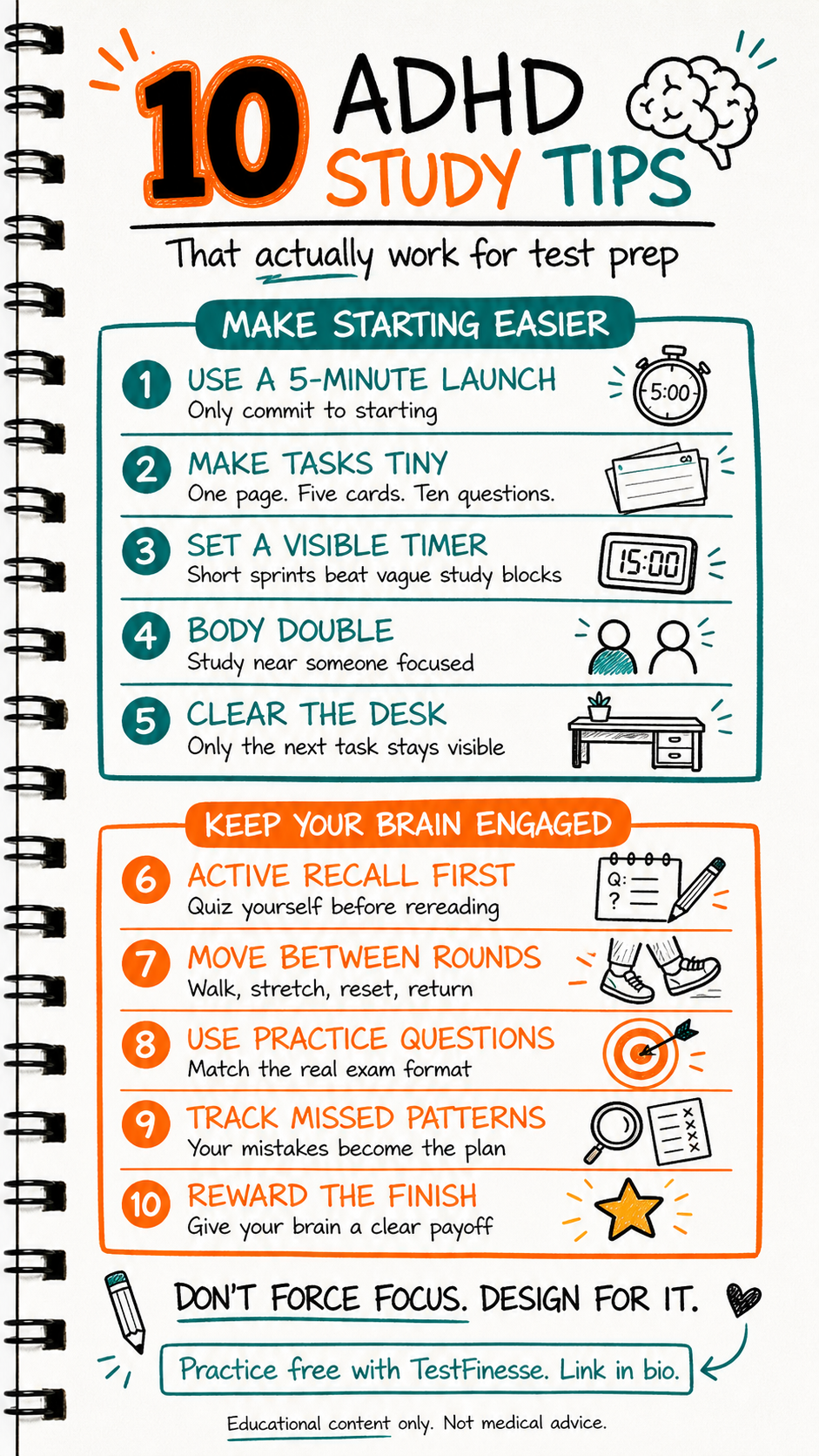
Studying with ADHD can feel frustrating because the problem is not always understanding the material.
Sometimes the harder part is starting, staying with the task, remembering what to do next, or coming back after getting distracted.
That is why generic advice like “just focus” usually does not help.
ADHD can affect attention, organization, time management, follow-through, and impulse control. For test prep, that means the best study plan is not the one that looks perfect on paper. It is the one that makes focus easier to access.
You do not need to force focus.
You need to design for it.
Make Starting Easier
For many students with ADHD, starting is the hardest part of studying.
The task feels too big. The deadline feels either far away or suddenly urgent. The materials are scattered. The brain wants stimulation, but the study task feels boring or overwhelming.
So the first goal is not to study for three hours.
The first goal is to start cleanly.
1. Use A 5-Minute Launch
Do not begin by committing to a full study session.
Commit to starting.
Set a timer for 5 minutes and choose one tiny action:
Open the practice set
Answer one question
Review one missed problem
Make five flashcards
Read one page
Write one formula
Organize one topic list
The 5-minute launch works because it lowers the pressure.
Your brain does not have to agree to a huge task. It only has to agree to beginning.
After five minutes, you can decide whether to continue. Many times, starting creates enough momentum to keep going.
2. Make Tasks Tiny
Big tasks are hard to start because they hide too many decisions.
“Study science” is vague.
“Do five anatomy flashcards” is clear.
Make the task small enough that you know exactly what to do.
Examples:
One page
Five cards
Ten questions
One passage
Three missed problems
One formula group
One grammar rule
Tiny tasks are not weak. They are strategic.
A small task gives your brain a clear target and a fast win. That matters when motivation is low or the task feels boring.
3. Set A Visible Timer
Time can feel slippery with ADHD.
A visible timer makes time concrete.
Instead of saying, “I’ll study for a while,” say:
15-minute sprint
10-question round
20-minute review block
5-minute reset
Short sprints beat vague study blocks because they create a beginning and an end.
Try this structure:
Set the timer
Do one focused task
Stop when the timer ends
Take a short reset
Start another round if useful
A visible timer also helps prevent two common problems:
Studying for too long and burning out
Avoiding the task because it feels endless
4. Body Double
Body doubling means working near another focused person.
They do not have to teach you. They do not even have to be studying the same thing.
Their presence helps create structure.
Body doubling can look like:
Studying beside a friend
Joining a quiet virtual study room
Sitting near someone focused at a library
Using an accountability call
Joining a study group with a clear work block
The point is not socializing.
The point is external structure.
For some ADHD learners, being near someone else who is working makes it easier to begin and stay anchored.
5. Clear The Desk
A cluttered workspace creates extra decisions.
If everything is visible, everything competes for attention.
Before studying, clear the desk so only the next task stays visible.
Keep out:
The current question set
A pencil or keyboard
A timer
Scratch paper
One reference sheet if needed
Put away:
Extra books
Old notes
Unrelated tabs
Random papers
Phone notifications
Anything not needed for the next round
This is not about having a perfect workspace.
It is about reducing visual noise so your brain knows where to land.
Keep Your Brain Engaged
Once you start, the next challenge is staying engaged long enough to learn.
For ADHD test prep, passive studying often fails because it does not give the brain enough to do.
Rereading, highlighting, or watching videos can feel productive, but they may not create strong recall.
Use active methods instead.
6. Active Recall First
Active recall means trying to retrieve the answer before looking it up.
Instead of rereading your notes first, quiz yourself first.
Try:
Cover the answer and explain it
Write the formula from memory
Answer a question before reading the explanation
Name the rule before checking notes
Teach the idea out loud
Make a quick brain dump before reviewing
This matters because tests require retrieval.
You do not get points for recognizing an explanation after seeing it. You get points for pulling the skill out when the question appears.
A good rule:
Quiz yourself before rereading.
7. Move Between Rounds
Movement can help reset attention.
You do not need a long workout between study blocks. Short movement breaks are enough.
Try:
Walk for two minutes
Stretch
Refill water
Stand up
Shake out your hands
Do a short reset before returning
The key is to make the break intentional.
A reset break is different from disappearing into your phone for 30 minutes.
Use movement to clear the last round and prepare for the next one.
8. Use Practice Questions
For test prep, practice questions are essential because they match the real task.
Notes teach information.
Practice questions teach application.
Use questions to find out:
Can I recognize what the question is asking?
Can I retrieve the rule?
Can I apply it under time pressure?
Can I avoid trap answers?
Can I explain why the right answer is right?
Practice questions are especially useful for ADHD learners because they create immediate engagement.
There is a task, a decision, and feedback.
That is much stronger than vague studying.
9. Track Missed Patterns
Your mistakes become the plan.
Do not only mark questions right or wrong.
Track the pattern behind the miss.
Common patterns include:
Content gap: I did not know the rule.
Wording trap: I misunderstood the question.
Careless slip: I knew it but rushed.
Focus drift: I lost the task halfway through.
Timing issue: I spent too long or guessed too fast.
Review gap: I recognized the explanation but could not do it alone.
Then write one fix.
Examples:
Next time, underline the command word first.
Next time, write the formula before using the calculator.
Next time, answer before reading the explanation.
Next time, do five similar questions tomorrow.
Missed-pattern tracking turns frustration into useful data.
10. Reward The Finish
ADHD brains often respond better when the payoff is clear.
Do not wait until the entire exam is over to reward effort.
Reward the finish of a study round.
Examples:
After 10 questions, take a 5-minute break
After one passage, make tea
After reviewing five misses, watch one short video
After a 20-minute sprint, check a message
After finishing the set, mark the scoreboard
The reward should be small, clear, and tied to completion.
This helps your brain understand:
Finish the round, then get the payoff.
Use The TestFinesse Practice Loop
For ADHD-friendly test prep, keep the learning loop simple:
Answer
Explain
Reveal
Fix the gap
This gives every question a clear structure.
Before checking the answer, ask:
What did I choose?
Why did I choose it?
How confident am I?
After revealing the answer, ask:
What was the question testing?
What caused the miss?
What is one rule for next time?
This keeps practice active and reduces the chance of drifting into passive review.
Final Takeaway
ADHD study success is not about forcing yourself to focus harder.
It is about designing a study system that makes focus easier to reach.
Use these 10 tips:
Use a 5-minute launch
Make tasks tiny
Set a visible timer
Body double
Clear the desk
Use active recall first
Move between rounds
Use practice questions
Track missed patterns
Reward the finish
Do not force focus.
Design for it.
Educational note: ADHD support can include behavioral strategies, school accommodations, coaching, therapy, and/or medication depending on the person. If ADHD symptoms are significantly interfering with school, work, or daily life, it is worth talking with a qualified healthcare professional or your school’s disability support office.
Accuracy sources checked: NIMH ADHD Overview, NIMH ADHD: What You Need to Know, CDC ADHD in the Classroom, and Understood ADHD Focus Tips.
Keep studying
Practice Exam Skills
Turn this into a better score
Reading about a skill only gets you so far. TestFinesse's AI coach walks you through exam questions, explains exactly where your reasoning breaks down, and adapts to what you actually need to practice next.
Explore All Exams