10 ACT Score Boosters: How to Study the Score Leak Instead of Studying Randomly
Last updated August 9, 2026
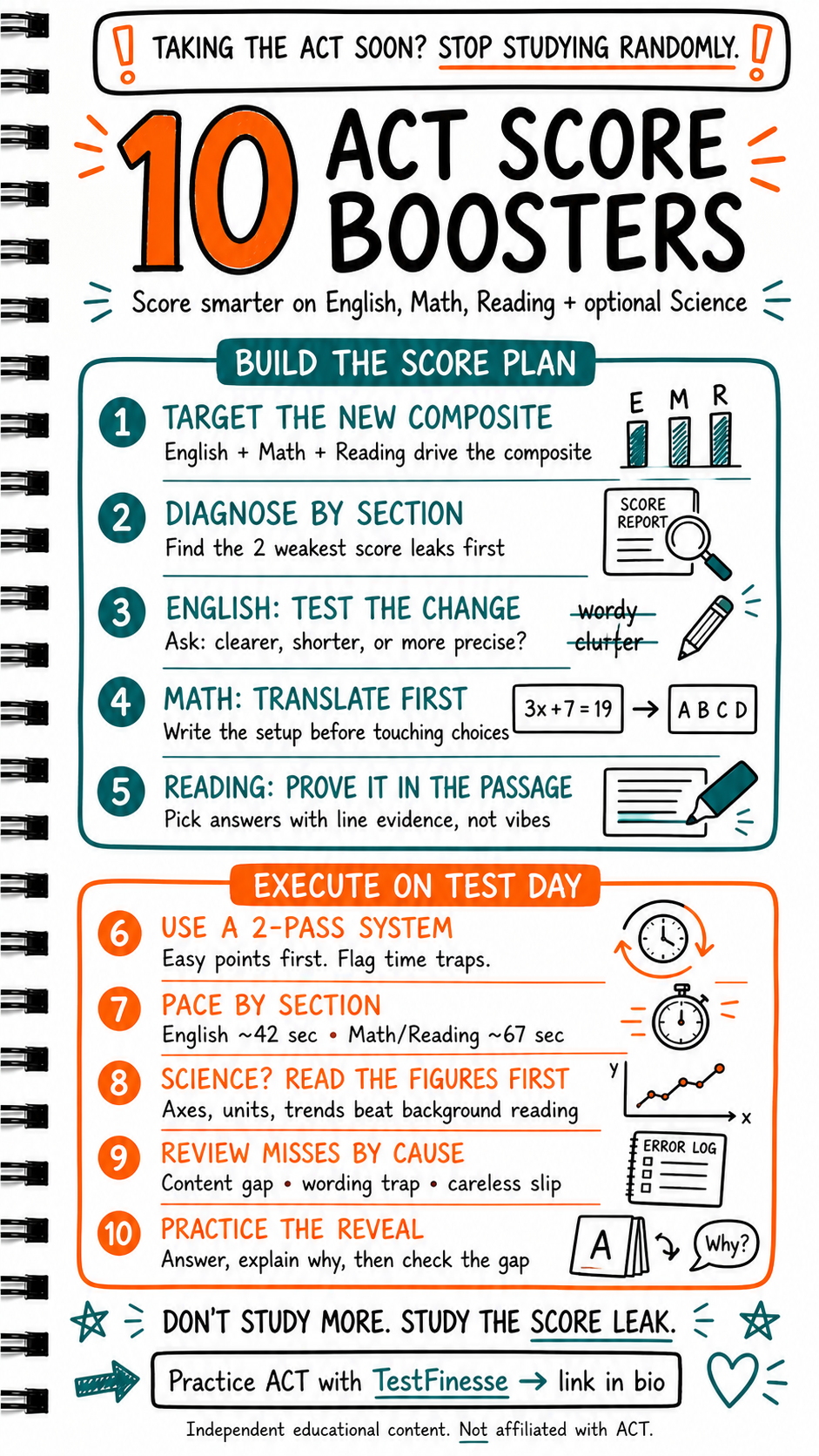
If you are taking the ACT soon, stop studying randomly.
More practice is not always better practice. A student can spend hours doing ACT questions and still miss the same grammar rule, math setup, reading trap, or pacing mistake again and again.
The fastest improvement usually comes from finding your score leak.
A score leak is the specific place where points keep escaping. It might be one section. It might be one question type. It might be timing. It might be careless mistakes. It might be the way you review.
The enhanced ACT makes this even more important because the Composite score is now based on English, Math, and Reading. Science is optional for ACT National testing and, if taken, is reported separately along with a STEM score.
That means your ACT score plan should be focused.
Do not study more.
Study the score leak.
Build The Score Plan
The first step is to stop treating the ACT like one giant test.
It is a set of sections with different timing, different skills, and different ways to lose points.
A strong ACT plan asks:
Which section affects my Composite most right now?
Which question types cost me the easiest points?
Where do I run out of time?
Where do I make careless mistakes?
Which misses are content gaps, wording traps, or process errors?
Once you know that, your studying becomes much more efficient.
1. Target The New Composite
The ACT Composite is now driven by:
English
Math
Reading
For enhanced ACT scoring, Science is no longer part of the Composite calculation. Students who take Science still receive a Science score, and Science can contribute to a STEM score with Math.
This matters because your score plan should match the scoring structure.
If your goal is to raise your Composite, your first question should be:
Which of English, Math, or Reading can move fastest?
For many students, English improves quickly because grammar and rhetoric patterns repeat. For others, Math improves fastest if they have a few clear content gaps. Reading often improves when students stop relying on vibes and start proving answers from the passage.
The key is to target the section that gives you the biggest realistic gain.
2. Diagnose By Section
Do not just say:
“I need to get better at ACT.”
That is too broad.
Break your score report or practice test into section leaks.
Ask:
English: Am I missing grammar rules, punctuation, sentence structure, or rhetorical strategy?
Math: Am I missing content, setup, formulas, or calculator decisions?
Reading: Am I missing evidence, main idea, inference, or time management?
Science, if taken: Am I missing figures, trends, experimental design, or conflicting viewpoints?
Then find your two weakest leaks first.
Not ten. Not everything.
Start with two.
Examples:
English punctuation + Reading evidence
Math word problems + Math functions
Reading timing + Science graph interpretation
English concision + Math geometry
A focused score plan beats random studying because it tells you exactly what to fix next.
3. English: Test The Change
ACT English is not about choosing the answer that sounds fancy.
It is about choosing the answer that makes the sentence clearer, shorter, more precise, and grammatically correct.
When an English question asks you to revise a phrase, test the change.
Ask:
Is this clearer?
Is this shorter without losing meaning?
Is this more precise?
Does it fit the sentence?
Does it create a grammar problem?
Does it match the tone and purpose?
ACT English often rewards concise writing. Wordy or repetitive answers are frequently wrong unless the extra language adds necessary meaning.
Watch for:
Unnecessary repetition
Comma errors
Subject-verb agreement
Pronoun clarity
Verb tense
Misplaced modifiers
Transition words
Sentence order and paragraph purpose
A good English habit is to read the answer back into the sentence and ask:
“What changed, and did that change improve the sentence?”
4. Math: Translate First
ACT Math mistakes often happen before the calculation starts.
Students jump into answer choices too soon.
Instead, translate first.
Before touching the choices, write the setup.
For example:
“Seven more than three times a number is 19” becomes:
3x + 7 = 19
That setup protects you from distractor answers.
Before solving, ask:
What is the question asking for?
What information is given?
What equation or relationship fits?
Are the units consistent?
Do I need an exact answer or an estimate?
Can I plug in answer choices efficiently?
ACT Math is timed, so efficiency matters. But speed without setup creates careless errors.
The order should be:
Translate
Set up
Solve
Check the question asked
Choose the answer
Many students solve correctly and still pick the wrong answer because the question asked for a different value. Always check what the final answer needs to represent.
5. Reading: Prove It In The Passage
ACT Reading answers should be supported by the passage.
Not by vibes.
Not by outside knowledge.
Not by what “sounds reasonable.”
The right answer must match what the passage says or clearly implies.
Before choosing an answer, ask:
Where is the evidence?
Which lines support this?
Is this answer too broad?
Is this answer too extreme?
Does this answer match the author’s point?
Am I using the passage or my own opinion?
ACT Reading often includes tempting answers that sound true but are not proven.
A strong habit is to predict the answer in simple language before reading the choices. Then find the choice that best matches the proof.
For Reading, your rule should be:
Line evidence beats vibes.
Execute On Test Day
The next five score boosters are about test-day execution.
Knowing content is not enough if your pacing breaks down or your review process is weak.
6. Use A 2-Pass System
A two-pass system helps you collect easy points first and avoid getting trapped.
Pass one:
Answer questions you can do efficiently.
Skip or flag time traps.
Avoid spending too long on one problem.
Keep moving.
Pass two:
Return to flagged questions.
Use remaining time strategically.
Make your best supported answer.
Do not leave answer choices blank.
This is especially useful when one question starts eating time.
A hard question is not allowed to steal points from five easier questions later.
Your test-day rule:
Easy points first. Time traps later.
7. Pace By Section
The enhanced ACT gives students more time per question than the older version, but pacing still matters.
Approximate pacing targets:
English: about 42 seconds per question
Math: about 67 seconds per question
Reading: about 67 seconds per question
Science, if taken: about 60 seconds per question
These are averages, not rules for every question.
Some questions should take 10 seconds. Others may take longer.
The real pacing goal is to avoid spending too much time on questions that are not paying you back.
Use checkpoints:
Am I moving steadily?
Did I spend too long on one item?
Do I need to guess, flag, and move?
Am I leaving enough time to finish the section?
A complete attempt matters because unanswered questions are lost opportunities.
8. Science? Read The Figures First
Science is optional for ACT National testing, but some students may still choose it because of college, scholarship, program, or STEM goals.
If you take Science, do not start by reading every background sentence.
Start with the figures.
Look at:
Axes
Units
Trends
Labels
Table headings
Experimental groups
Increases and decreases
What each figure is measuring
Most ACT Science questions are about interpretation, analysis, and reasoning. You usually do not need advanced science knowledge. You need to understand the data.
Ask:
What does this graph show?
What changes as x increases?
Which group is higher or lower?
What unit is being used?
Which figure answers this question?
For Science, the rule is:
Axes, units, and trends beat background reading.
9. Review Misses By Cause
Do not review missed questions by only writing down the right answer.
That is not enough.
Label the cause.
Common causes include:
Content gap: I did not know the rule, formula, or concept.
Wording trap: I misunderstood what the question asked.
Careless slip: I knew it but rushed or copied wrong.
Timing error: I spent too long or panicked.
Evidence error: I chose an answer without passage support.
Setup error: I started solving before translating the problem.
Each cause needs a different fix.
A content gap needs study.
A careless slip needs a checklist.
A wording trap needs question-language practice.
A timing error needs pacing drills.
An evidence error needs proof-based review.
If you do not label the cause, you may study the wrong thing.
10. Practice The Reveal
The best ACT practice is not just:
Answer, check, move on.
Use this loop:
Answer
Explain why
Reveal the correct answer
Fix the gap
Before checking the answer, explain your reasoning.
Ask:
Why did I choose this?
What rule did I use?
What evidence supports it?
Why are the other answers wrong?
How confident am I?
Then reveal the answer and diagnose the gap.
This makes your thinking visible.
It also helps you catch lucky correct answers. If you got it right but cannot explain why, that skill is not stable yet.
Practice should teach you what to do next time.
Final Takeaway
The best ACT score boosters are not random.
They are targeted.
Focus on these 10 moves:
Target the new English, Math, and Reading Composite
Diagnose your two weakest score leaks
Test the change in English
Translate first in Math
Prove Reading answers in the passage
Use a two-pass system
Pace by section
Read Science figures first if taking Science
Review misses by cause
Practice the reveal
Do not study everything equally.
Find the leak.
Fix the leak.
Then practice until the new move becomes automatic.
Accuracy sources checked: ACT Exam Sections and Structure, ACT Test Enhancements for Higher Education, Enhanced ACT FAQs, and ACT Multiple Scores.
Keep studying
Practice Exam Skills
Turn this into a better score
Reading about a skill only gets you so far. TestFinesse's AI coach walks you through exam questions, explains exactly where your reasoning breaks down, and adapts to what you actually need to practice next.
Explore All Exams