The Night Before Your Exam: Protect Tomorrow, Don’t Try to Rescue Today
Last updated August 14, 2026
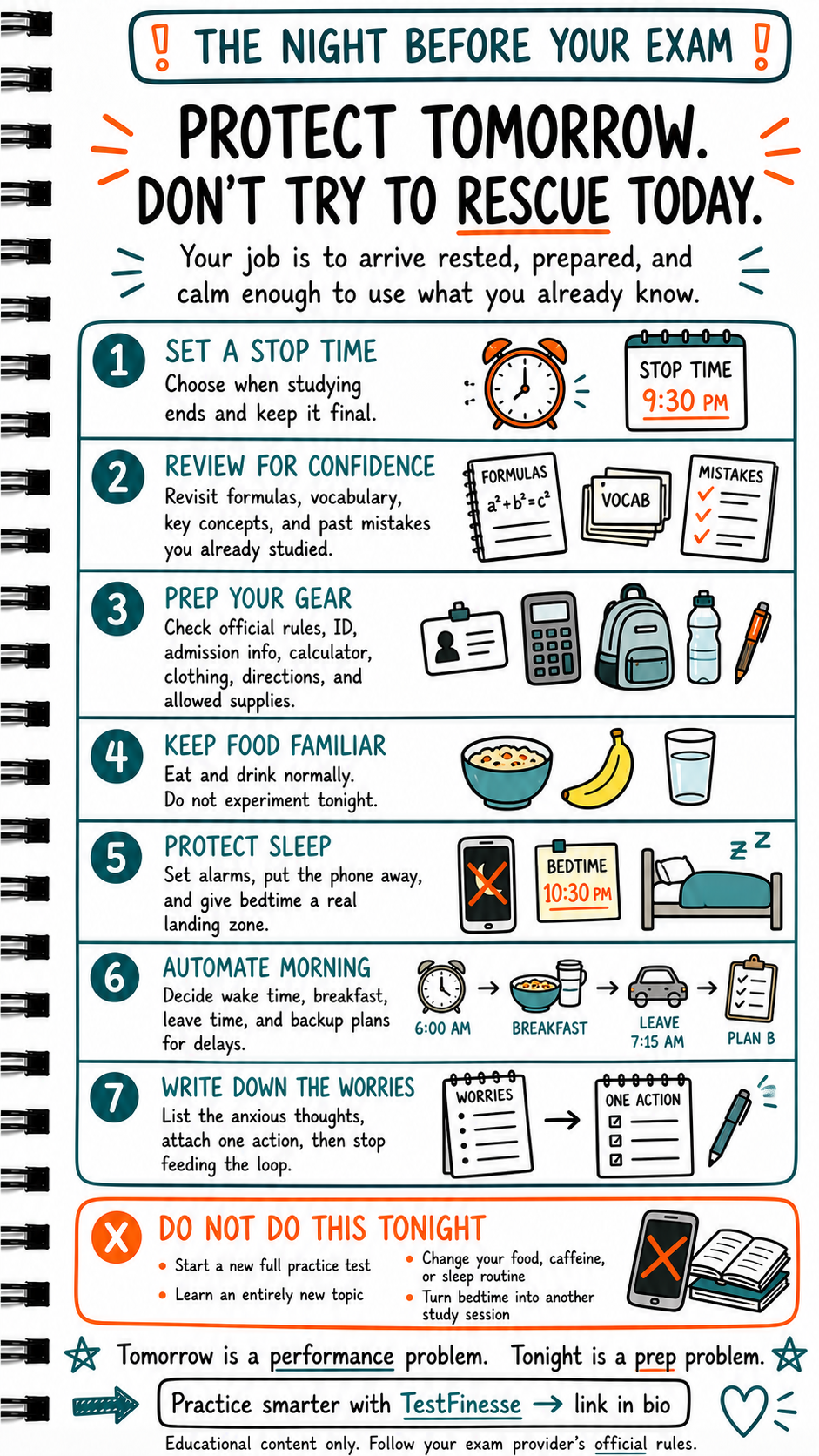
The night before an exam is not the time to fix everything.
That is the mistake students make when they feel behind. They sit down and try to rescue the whole week in one evening. They start a full practice test, learn a brand-new topic, reread every note, and stay up late trying to force confidence into existence.
That usually backfires.
The night before an exam has one job:
Help you arrive rested, prepared, and calm enough to use what you already know.
That is the TestFinesse approach here. You are not trying to become a new student overnight. You are protecting the work you already did so it shows up on test day.
Why The Night Before Matters
The exam itself is a performance problem.
Tonight is a prep problem.
That distinction matters. If you treat tonight like a full study day, you will probably damage tomorrow’s performance. Sleep gets worse. Anxiety gets louder. Confidence gets shakier. Your brain starts chasing new information instead of stabilizing the knowledge already there.
A better night-before routine is short, deliberate, and boring in the right ways. It should reduce decisions, reduce stress, and reduce surprises.
1. Set A Stop Time
Choose when studying ends and keep it final.
A stop time protects you from the spiral of “just one more thing.” Without a hard cutoff, the night can swallow itself. One more video becomes one more chapter. One more chapter becomes panic. Panic becomes lost sleep.
Pick a finish line and honor it.
Good stop-time habits:
Set the cutoff before the evening starts
Tell someone else so you are accountable
Use a timer if needed
Stop while your brain is still functional
Do not renegotiate the cutoff at 9:45 PM
A stop time does not mean you are unprepared. It means you are done feeding the panic loop.
2. Review For Confidence
Use the last study block to reinforce what you already know.
This is not the time for brand-new material. It is the time for familiar material that lowers friction tomorrow.
Good confidence review includes:
Key formulas
Core vocabulary
High-value concepts
Common trap patterns
A short list of mistakes you have already corrected
What you are trying to do is remind your brain, “I have seen this before.”
That is more useful than trying to force one last burst of learning. Your goal is not maximum novelty. Your goal is maximum recall.
TestFinesse rule: Review for retrieval, not rescue.
3. Prep Your Gear
Check official rules, ID, admission info, calculator, clothing, directions, and allowed supplies.
This is one of the cleanest ways to reduce test-day stress because it removes avoidable decisions.
Make sure you know:
What identification you need
What time you need to leave
Where you are going
What is allowed in the room
What calculator or materials are permitted
What to wear
What the weather or commute might affect
Whether you need snacks, water, or parking details
Lay out everything before bed. Do not leave your morning to memory. Morning memory is weaker than evening planning.
If your exam provider has specific rules, follow those rules first. Your job tonight is not improvisation. Your job is compliance and clarity.
4. Keep Food Familiar
Eat and drink normally.
Do not experiment tonight.
This is not the evening to introduce a new meal, a different caffeine level, a giant sugar swing, or a random “healthy” food plan you do not usually use. Your body should not have to process surprises while your brain is also trying to stay calm.
Keep it simple:
Eat what you know sits well
Hydrate normally
Avoid extremes
Do not overdo caffeine late
Do not under-eat and then crash
Familiar food is part of the stability plan.
5. Protect Sleep
Sleep is not a luxury tonight. It is the point.
You are not trying to win the night. You are trying to earn a steady morning.
A good sleep plan includes:
A firm bedtime
Phones put away early
Low-light wind-down
Final outfit and gear prep before bed
No screens in the last stretch if that helps you settle
A calm routine you have used before
Give bedtime a real landing zone.
That means you do not jump from panic studying straight into sleep and expect your brain to cooperate. Create a small buffer. Let your mind slow down on purpose.
If you cannot sleep perfectly, still protect the window. Restful stillness is better than frantic scrolling.
6. Automate Tomorrow Morning
Decide now what tomorrow will look like.
Do not leave the morning to chance. Build the sequence while you are calm.
Decide:
What time you wake up
What you eat
What time you leave
What backup plan you use if traffic is slow
When you stop checking your phone
What you do if anxiety spikes
The more of tomorrow you automate tonight, the fewer decisions you have to make under pressure.
A simple morning script is better than a perfect one.
Example:
Wake up
Shower
Eat the same breakfast you trust
Check gear once
Leave early
Breathe before entry
That is enough.
7. Write Down The Worries
This is one of the most useful night-before moves.
Take a few minutes to list what is still making you nervous. Then attach one action to each worry.
Examples:
“I’m afraid I’ll forget my ID” → put it in the bag now
“I’m worried about timing” → review your section pacing once, then stop
“I’m scared I’ll blank” → write your reset sequence on paper
“I’m worried I’m not ready” → remind yourself of the work you already completed
The point is not to eliminate fear. The point is to stop feeding it.
Write the worry. Attach the action. Stop the loop.
Do Not Do This Tonight
There are a few things that look productive but are not.
Do not:
Start a new full practice test
Learn an entirely new topic
Change your food, caffeine, or sleep routine
Turn bedtime into another study session
Keep reopening old notes just because you feel nervous
These behaviors create activity, not readiness.
If you have already prepared, tonight is about protecting the work, not proving it again.
Use The TestFinesse Practice Loop
The TestFinesse method is:
Answer
Explain
Reveal
Fix the gap
The night before an exam, the loop becomes shorter:
Answer: What is the next practical move?
Explain: Why does that move protect tomorrow?
Reveal: Did the prep reduce uncertainty?
Fix the gap: What still needs to be handled before bed?
That keeps the evening from becoming a panic marathon.
Final Takeaway
The night before your exam is not for rescuing the whole week.
It is for protecting tomorrow.
Set a stop time. Review for confidence. Prep your gear. Keep food familiar. Protect sleep. Automate the morning. Write down the worries once, then stop feeding them.
Tomorrow is a performance problem. Tonight is a prep problem.
Keep studying
Practice Exam Skills
Turn this into a better score
Reading about a skill only gets you so far. TestFinesse's AI coach walks you through exam questions, explains exactly where your reasoning breaks down, and adapts to what you actually need to practice next.
Explore All Exams