Test Study Hack: Diagnose the Miss, Then Train the Exact Skill
Last updated August 13, 2026
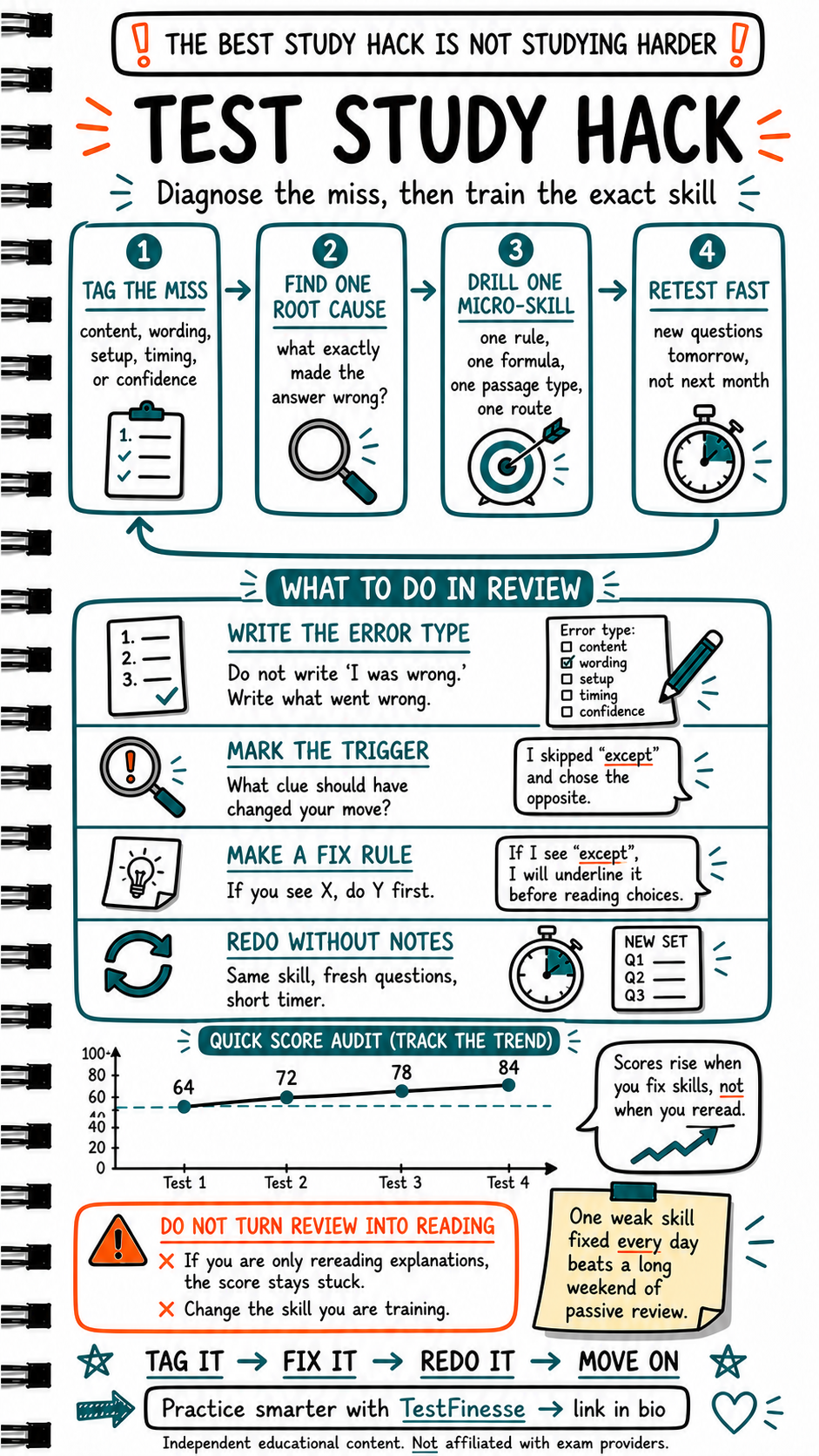
The best study hack is not studying harder.
It is studying more specifically.
A lot of students stay stuck because their review process is too vague. They finish a practice set, notice they missed a few questions, and then move on with some version of “I need to review more.” That sounds responsible, but it does not change much. The same miss comes back in a different form, on a different day, under the same pressure.
The better move is simpler:
Diagnose the miss, then train the exact skill.
That is the whole point of this study hack. You do not need a bigger pile of notes. You need a sharper loop.
Why Random Review Stalls Progress
Random review feels productive because it keeps you busy.
But busy is not the same as targeted.
If a miss came from a wording trap, rereading content will not fix it. If the miss came from a setup error, drilling harder arithmetic will not fix it. If the miss came from timing, more passive rereading will not fix it. If the miss came from confidence, more exposure without a rule will not fix it.
That is why weak students often study more hours and see the same score.
The problem is not always effort.
The problem is usually diagnosis.
1. Tag The Miss
Start by labeling every miss with an error type.
Use simple buckets:
Content
Wording
Setup
Timing
Confidence
This one habit creates clarity.
Do not write:
“I was wrong.”
“I forgot.”
“I need to do better.”
“That was dumb.”
Write the actual miss type.
Examples:
“Content: I did not know the rule.”
“Wording: I missed the except/least clue.”
“Setup: I started with the wrong variable.”
“Timing: I spent too long on the first question.”
“Confidence: I got it right but could not explain why.”
That is a better review note because it tells you what to fix next.
2. Find One Root Cause
After tagging the miss, ask one harder question:
What exactly made the answer wrong?
Do not stop at the label. Go one level deeper.
For example:
Content miss: Did you not know the rule, or did you know it but confuse it with a similar one?
Wording miss: Did you miss a negative word, or did the sentence look familiar and trick you into rushing?
Setup miss: Did you choose the wrong formula, or did you fail to identify what the question was actually asking?
Timing miss: Did you freeze, overwork a hard question, or reread too much?
Confidence miss: Did you guess correctly, or did you actually have a weak rule?
The point is to name the root cause, not just the category.
If the category says setup, the root cause might be “I did not identify the target before reading the choices.”
If the category says wording, the root cause might be “I skipped the word except.”
If the category says timing, the root cause might be “I tried to perfect a problem that should have been skipped and returned to later.”
When you know the root cause, you can build a fix rule.
3. Drill One Micro-Skill
Do not drill everything.
Drill one exact skill.
A micro-skill can be:
one rule
one formula
one passage type
one route
one punctuation pattern
one conversion
one question stem
one trap pattern
That is the difference between a smart fix and a vague study session.
Examples:
If you missed “except” questions, drill negative wording.
If you missed unit problems, drill unit cancellation.
If you missed inference questions, drill text-only proof.
If you missed percent questions, drill original vs. change.
If you missed route selection, drill backsolving vs. algebra.
If you missed confidence questions, drill explain-before-check.
A micro-skill drill should be small and focused. The goal is to make the exact move automatic.
One rule. One formula. One passage type. One route.
That is enough to change the pattern.
4. Retest Fast
Do not wait until next month to see whether the fix worked.
Retest fast.
Use fresh questions, but keep the same target skill. If possible, retest the same idea within a short window so you can tell whether the new rule actually changed your performance.
A useful retest uses:
new questions
same skill
short timer
no notes
immediate check
That matters because a lot of students confuse recognition with mastery. They see the explanation, nod, and feel better. But feeling better is not the same as performing better on fresh questions.
The retest tells you whether the new rule survived contact with a new problem.
What To Do In Review
This is where most students drift into passive reading.
Do not turn review into reading explanations and hoping for the best.
Instead, do four things.
Write The Error Type
Record the type of miss clearly.
Ask:
Was this content?
Was this wording?
Was this setup?
Was this timing?
Was this confidence?
If you only write “wrong,” you have not created a fix.
Mark The Trigger
Identify the clue that should have changed your move.
Examples:
“I skipped except.”
“I started solving before naming the target.”
“I ignored the unit.”
“I spent too long on the first step.”
“I trusted a familiar-looking answer too quickly.”
The trigger is useful because it tells you what to watch for next time.
Make A Fix Rule
Turn the miss into a rule.
Examples:
“If I see except, I underline it before reading choices.”
“If I cannot name the ask, I do not calculate yet.”
“If the units do not match, I stop and reset.”
“If I have no progress after 60 seconds, I flag and move.”
“If I get a question right but cannot explain it, I review it again.”
A fix rule is what turns a mistake into a behavior change.
Redo Without Notes
Then do the same skill again with fresh questions and a short timer.
This is important because the goal is not to memorize the explanation. The goal is to build the new response.
If you only reread notes, you may feel improved without proving it.
If you redo without notes, you find out whether the skill actually changed.
Track The Trend, Not The Feeling
Score trends matter more than one emotional review session.
Look for movement over time:
Are the same errors shrinking?
Is one bucket getting smaller?
Are you getting faster on the same skill?
Are fewer questions falling into the same trap?
A good audit shows a trend. The graph does not need to jump overnight. It just needs to move in the right direction because the skill is getting sharper.
That is the hidden payoff of targeted study. When you fix the right miss, the score often rises as a side effect.
Use The TestFinesse Practice Loop
The TestFinesse method is:
Answer
Explain
Reveal
Fix the gap
For this study hack, the loop becomes even tighter:
Tag it → fix it → redo it → move on
That sequence keeps review from turning into passive reading.
After every miss, ask:
What kind of miss was it?
What was the root cause?
What exact skill do I need to drill?
Can I retest it quickly?
Did the new rule actually help?
That is visible thinking. That is how you stop repeating the same mistake with a different question number.
Final Takeaway
The goal is not to study harder.
The goal is to study the exact skill that caused the miss.
Use this sequence:
Tag it → fix it → redo it → move on
One weak skill fixed every day beats a long weekend of passive review.
Tag the miss. Find the root cause. Drill one micro-skill. Retest fast.
Independent educational content. Not affiliated with exam providers.
Practice Exam Skills
Turn this into a better score
Reading about a skill only gets you so far. TestFinesse's AI coach walks you through exam questions, explains exactly where your reasoning breaks down, and adapts to what you actually need to practice next.
Explore All Exams