Study Groups That Actually Teach: Why Visible Thinking Beats Bigger Chats
Last updated August 9, 2026
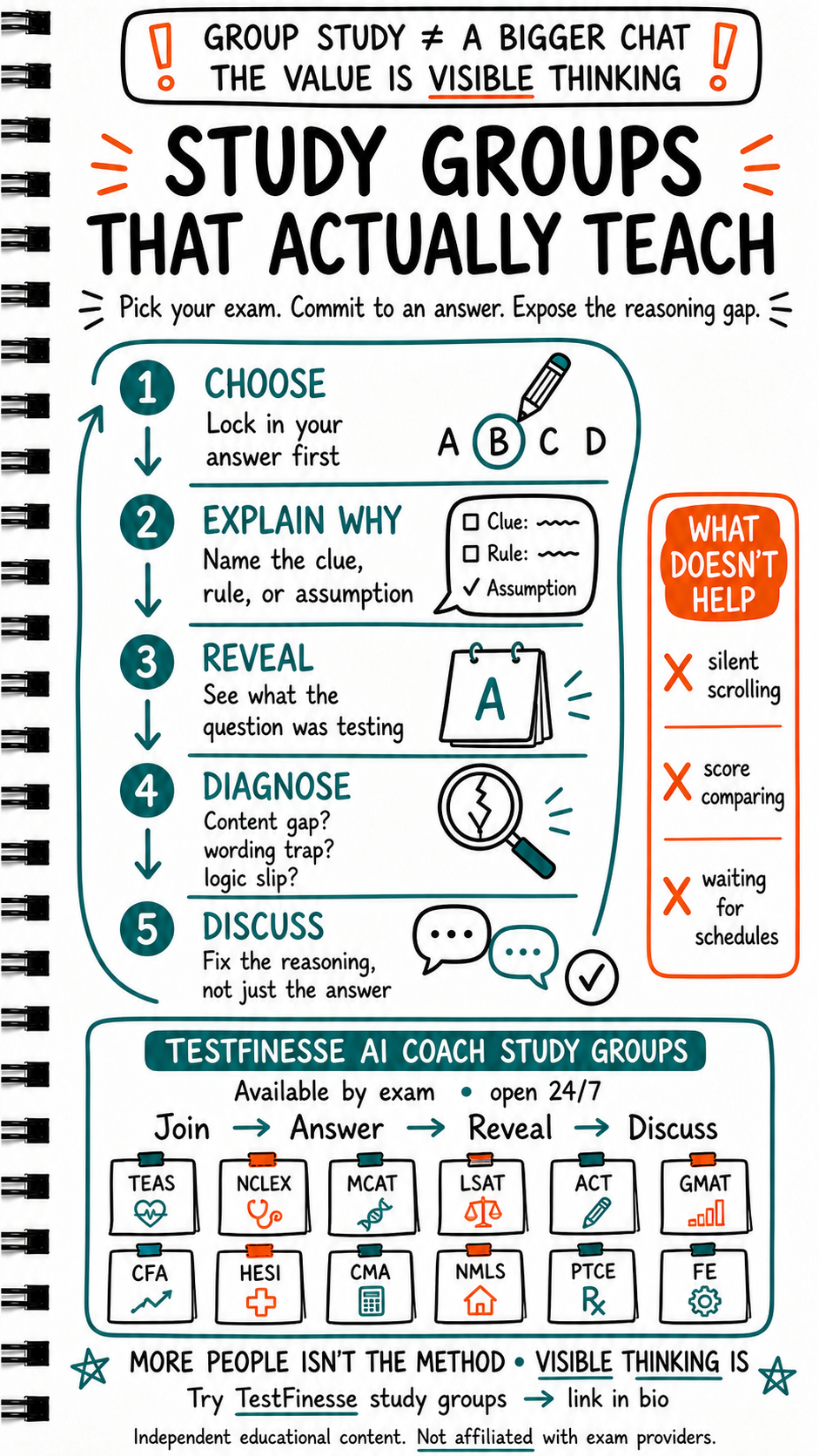
A study group is not automatically helpful just because more people are in it.
In fact, many study groups turn into a bigger chat, a shared panic room, or a place where everyone compares scores without actually learning.
That is not the point.
The value of a strong study group is visible thinking.
Visible thinking means you do not just say what answer you picked. You show why you picked it. You name the clue, rule, assumption, process, or trap that led you there.
That is where learning happens.
The best study groups do not just reveal the right answer. They expose the reasoning gap.
Why Most Study Groups Do Not Work
Most students join study groups because they want accountability, explanations, or reassurance.
Those are useful, but they are not enough.
A weak study group often becomes:
Silent scrolling
Random question sharing
Score comparing
Waiting for everyone’s schedule
One person explaining while everyone else watches
Answer dumping without reasoning
Chatting more than practicing
The problem is not the group.
The problem is the method.
If students are not required to commit, explain, reveal, diagnose, and discuss, the group can feel active without creating much improvement.
A helpful study group needs a repeatable learning loop.
The Study Group Learning Loop
The most effective study groups follow five steps:
Choose
Explain why
Reveal
Diagnose
Discuss
This structure works for almost any exam because it focuses on reasoning, not just answers.
Whether you are studying for TEAS, NCLEX, MCAT, LSAT, ACT, GMAT, CFA, HESI, CMA, NMLS, PTCE, FE, or another exam, the core learning problem is often the same:
Can you explain why your answer makes sense before you see the explanation?
If not, the question has something to teach you.
1. Choose: Lock In Your Answer First
The first step is to choose an answer before seeing the explanation.
No peeking.
No waiting to see what everyone else picked.
No changing your answer because someone sounded confident.
Locking in your answer matters because it captures your real test-day thinking.
Ask:
What answer would I choose on the actual exam?
Am I confident, unsure, or guessing?
What made this answer look right?
What made the other choices look wrong?
This step prevents passive studying.
When you commit first, the review becomes more honest.
A student who says, “I picked B because the question asked for the safest nursing action,” has something to analyze.
A student who says, “I was between B and C but waited for the answer,” loses the chance to see the decision clearly.
2. Explain Why: Name The Clue, Rule, Or Assumption
After choosing, explain your reasoning before the reveal.
This is the most important part of the study group.
Do not just say:
“I picked B.”
Say:
“I picked B because the keyword is except.”
“I picked B because the passage directly supports it.”
“I picked B because this formula uses gross monthly income.”
“I picked B because the patient priority is airway.”
“I picked B because the argument assumes the sample is representative.”
Good explanations name the thinking move.
They identify:
The clue
The rule
The assumption
The formula
The evidence
The process
The trap
This makes reasoning visible.
Once reasoning is visible, it can be improved.
3. Reveal: See What The Question Was Testing
After everyone commits and explains, reveal the answer.
But do not stop at:
“The answer is A.”
Ask:
“What was this question testing?”
The answer might be testing:
A content rule
A vocabulary phrase
A formula
A safety priority
A passage detail
A reasoning flaw
A data interpretation skill
A wording trap
A common misconception
The reveal should clarify the purpose of the question.
For example:
An ACT English question might be testing concision.
An LSAT question might be testing the author’s conclusion.
An NMLS question might be testing DTI, not LTV.
An NCLEX question might be testing priority, not diagnosis.
A GMAT Data Insights question might be testing source selection before calculation.
When students understand what the question was testing, the lesson becomes reusable.
4. Diagnose: Find The Real Gap
After the reveal, diagnose the gap.
Do not treat every miss the same.
Common gap types include:
Content gap: You did not know the concept, rule, fact, or formula.
Wording trap: You missed a key phrase like not, except, least, most likely, best, primarily, or supported.
Logic slip: Your reasoning moved in the wrong direction.
Evidence error: You picked an answer without enough proof.
Process error: You skipped setup, failed to check units, or rushed.
Confidence error: You were right but could not explain why.
Timing error: You knew what to do but spent too long.
The diagnosis tells you what to fix.
A content gap needs study.
A wording trap needs pattern recognition.
A logic slip needs reasoning repair.
A process error needs a checklist.
A timing error needs practice under pressure.
Without diagnosis, a missed question just becomes a disappointment.
With diagnosis, it becomes a training target.
5. Discuss: Fix The Reasoning, Not Just The Answer
Discussion is where the group becomes valuable.
But the discussion should not be:
“Why is the answer A?”
That is too narrow.
The better question is:
“What reasoning would get us to A next time?”
Good discussion prompts include:
What clue mattered most?
Which wrong answer was most tempting?
Why did that wrong answer almost work?
What rule would prevent this miss next time?
What should we notice earlier?
How would this same skill appear in a different question?
What is the one-sentence takeaway?
The goal is to fix the process.
A strong study group turns each question into a usable rule.
What Does Not Help
The infographic points out three study group habits that usually do not help:
Silent scrolling
Score comparing
Waiting for schedules
These habits are common, but they do not create visible thinking.
Silent scrolling keeps reasoning hidden.
Score comparing turns practice into pressure instead of learning.
Waiting for schedules can make consistency harder, especially when students are balancing school, work, and family.
A better study system should make it easy to practice when you are ready and still get structured reasoning support.
Why AI Coach Study Groups Can Help
TestFinesse AI Coach study groups are designed around the visible thinking method:
Join
Answer
Reveal
Discuss
They are available by exam and open 24/7, so students can practice without waiting for a traditional group to meet.
The value is not just that an AI coach can show an explanation.
The value is that the process can ask you to think first.
That matters because reading explanations is passive. Explaining your answer is active.
A strong AI Coach study group can help you:
Commit to an answer
Explain your reasoning
Identify the tested skill
Diagnose the gap
Review the tempting wrong answer
Turn the miss into a rule
Practice a similar question later
The method works because it keeps the focus on reasoning.
More people is not the method.
Visible thinking is the method.
How To Use A Study Group For Any Exam
This structure can work across many exam types.
For nursing exams like TEAS, HESI, and NCLEX, focus on:
Patient priority
Safety
Clinical clues
Elimination reasoning
Why the tempting answer is unsafe or incomplete
For admissions exams like ACT, GMAT, MCAT, and LSAT, focus on:
Question type
Evidence
Logic
Timing
Trap answers
The author’s or argument’s move
For professional exams like CFA, CMA, NMLS, PTCE, and FE, focus on:
Rules
Formulas
Definitions
Scenario details
Process steps
Common calculation traps
The exam changes, but the learning loop stays the same:
Choose. Explain. Reveal. Diagnose. Discuss.
How To Tell If A Study Group Is Working
A study group is working if you leave with better rules, not just more completed questions.
After a session, you should be able to say:
I know what mistake I made.
I know why the wrong answer tempted me.
I know what rule to use next time.
I understand what the question was testing.
I can explain the reasoning in my own words.
A study group is probably not working if:
Only one person talks
Everyone waits for the answer
People compare scores more than strategies
Explanations happen before commitment
Nobody diagnoses the mistake
The same errors keep repeating
The real measure is not how many questions the group covered.
The real measure is whether your next decision improves.
Final Takeaway
A bigger chat is not the same as a better study group.
The best study groups make thinking visible.
They require students to:
Choose an answer
Explain why
Reveal the tested skill
Diagnose the gap
Discuss the reasoning
Turn the miss into a rule
That is how practice becomes learning.
Do not look for more noise.
Look for a method that exposes the reasoning gap.
More people is not the method. Visible thinking is.