Stop Waiting for Perfect Confidence: How to Know When You’re Ready for Your Exam
Last updated August 20, 2026
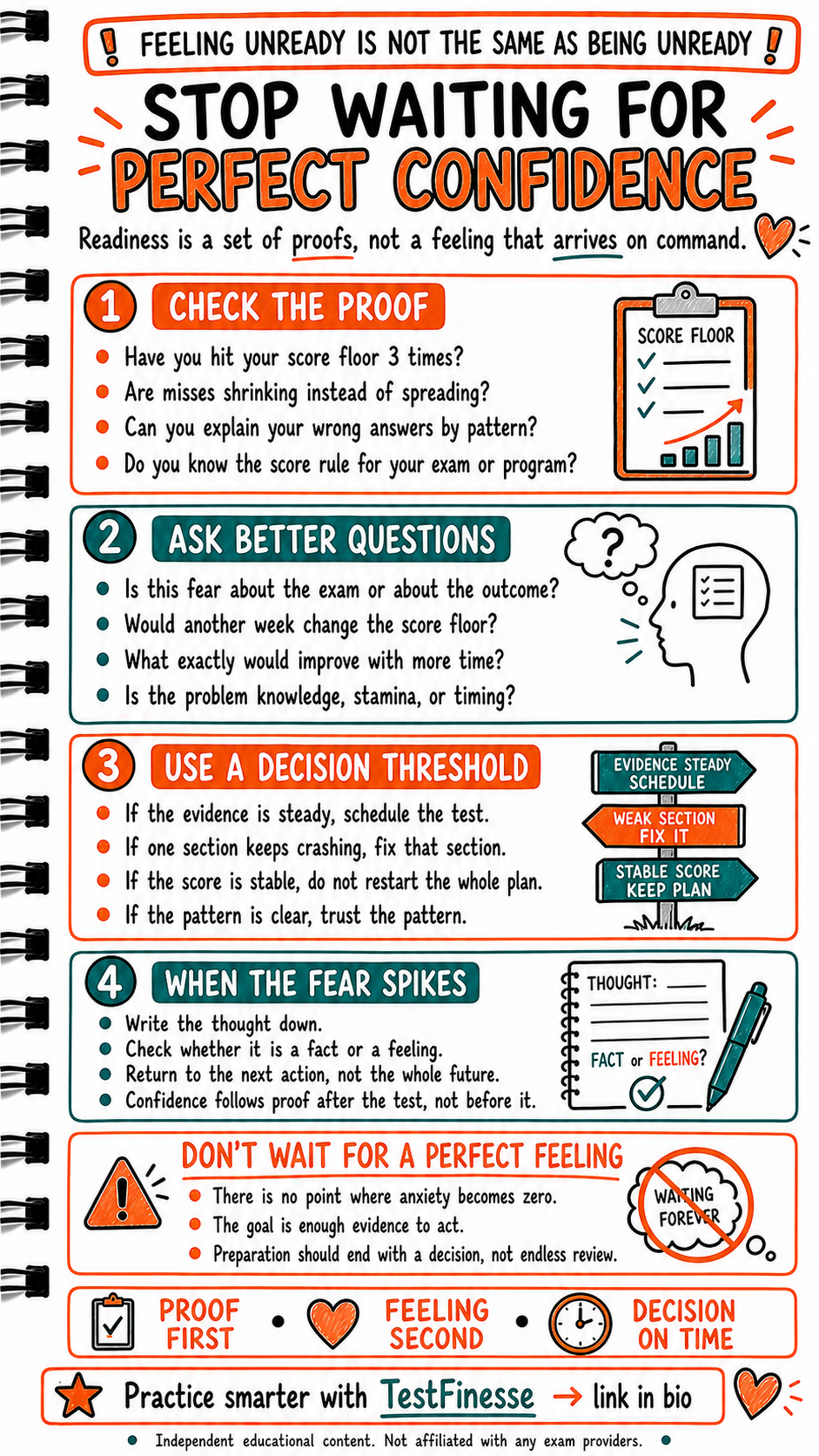
Feeling unready does not always mean you are unprepared.
Many students keep studying because they are waiting for a specific emotional signal: complete confidence, zero anxiety, or the feeling that they have finally “covered everything.” That feeling may never arrive. Even well-prepared students can feel nervous before an important exam.
The better question is not, “Do I feel perfectly confident?”
It is:
“What evidence shows that I am ready to make a reasonable decision?”
Readiness is not a mood. It is a collection of observable proofs. Your scores, error patterns, timing, and ability to explain missed questions can tell you much more than your anxiety level.
1. Check the Proof
Before scheduling an exam or deciding to delay it, look for measurable evidence.
The infographic suggests asking questions such as:
Have you reached your target score floor multiple times?
Are your mistakes becoming less frequent or less concentrated?
Can you explain your wrong answers by pattern?
Do you understand the scoring and retake rules for your exam or program?
The exact benchmark should be customized to your exam, school, licensing program, and application requirements. A score target that works for one student may not be sufficient for another.
The important idea is consistency.
One unusually high practice score may be encouraging, but it is not the same as a stable performance pattern. Look across several realistic practice sessions and ask:
Are scores staying within a similar range?
Are you improving under timed conditions?
Are the same sections still collapsing?
Are you missing questions because of knowledge gaps, wording traps, setup errors, timing, or confidence?
Readiness comes from repeated evidence, not one lucky result.
2. Ask Better Questions
Fear often creates vague questions:
“What if I fail?”
“What if I am not ready?”
“What if I forget everything?”
These questions feel urgent, but they do not always produce a useful study decision. Convert them into questions that can be answered with evidence.
Ask:
Is my fear about the exam itself or about the outcome?
Would another week of study change my score floor?
What specifically would improve with more time?
Is the main problem knowledge, stamina, timing, or decision-making?
Which section has the clearest opportunity for improvement?
This distinction matters because more time is not automatically better. If another week would consist only of rereading notes and taking unfocused practice tests, it may not change the underlying problem.
On the other hand, if your review shows a specific weakness, additional time may be valuable. For example, you might discover that:
You know the content but misread “except” questions.
You understand the formulas but choose the wrong setup.
You answer accurately but run out of time.
You perform well overall but repeatedly miss one heavily tested section.
Extra time is useful when it has a defined job.
3. Use a Decision Threshold
A decision threshold turns preparation into a practical rule.
For example:
If your scores are stable and your miss patterns are shrinking, schedule the exam.
If one section keeps crashing, repair that section before adding more full tests.
If your score is stable, do not restart your entire study plan.
If the pattern is clear, trust the pattern and act on it.
The threshold should be specific enough to prevent endless review. You might define readiness using:
A minimum practice-score range.
A maximum number of repeated errors.
A target timing range.
A demonstrated ability to explain missed questions.
Completion of the exam provider’s registration or eligibility requirements.
Do not treat the “three times” idea from the infographic as a universal rule. Use it as a starting point for building your own evidence standard.
The goal is not to eliminate every possible risk. The goal is to gather enough information to make a rational next move.
4. When Fear Spikes
Even after you have strong evidence, anxiety may suddenly return. That does not automatically invalidate your preparation.
When fear spikes, use a short reset:
Write the thought down.
Separate the fact from the feeling.
Identify the next action.
Return to that action instead of mentally rehearsing the entire future.
For example:
Thought: “I am going to forget everything.”
Fact check: “My last three timed sets were within my target range.”
Next action: “Complete five questions from my weakest question type.”
This process does not require you to argue with every anxious thought. It simply prevents the thought from becoming the only source of information.
Some test-related anxiety is common and may even motivate preparation, but anxiety that interferes with daily functioning deserves additional support. The American Psychological Association notes that some anxiety around tests can be normal, while excessive anxiety can interfere with functioning. The National Institute of Mental Health recommends seeking professional help when anxiety or other symptoms begin causing problems in everyday life.
Study strategy can support preparation, but it is not a replacement for mental-health care.
Do Not Wait for a Perfect Feeling
There may never be a moment when anxiety reaches zero. A student can be prepared and nervous at the same time.
Instead of asking, “Do I feel ready?” ask:
Do my practice results show a stable floor?
Are my mistakes becoming more specific?
Can I identify what I need to fix?
Do I understand the exam’s rules and requirements?
Would more study time produce a measurable improvement?
Do I have a concrete plan for test day?
If the answers are mostly yes, you may have enough evidence to schedule or take the next step, even if your emotions are still uncomfortable.
Use The TestFinesse Practice Loop
Confidence grows more reliably from visible proof than from passive reassurance. Use the TestFinesse loop:
Answer a realistic question or timed set.
Explain why you chose your answer.
Reveal the correct reasoning and identify the exact miss type.
Fix the gap with one targeted rule, drill, or timing adjustment.
Then repeat the same skill with fresh questions.
This makes your preparation measurable. Instead of simply asking whether you studied, you can track:
Which weaknesses were fixed.
Which traps still repeat.
Whether timing improved.
Whether your score floor moved.
Whether your confidence is now supported by evidence.
Final Takeaway
You do not need perfect confidence to be ready.
You need enough evidence to understand your current performance, identify the remaining score leak, and choose the next action deliberately.
Proof first. Feelings second. Decision on time.
Educational content only. Not medical or mental-health advice. Seek qualified support if anxiety is interfering with daily life or functioning.
Accuracy sources checked: American Psychological Association: Students Experiencing Anxiety, National Institute of Mental Health: My Mental Health: Do I Need Help?
Keep studying
Practice Exam Skills
Turn this into a better score
Reading about a skill only gets you so far. TestFinesse's AI coach walks you through exam questions, explains exactly where your reasoning breaks down, and adapts to what you actually need to practice next.
Explore All Exams