Language Sections Are Rule Sections: Read the Clue Before the Grammar Rule
Last updated August 19, 2026
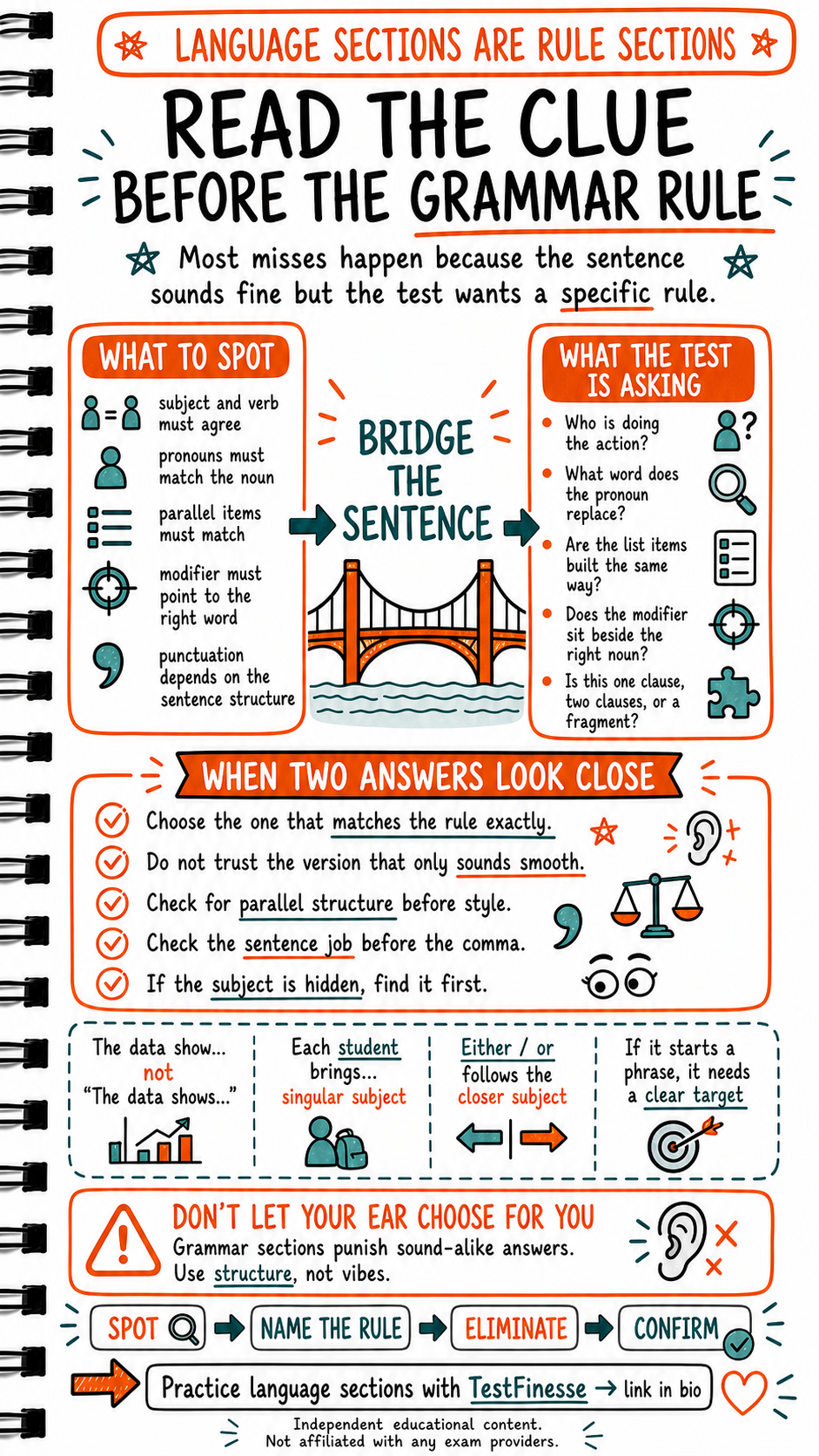
Language sections do not reward vibes.
They reward rules.
That is the shift most students need. A sentence can sound fine and still be wrong if the test is asking for a specific grammar, usage, or structure rule. If you go straight to what “sounds right,” you will miss questions that were built to punish that habit.
The better move is simple:
Read the clue before the grammar rule.
That means you look at the sentence job first, then decide which rule is being tested, then eliminate answers that do not match the structure.
Why This Matters
A lot of language questions are designed to feel smooth.
That is the trap.
The wrong answer often sounds natural, familiar, or polished. But language sections usually care about one of a handful of structural ideas:
subject and verb agreement
pronoun reference
parallel structure
modifier placement
punctuation
sentence completeness
If you do not identify the clue, you may choose the answer that sounds best to your ear instead of the one that matches the rule.
The TestFinesse rule is:
Bridge the sentence.
You are connecting the sentence clue to the grammar rule, not memorizing grammar in isolation.
1. What To Spot
Before you choose an answer, scan for the structural clue.
Look for:
subject and verb must agree
pronouns must match the noun
parallel items must match
modifiers must point to the right word
punctuation depends on sentence structure
These are not separate trivia facts. They are the families language questions keep returning to.
If you can identify the family, the right answer becomes much easier to find.
Subject and Verb
Ask whether the subject and verb agree in number.
This gets tricky when the subject is hidden inside a phrase.
For example, the sentence may contain extra words between the subject and the verb. Do not let the filler distract you. Find the real subject first.
Pronouns
Ask what noun the pronoun replaces.
If the noun is singular, the pronoun should match. If the noun is plural, the pronoun should match that too. If the sentence has more than one possible noun, slow down.
Parallel Items
Ask whether the list items are built the same way.
If one item is a verb phrase, the others should match. If one item is a noun, the others should not suddenly become clauses.
Modifiers
Ask what word the modifier is pointing to.
A modifier should sit beside the word it describes. If it is too far away, or attached to the wrong noun, the sentence breaks.
Punctuation
Ask what the sentence structure is doing.
Punctuation is not random decoration. It depends on whether you have one clause, two clauses, a list, an interruption, or an introductory phrase.
Rule: Spot the structure before you spot the style.
2. What The Test Is Asking
Once you see the clue, ask the real question behind it.
That might be:
Who is doing the action?
What word does the pronoun replace?
Are the list items built the same way?
Does the modifier sit beside the right noun?
Is this one clause, two clauses, or a fragment?
Those questions are better than reading the answer choices first because they force you to think in terms of grammar jobs.
A good language question is not just asking whether the sentence sounds smooth. It is asking whether the sentence performs the correct job.
TestFinesse rule: Name the rule before you judge the style.
3. When Two Answers Look Close
This is where students lose easy points.
If two answers both seem possible, do not ask which one sounds smoother.
Ask which one matches the rule exactly.
Use this sequence:
Choose the one that matches the rule exactly.
Do not trust the version that only sounds smooth.
Check for parallel structure before style.
Check the sentence job before the comma.
If the subject is hidden, find it first.
That is a much better filter than ear-based guessing.
Sound-Alike Traps
Language sections love sound-alike answers.
One choice may sound more polished. Another may sound more formal. Another may sound more academic. But none of that matters if the sentence structure is wrong.
Do not let your ear choose for you.
Rule: Structure beats vibes.
4. Use Sentence Clues
The sentence itself is often the best clue.
Examples of useful sentence clues:
“The data show…” does not mean “The data shows…”
“Each student brings…” needs a singular subject and verb
“Either / or” follows the closer subject
If a phrase starts the sentence, it needs a clear target
These are not just examples. They are patterns.
The sentence clue tells you which family to check.
Data Show
When the subject is something plural like data, the verb should match that number.
Each Student
Words like each can pull the sentence toward singular agreement.
Either / Or
With paired construction, the verb should agree with the closer subject.
Introductory Phrase
If the sentence starts with a phrase, check where it points before choosing the answer.
Clue rule: The sentence tells you which grammar family is alive.
5. Don’t Memorize In Isolation
A grammar rule by itself is not enough.
You need the rule plus the sentence.
That is because language questions are contextual. A rule that is correct in one sentence may not apply in another if the structure changes. That is why memorizing a definition without checking the sentence can mislead you.
A strong language answer usually comes from three things:
the clue
the rule
the sentence job
If one of those is missing, the answer is weaker.
6. Why This Strategy Works
This strategy works because language sections punish shallow recognition.
If you see only the surface meaning, you will miss the structure. If you see only the rule, you may apply the wrong one. If you only trust your ear, you will fall for smooth but wrong answers.
The better habit is to bridge the sentence.
That means:
find the grammar family
identify the tested rule
compare the answer choices
eliminate anything that breaks structure
confirm the final choice fits the sentence job
That is a repeatable process. It is better than random correction and more reliable than intuition.
Use The TestFinesse Practice Loop
The TestFinesse method is:
Answer
Explain
Reveal
Fix the gap
For language questions, use it like this:
Answer: Which choice do I think is right?
Explain: What clue in the sentence made me think that?
Reveal: Which rule was actually being tested?
Fix the gap: Did I miss the subject, pronoun, parallelism, modifier, or punctuation structure?
That turns every missed language question into a rule you can reuse.
Final Takeaway
Language sections are rule sections.
Do not trust the answer that only sounds smooth. Read the clue first, name the rule, then match the structure.
Spot the clue. Name the rule. Eliminate. Confirm.
If you can bridge the sentence instead of guessing from the surface, you will stop losing points to sound-alike traps.
Educational content only. Not affiliated with any exam providers.
Keep studying
Practice Exam Skills
Turn this into a better score
Reading about a skill only gets you so far. TestFinesse's AI coach walks you through exam questions, explains exactly where your reasoning breaks down, and adapts to what you actually need to practice next.
Explore All Exams