How to Find Study Motivation: Do Not Wait to Feel Motivated
Last updated August 9, 2026
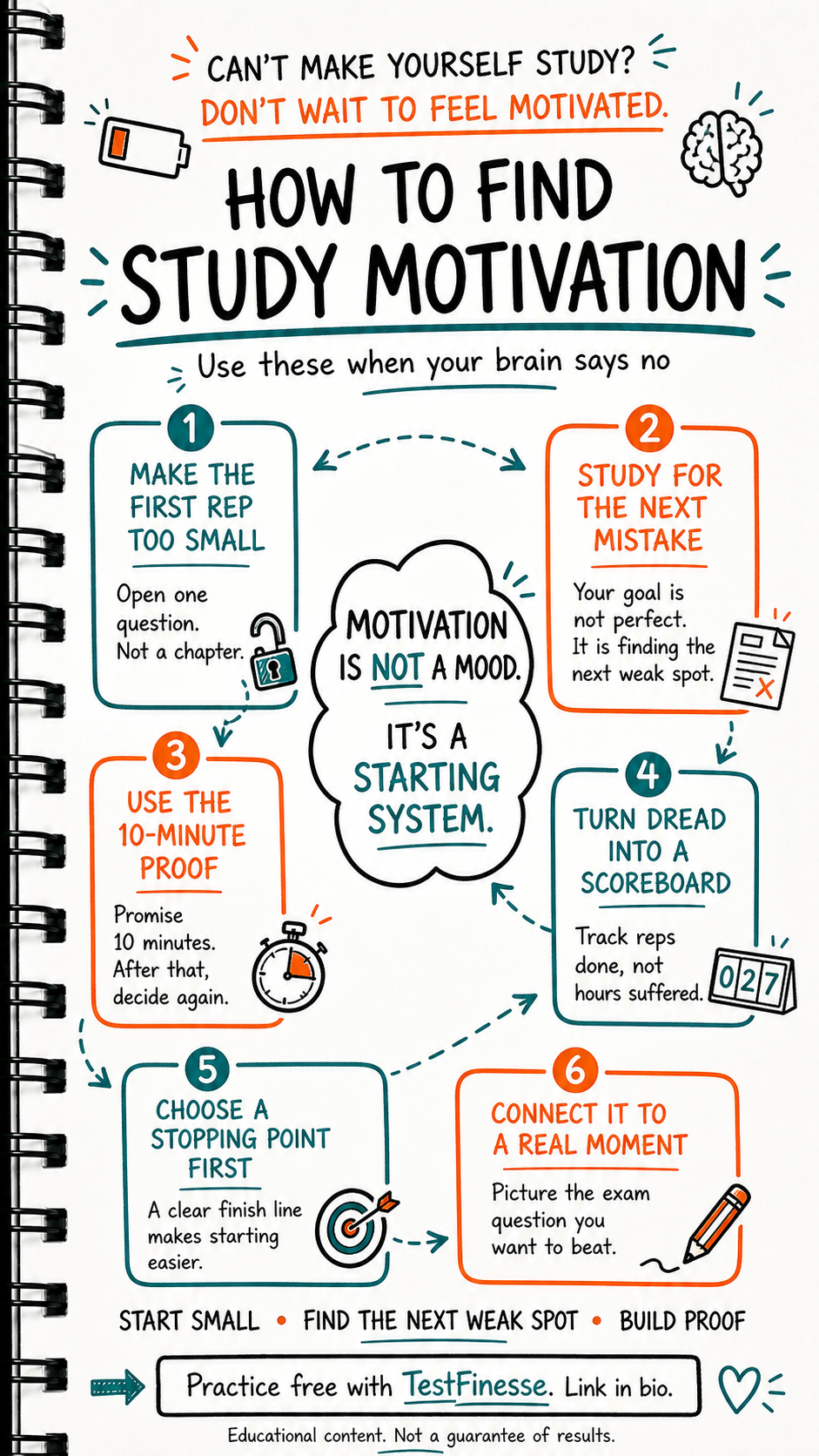
If you cannot make yourself study, the problem may not be laziness.
It may be that you are waiting for motivation to arrive before you start.
That sounds reasonable, but it usually does not work.
Motivation is unreliable. Some days you feel focused, clear, and ready. Other days your brain says no before you even open the book.
If your study plan depends on feeling motivated first, your progress will be inconsistent.
A better approach is to treat motivation as a starting system.
You do not need to feel inspired to begin. You need a first move that is small enough to do even when your energy is low.
The goal is simple:
Start small. Find the next weak spot. Build proof.
Motivation Is Not A Mood. It Is A Starting System.
Most students think motivation is a feeling.
They imagine they need to feel ready, excited, confident, or disciplined before they study.
But motivation often shows up after action, not before it.
Starting creates evidence:
I opened the question.
I did one problem.
I reviewed one missed answer.
I practiced for 10 minutes.
I found one weak spot.
That evidence matters.
Your brain starts to believe:
“Maybe I can do this.”
That is why the best study motivation strategies are not dramatic. They are small, repeatable systems that reduce the friction of starting.
1. Make The First Rep Too Small
When your brain says no, shrink the first step.
Do not make the first task:
Study the whole chapter
Finish a full practice test
Review every missed question
Watch a two-hour lecture
Catch up on everything
That is too big.
Make the first rep almost too small to refuse.
Try:
Open one question
Read one explanation
Solve one flashcard
Underline one formula
Review one missed answer
Write one rule
Set up one math problem without solving it
The smaller the first rep, the easier it is to start.
And once you start, continuing becomes more likely.
A useful rule:
Open one question, not a chapter.
You can always do more after the first rep. But the first rep should be easy enough that your brain does not fight it.
2. Study For The Next Mistake
Perfection is a terrible study goal.
It creates pressure before you even begin.
Instead of trying to study perfectly, study for the next mistake.
Your goal is not:
“I need to get everything right.”
Your goal is:
“I need to find the next weak spot.”
That changes the emotional meaning of practice.
A missed question is no longer proof that you are failing. It is information about what to fix next.
Ask:
What mistake is most likely to show up again?
What question type keeps costing me points?
What rule do I almost know but not fully trust?
What wording trap keeps catching me?
What would help me avoid this miss next time?
When you study for the next mistake, practice becomes less threatening.
You are not trying to prove you are already ready.
You are collecting evidence about what needs work.
3. Use The 10-Minute Proof
When you do not feel motivated, do not promise yourself a long study session.
Promise yourself 10 minutes.
Set a timer and say:
“I only have to study for 10 minutes. After that, I can decide again.”
This works because starting is usually harder than continuing.
After 10 minutes, one of two things happens:
You stop, but you still kept the promise.
You continue because momentum has started.
Either outcome is useful.
The 10-minute proof gives your brain evidence that studying is possible even when you did not feel like it.
Use it for:
One short practice set
A small review session
Flashcards
Missed question review
Formula recall
Reading one passage
Writing one fix rule
The goal is not to trick yourself into hours of work.
The goal is to prove that you can begin.
4. Turn Dread Into A Scoreboard
When studying feels vague, dread grows.
“Study more” is not a clear task. It has no finish line.
A scoreboard makes progress visible.
Instead of tracking how many hours you suffered, track reps completed.
Examples:
Questions answered
Misses reviewed
Rules written
Flashcards recalled correctly
Practice sets completed
Passages mapped
Formulas retrieved
Weak spots fixed
This matters because time spent is not the same as learning.
Two hours of distracted studying may teach less than 20 focused minutes of mistake review.
A better scoreboard might say:
10 questions answered
4 misses diagnosed
3 fix rules written
1 weak topic identified
That is real progress.
Track reps done, not hours suffered.
5. Choose A Stopping Point First
A clear finish line makes starting easier.
If your brain thinks studying could last forever, it will resist.
Before you begin, choose a stopping point.
Examples:
I will stop after 10 questions.
I will stop after reviewing 3 misses.
I will stop after 20 minutes.
I will stop after writing 5 flashcards.
I will stop after one passage.
I will stop after one formula set.
This reduces the emotional weight of starting.
You are not signing up for endless studying. You are completing one defined rep.
A stopping point also helps prevent burnout.
You want to finish with a clear sense of completion, not with your brain exhausted and resentful.
A good study session has a beginning and an end.
6. Connect It To A Real Moment
Motivation improves when studying connects to a real test moment.
Do not just think:
“I should study math.”
Picture the actual moment you want to beat.
For example:
The exam question where you usually freeze
The reading passage that feels too long
The answer choice pair that always confuses you
The formula you forget under pressure
The grammar rule you keep missing
The clinical priority question that makes you second-guess
The timed section where you usually rush
Then study for that moment.
Ask:
“What do I want my future self to do differently when this shows up?”
That question gives the session a purpose.
You are not studying in general.
You are preparing one specific response for one specific moment.
What To Do When Your Brain Says No
When your brain says no, do not argue with it for an hour.
Use the system.
Try this sequence:
Make the first rep tiny.
Set a 10-minute timer.
Choose a clear stopping point.
Answer one question.
Review the result.
Write one rule for next time.
That is enough to start.
You can build from there.
The point is not to force a perfect session. The point is to create motion.
Study Motivation Mistakes To Avoid
Some common advice makes motivation harder.
Avoid these traps:
Waiting until you feel ready
Planning huge sessions when your energy is low
Tracking only hours instead of useful reps
Trying to be perfect before practicing
Using shame as your main fuel
Starting without a stopping point
Reviewing passively instead of finding the next weak spot
Shame may create short bursts of action, but it usually does not create consistent learning.
A starting system works better because it gives you something practical to do.
Use The TestFinesse Practice Loop
The TestFinesse method is simple:
Answer
Explain
Reveal
Fix the gap
If motivation is low, make the loop smaller.
Do one question.
Then ask:
What did I choose?
Why did I choose it?
What was the correct answer?
What gap did this reveal?
What is one rule for next time?
That single loop can create momentum because it gives you a complete learning cycle.
You do not need a huge session to make progress.
You need one honest rep.
Final Takeaway
Do not wait to feel motivated.
Build a starting system.
Use these six moves:
Make the first rep too small
Study for the next mistake
Use the 10-minute proof
Turn dread into a scoreboard
Choose a stopping point first
Connect practice to a real exam moment
Motivation is not something you have to find before studying.
Often, it is something you build by starting.
Start small.
Find the next weak spot.
Build proof.