How to Actually Learn From Practice Questions: Turn Every Miss Into a Rule
Last updated August 9, 2026
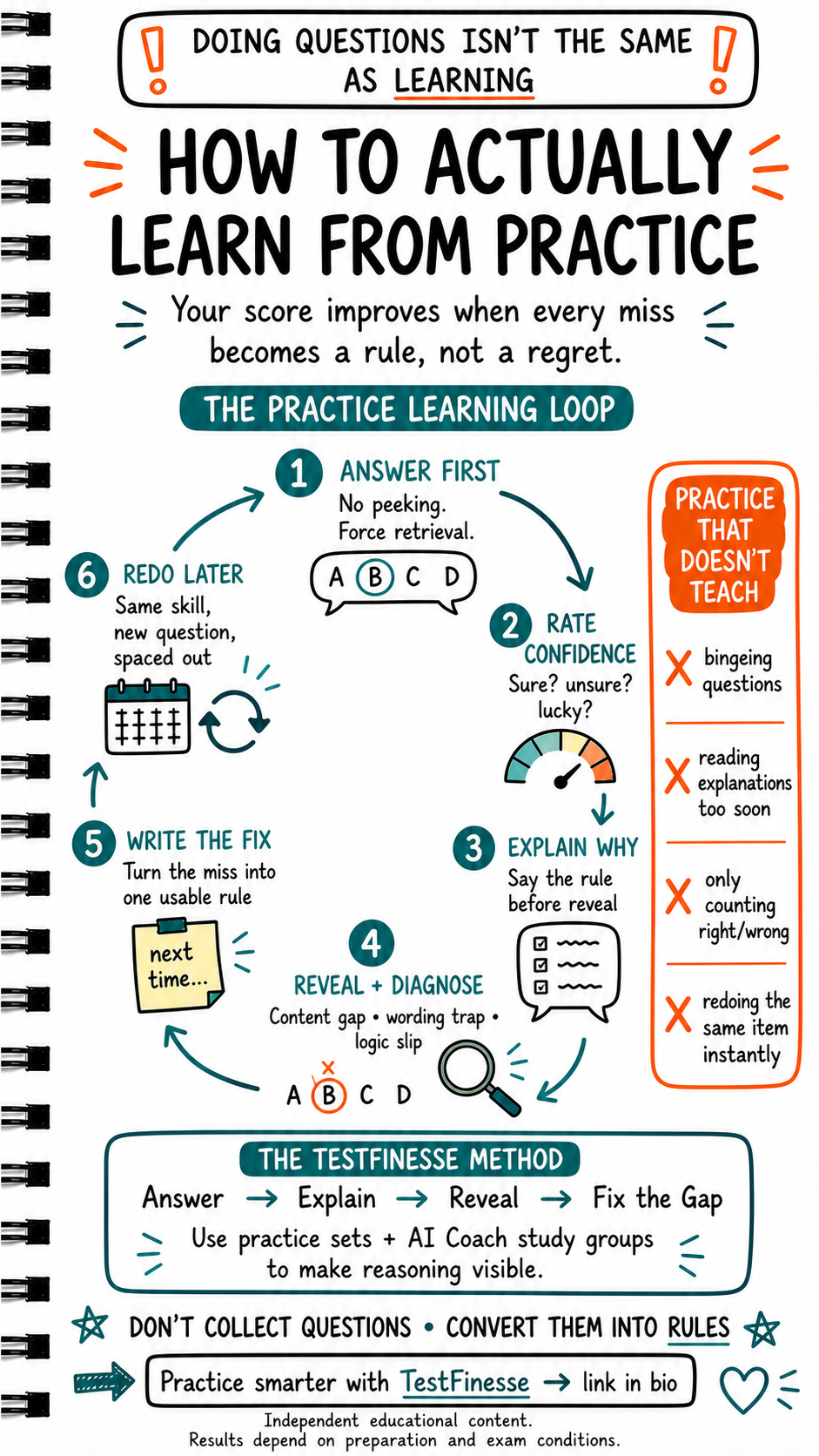
Doing practice questions is not the same as learning.
That is one of the biggest traps in test prep.
Many students feel productive because they finish a long set of questions. They answer, check the score, read a few explanations, and move on. But a week later, the same mistake shows up again.
That is not because they did not practice.
It is because the practice did not teach.
Your score improves when every miss becomes a rule, not a regret.
The goal is not to collect more questions. The goal is to convert each question into better decision-making for the next one.
That is where the practice learning loop comes in.
Why More Questions Do Not Always Mean More Learning
Practice questions are valuable, but only if they change what you do next.
If you answer 40 questions and only count right or wrong, you may know your score, but you may not know why that score happened.
You need to know:
Which skills are improving
Which mistakes keep repeating
Which misses came from content gaps
Which misses came from wording traps
Which answers were lucky guesses
Which correct answers were actually unstable
That last one matters.
A correct answer does not always mean mastery. Sometimes you guessed well. Sometimes you eliminated poorly but got lucky. Sometimes you used the right formula without fully understanding why.
That is why effective review has to look beyond right and wrong.
A practice question should answer two questions:
What did I choose?
What did this reveal about my thinking?
The second question is where the learning happens.
The Practice Learning Loop
The practice learning loop has six steps:
Answer first
Rate confidence
Explain why
Reveal and diagnose
Write the fix
Redo later
Each step has a job. Skip one, and practice becomes weaker.
1. Answer First
Start by answering before you look at the explanation.
No peeking.
This forces retrieval, which means your brain has to pull the idea out instead of simply recognizing it after someone else explains it.
That distinction matters.
Reading an explanation can make something feel obvious. But feeling like you understand is not the same as being able to produce the answer under test conditions.
Before you reveal anything, commit to an answer.
Then ask:
What answer am I choosing?
What evidence supports it?
What rule, formula, or process am I using?
What made the other choices less convincing?
The goal is not perfection. The goal is honest thinking.
You cannot fix your process if you never see it clearly.
2. Rate Confidence
After answering, rate your confidence before you check the result.
Use a simple system:
High confidence: I know why this is correct.
Medium confidence: I think this is right, but I am not fully sure.
Low confidence: I guessed or felt stuck.
Lucky: I chose correctly, but I could not explain it clearly.
Confidence ratings help you catch hidden weaknesses.
For example:
Right + high confidence usually means the skill is stable.
Right + low confidence means the question still needs review.
Wrong + high confidence means your rule may be incorrect.
Wrong + low confidence may signal a content gap or wording problem.
A wrong answer is useful. But a confident wrong answer is especially useful because it shows you exactly where your thinking needs correction.
That is not failure. That is data.
3. Explain Why Before You Reveal
Before checking the answer, explain your reasoning.
Say the rule out loud or write one short sentence.
Examples:
“I chose B because the passage supports this claim directly.”
“I used the area formula because the question asks for square units.”
“I eliminated C because it answers a different question.”
“This is an inference question, so the answer must be supported but not directly stated.”
“The keyword ‘except’ means I am looking for the answer that does not fit.”
This step makes your reasoning visible.
Without it, you may read the explanation and convince yourself that you “basically knew it.” That is one of the most common ways students lose learning opportunities.
If you cannot explain why before the reveal, mark the question for review even if you get it right.
A correct answer without a clear reason is not fully learned yet.
4. Reveal And Diagnose
Now reveal the answer.
But do not stop at right or wrong.
Diagnose the result.
Common mistake types include:
Content gap: You did not know the concept, rule, formula, or fact.
Wording trap: You misunderstood the task or missed a key word.
Logic slip: Your reasoning moved in the wrong direction.
Careless error: You knew what to do but rushed, copied wrong, or skipped a detail.
Timing error: You spent too long or panicked under time pressure.
Evidence error: You chose an answer that sounded good but lacked support.
This is the most important part of review.
Different mistakes need different fixes.
A content gap needs study. A wording trap needs language awareness. A careless slip needs a process check. A timing error needs pacing practice. A logic slip needs argument or reasoning repair.
If you label every miss as “I got it wrong,” you lose the chance to improve the specific skill that caused the miss.
5. Write The Fix
After diagnosing the mistake, write one usable rule.
Not a long explanation. Not a copied paragraph. One rule you can use next time.
Examples:
Next time, underline “except” before reading the choices.
Next time, identify the conclusion before judging the argument.
Next time, convert the annual rate to a monthly rate before calculating.
Next time, check whether the question asks for percent increase or final value.
Next time, use the lower of price or appraisal if the problem says to calculate LTV that way.
Next time, find the verb in the question stem before answering.
The fix should be specific enough to change your behavior.
Weak fix:
“Be more careful.”
Better fix:
“Before selecting an answer, circle whether the question asks for least, most, not, or except.”
Weak fix:
“Study geometry.”
Better fix:
“When a triangle question gives two sides, check whether it is asking for perimeter, area, or a missing side before solving.”
The more usable the rule, the more likely it is to help on the next question.
6. Redo Later With A New Question
Do not immediately redo the exact same item and call it learned.
If you just saw the explanation, you may remember the answer instead of understanding the skill.
Better practice is:
Review the miss.
Write the fix.
Wait.
Try a new question testing the same skill.
That spacing matters.
A new question proves whether the rule transferred. If you can only solve the original question after reading the explanation, the learning is still fragile.
Your goal is not to memorize one item.
Your goal is to recognize the same skill in a new form.
Practice That Does Not Teach
Some practice habits feel productive but do not create much improvement.
Avoid these traps:
Bingeing questions without review
Reading explanations too soon
Only counting right and wrong
Redoing the same item instantly
Skipping confidence ratings
Copying explanations instead of writing your own rule
Ignoring lucky correct answers
Moving on before diagnosing the miss
These habits create motion, but not always learning.
If you finish a practice set and cannot say what you will do differently next time, the set did not teach enough.
The TestFinesse Method
The TestFinesse method is simple:
Answer
Explain
Reveal
Fix the gap
This method works because it makes reasoning visible.
When you explain before revealing, you capture your actual thinking. When you diagnose after revealing, you find the real cause. When you write the fix, you turn the miss into a reusable rule.
That is how practice becomes training.
This is also why AI Coach study groups can be powerful when used correctly. The point is not to have AI simply give you the answer. The point is to use it to pressure-test your reasoning.
Good prompts include:
“Ask me why I chose this answer before explaining it.”
“Help me identify whether this was a content gap, wording trap, or logic slip.”
“Turn this missed question into one rule I can use next time.”
“Give me a similar question later to test the same skill.”
“Show me why the wrong answer was tempting.”
The more visible your reasoning becomes, the easier it is to improve.
How To Review Correct Answers
Do not review only missed questions.
Some correct answers deserve attention too.
Review a correct answer if:
You guessed
You were unsure
You could not explain your reasoning
You used a shortcut you do not fully trust
You chose between two answers and got lucky
The question took too long
A correct answer can still hide a weak skill.
Use your confidence rating to decide what needs review. High-confidence correct answers can usually move on. Low-confidence correct answers should become learning opportunities.
Ask:
“Could I get this right again tomorrow with different wording?”
If the answer is no, review it.
How To Track Your Practice
A simple practice tracker can make your review much stronger.
Track:
Question type
Result
Confidence
Mistake type
Fix rule
Redo date
New-question result
Example:
Question type: Inference
Result: Wrong
Confidence: Medium
Mistake type: Wording trap
Fix rule: For inference, choose what must be supported, not what sounds interesting.
Redo date: Friday
New-question result: Correct
This turns practice into a feedback system.
You are no longer collecting questions. You are collecting rules.
Final Takeaway
Doing more questions can help, but only if each question teaches you something.
The strongest students do not just ask:
“Was I right?”
They ask:
Was I confident?
Can I explain why?
What caused the miss?
What rule fixes it?
Can I apply that rule later on a new question?
That is how a practice set becomes score improvement.
Do not collect questions.
Convert them into rules.