10 Test Prep Study Hacks That Actually Work
Last updated August 9, 2026
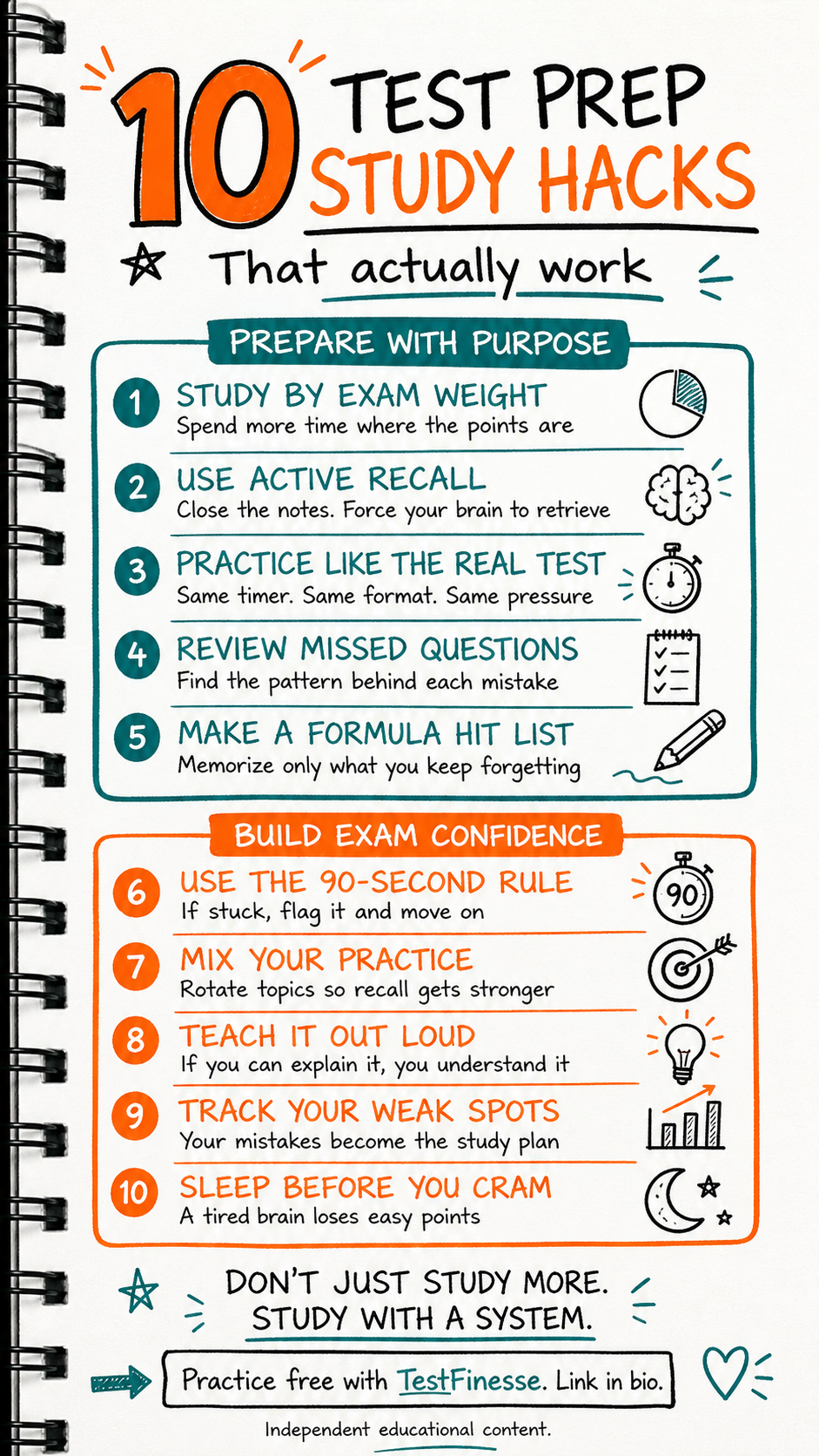
Studying more is not always the answer.
A lot of students put in hours but still feel stuck because their study time does not match the way the test actually works. They reread notes, highlight chapters, watch videos, and do random questions, but their score barely moves.
The problem is not always effort.
It is the system.
Strong test prep should help you do three things:
Remember the right information
Practice under realistic conditions
Fix the mistakes that keep costing points
These 10 test prep study hacks work because they turn studying into a repeatable process instead of a guessing game.
Do not just study more.
Study with a system.
Prepare With Purpose
Good test prep starts before the first practice question.
You need to know what matters most, how the exam is structured, and where your own weak spots are hiding.
1. Study By Exam Weight
Not every topic deserves the same amount of study time.
Most exams have content areas, section weights, or question-type patterns. If one area makes up a large part of your score, it deserves serious attention.
Ask:
Which sections have the most questions?
Which topics are tested most often?
Which skills affect the score the most?
Which areas are required by my program or licensing body?
Where am I losing the easiest points?
Studying by exam weight helps you avoid spending too much time on low-value material while ignoring the areas that actually move your score.
A simple rule:
Spend more time where the points are.
2. Use Active Recall
Rereading feels comfortable, but it is often too passive.
Active recall means closing the notes and forcing your brain to retrieve the information.
Try:
Answering a question before checking notes
Writing a formula from memory
Explaining a rule without looking
Using flashcards
Doing a brain dump
Teaching the idea out loud
This works because exams require retrieval. You need to pull information out under pressure, not just recognize it when it is sitting in front of you.
Before rereading, ask:
“What can I remember first?”
Then check your notes to fill the gaps.
3. Practice Like The Real Test
Practice should look like the real exam.
That means using:
The same timer
The same format
The same question types
The same calculator rules, if possible
The same level of pressure
The same pacing expectations
Untimed practice is useful when learning a new skill, but at some point you need realistic practice.
If the real test is timed, practice timed.
If the real test uses passage sets, practice passage sets.
If the real test includes alternate item types, practice those too.
The goal is to make test day feel familiar.
4. Review Missed Questions
Doing questions is only half the work.
Reviewing them is where the score improvement happens.
When you miss a question, do not just read the explanation and move on.
Ask:
Why did I miss this?
Was it a content gap?
Was it a wording trap?
Was it a careless slip?
Was it a timing problem?
Did I use the wrong formula or rule?
Did I understand the question but choose too quickly?
Every missed question should teach you something specific.
A wrong answer is not just a mistake.
It is a map.
5. Make A Formula Hit List
Do not try to memorize every formula equally.
Make a hit list of the formulas, rules, conversions, or facts you keep forgetting.
Your hit list might include:
Math formulas
Science equations
Grammar rules
Medication calculations
Financial ratios
Unit conversions
Legal or licensing definitions
Common test phrases
Review this list often, but keep it focused.
The best formula hit list is short enough to use and targeted enough to matter.
A good rule:
Memorize what you keep forgetting.
Build Exam Confidence
Confidence does not come from telling yourself you are ready.
It comes from repeated evidence that you know what to do under pressure.
The next five hacks help you build that evidence.
6. Use The 90-Second Rule
If you are stuck, do not let one question steal the whole section.
Use a 90-second rule during practice:
If you are still stuck after about 90 seconds, flag it and move on.
This does not mean every question should take exactly 90 seconds. Some exams have shorter or longer pacing. Adjust the rule based on your test.
The point is to avoid getting trapped.
A hard question can cost more than one point if it causes you to rush through easier questions later.
Use the rule to protect your time.
7. Mix Your Practice
Studying one topic at a time can feel easier, but mixed practice often builds stronger recall.
Instead of doing only one type of question for a long block, rotate topics.
For example:
Grammar, then reading, then math
Ratios, then geometry, then data
Cardiac, respiratory, endocrine
Logical reasoning, then reading comp
Formulas, then application questions
Mixed practice forces your brain to identify the skill instead of being told what skill to use.
That is closer to the real test.
On exam day, questions do not always announce:
“Use the rule you studied yesterday.”
You have to recognize it.
8. Teach It Out Loud
If you can explain it, you probably understand it better.
Teach the concept out loud as if you were helping another student.
Explain:
What the rule means
When to use it
What clues tell you it applies
What mistake to avoid
How to check your answer
If your explanation falls apart, that is useful.
It shows you exactly where your understanding is weak.
Try this prompt:
“The rule is ___, I use it when ___, and the trap is ___.”
That one sentence can reveal a lot.
9. Track Your Weak Spots
Your mistakes should become the study plan.
Keep a simple weak spot tracker.
Include:
Topic
Question type
Mistake cause
Fix rule
Redo date
Result on the next attempt
Example:
Topic: Percent change
Mistake cause: Used final value instead of original value
Fix rule: Percent change = change ÷ original
Redo date: Friday
Tracking weak spots helps you stop guessing what to study.
It tells you.
10. Sleep Before You Cram
A tired brain loses easy points.
Sleep supports attention, memory, learning, and decision-making. Cramming late into the night may feel productive, but if it leaves you exhausted, it can hurt performance.
Before an exam, prioritize:
Sleep
Light review
Materials ready
A clear morning plan
A short confidence set
No last-minute panic spiral
This does not mean you should never review the night before. It means do not sacrifice your brain’s ability to function for one more rushed study block.
The final night is for sharpening, not rebuilding everything.
Use The TestFinesse Practice Loop
The TestFinesse method is:
Answer
Explain
Reveal
Fix the gap
Use this loop with any exam.
Before checking an answer, explain your reasoning.
After revealing, diagnose the mistake.
Then write one rule for next time.
This keeps practice active, targeted, and useful.
Final Takeaway
Good test prep is not random.
It is a system.
Use these 10 study hacks:
Study by exam weight
Use active recall
Practice like the real test
Review missed questions
Make a formula hit list
Use the 90-second rule
Mix your practice
Teach it out loud
Track your weak spots
Sleep before you cram
Do not just study more.
Study with a system.