10 FE Mechanical Formula Shortcuts: Time-Saving Equations for Exam Day
Last updated August 9, 2026
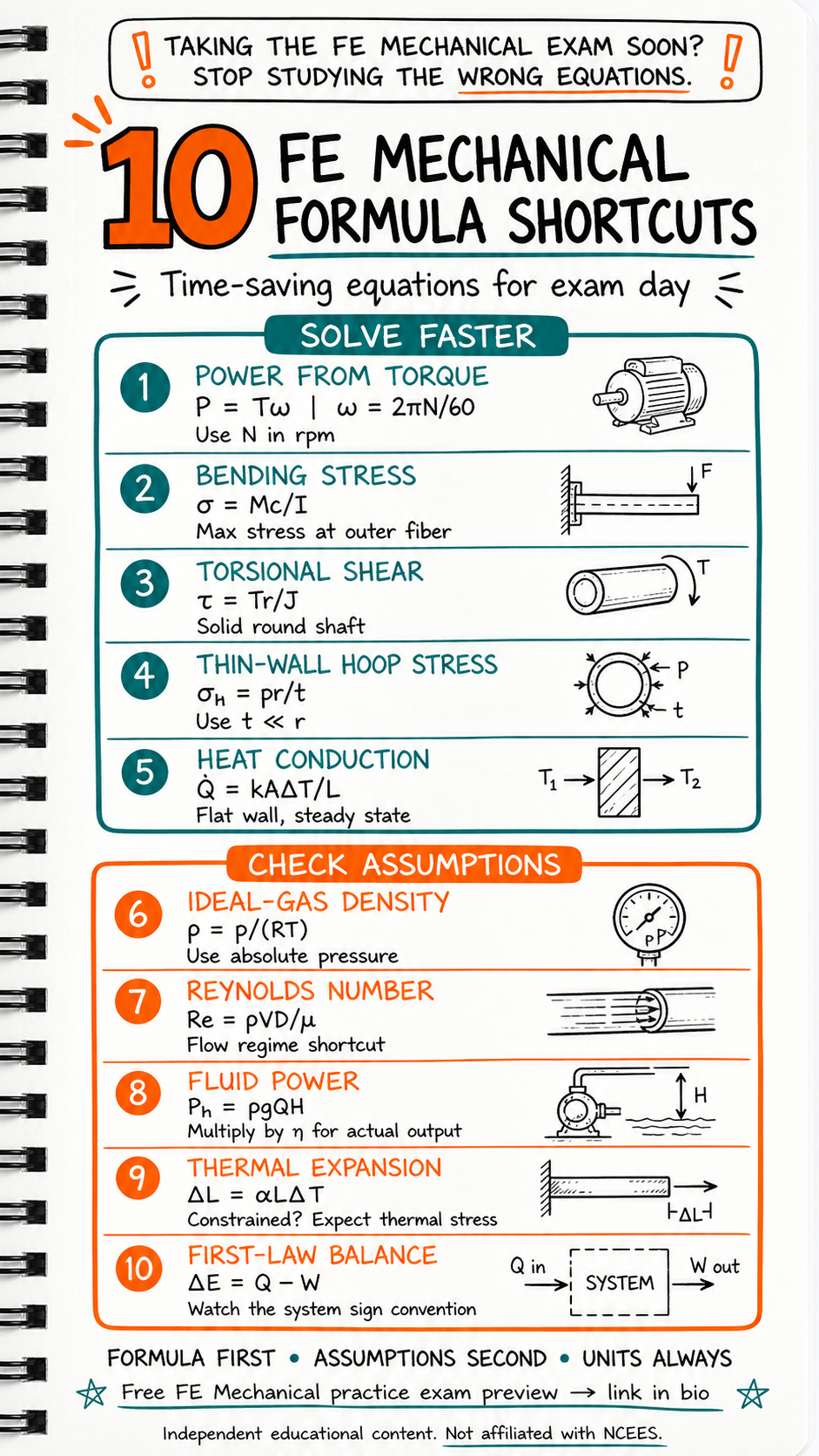
If you are taking the FE Mechanical exam soon, do not just study more equations.
Study the equations that save time.
The FE Mechanical exam gives you access to the NCEES reference handbook, so the goal is not to memorize every formula perfectly. The real goal is knowing which equation fits the problem, what assumptions it requires, and which unit traps can wreck the answer.
Many FE Mechanical questions are not hard because the math is long.
They are hard because students choose the wrong model, skip a unit conversion, or miss one phrase in the question.
Use these 10 formula shortcuts as a fast review for common mechanical engineering exam patterns.
Solve Faster
The first five formulas are high-value equations that show up across mechanics, machine design, heat transfer, and fluids.
1. Power From Torque
Use:
P = T omega
Where:
P = power
T = torque
omega = angular speed in rad/s
If speed is given in RPM, convert first:
omega = 2 pi N / 60
Where N is in revolutions per minute.
This is one of the easiest places to lose points. RPM is not rad/s. If a problem gives torque and rotational speed, check the speed unit before plugging in.
2. Bending Stress
Use:
sigma = Mc / I
Where:
sigma = bending stress
M = bending moment
c = distance from neutral axis to the outer fiber
I = area moment of inertia
The maximum bending stress occurs at the outer fiber, farthest from the neutral axis.
Common traps:
Using the wrong moment of inertia
Confusing diameter and radius
Forgetting that stress changes with distance from the neutral axis
Using the wrong section property for the shape
Shortcut question:
Where is the farthest fiber, and what is the correct I?
3. Torsional Shear
Use:
tau = Tr / J
Where:
tau = torsional shear stress
T = torque
r = radial location
J = polar moment of inertia
For maximum shear stress in a circular shaft, use the outer radius.
For a solid circular shaft, the polar moment depends on diameter or radius. Be careful with the formula version you choose.
The trap is usually geometry.
If the problem gives diameter, do not accidentally use it where the formula needs radius.
4. Thin-Wall Hoop Stress
For a thin-walled cylindrical pressure vessel, use:
sigma_h = pr / t
Where:
sigma_h = hoop stress
p = internal pressure
r = vessel radius
t = wall thickness
This shortcut applies when the wall is thin compared with the radius. The infographic’s reminder t << r is important.
Common traps:
Using diameter instead of radius
Forgetting pressure units
Using this thin-wall formula when the wall is not thin
Confusing hoop stress with longitudinal stress
For a thin-walled cylinder, hoop stress is larger than longitudinal stress, so make sure the question asks for the correct stress direction.
5. Heat Conduction
For steady one-dimensional conduction through a flat wall, use:
Q dot = kA delta T / L
Where:
Q dot = heat transfer rate
k = thermal conductivity
A = area
delta T = temperature difference
L = wall thickness
This is a rate equation, not total heat.
If the question asks for total heat over time, then use:
Q = Q dot × time
Common traps:
Mixing rate and total energy
Forgetting area
Using the wrong wall thickness
Missing unit conversions for cm to m or inches to feet
Check Assumptions
The next five formulas are powerful, but only when the assumptions fit.
6. Ideal-Gas Density
Use:
rho = P / (R T)
Where:
rho = density
P = absolute pressure
R = specific gas constant
T = absolute temperature
This comes from the ideal gas relationship.
The key reminders are:
Use absolute pressure
Use absolute temperature
Use the correct R for the gas and unit system
Do not use gauge pressure directly. Do not use Celsius or Fahrenheit directly. Convert first.
7. Reynolds Number
Use:
Re = rho V D / mu
Where:
rho = fluid density
V = average velocity
D = characteristic length, usually pipe diameter for internal flow
mu = dynamic viscosity
Reynolds number helps identify flow regime.
For pipe flow, students often use it to think about whether flow is laminar, transitional, or turbulent.
Common traps:
Using radius instead of diameter for pipe flow
Mixing dynamic viscosity and kinematic viscosity
Forgetting that kinematic viscosity changes the formula to Re = VD / nu
Using inconsistent units
Shortcut question:
Which viscosity did the problem give me?
8. Fluid Power
Hydraulic power is commonly written as:
P_h = rho g Q H
Where:
P_h = hydraulic power
rho = fluid density
g = gravitational acceleration
Q = volumetric flow rate
H = head
Efficiency depends on the device and what the problem asks.
For a turbine-style useful output question, actual output may be:
P_actual = eta P_h
For a pump input question, required shaft input is often:
P_input = P_h / eta
This distinction matters.
Do not blindly multiply by efficiency every time. First ask:
Am I solving for useful output or required input?
9. Thermal Expansion
Use:
delta L = alpha L delta T
Where:
delta L = change in length
alpha = coefficient of linear thermal expansion
L = original length
delta T = temperature change
If the object is free to expand, the formula gives the length change.
If the object is constrained, expansion may create thermal stress.
Common traps:
Forgetting that this is linear expansion
Using the wrong coefficient
Mixing Celsius and Kelvin incorrectly
Ignoring the word constrained
For temperature differences, a change of 1°C equals a change of 1 K. But absolute temperature equations are different. Know which situation you are in.
10. First-Law Balance
A common closed-system form is:
delta E = Q - W
Using the convention:
Q positive when heat enters the system
W positive when work is done by the system
This sign convention is common, but sign conventions must be handled carefully.
Before solving, define the system.
Ask:
What crosses the system boundary?
Is heat entering or leaving?
Is work entering or leaving?
Is this a closed system or control volume?
Are kinetic or potential energy changes important?
The formula is simple. The setup is the real work.
Formula First, Assumptions Second, Units Always
For FE Mechanical practice, use this checklist before calculating:
Formula: Which equation matches the task?
Assumption: Is the model valid here?
Units: Do all units match?
Inputs: Did I use radius, diameter, absolute pressure, or correct temperature scale?
Size check: Does the answer make physical sense?
This is how you avoid losing easy points after finding the right equation.
Final Takeaway
These 10 FE Mechanical formula shortcuts are worth knowing cold:
Power from torque: P = T omega
Bending stress: sigma = Mc / I
Torsional shear: tau = Tr / J
Thin-wall hoop stress: sigma_h = pr / t
Heat conduction: Q dot = kA delta T / L
Ideal-gas density: rho = P / RT
Reynolds number: Re = rho V D / mu
Fluid power: P_h = rho g Q H
Thermal expansion: delta L = alpha L delta T
First-law balance: delta E = Q - W
Do not just study the equation.
Study the assumption, the units, and the trap hiding inside the setup.
Accuracy sources checked: NCEES FE Exam, NCEES Reference Handbooks, OpenStax Heat Conduction, OpenStax Thermal Expansion, OpenStax Ideal Gas Law, Engineering LibreTexts Torsion, and LibreTexts First Law.
Keep studying
Practice Exam Skills
Turn this into a better score
Reading about a skill only gets you so far. TestFinesse's AI coach walks you through exam questions, explains exactly where your reasoning breaks down, and adapts to what you actually need to practice next.
Explore All Exams